Issue
New Currents: Eunjo Lee
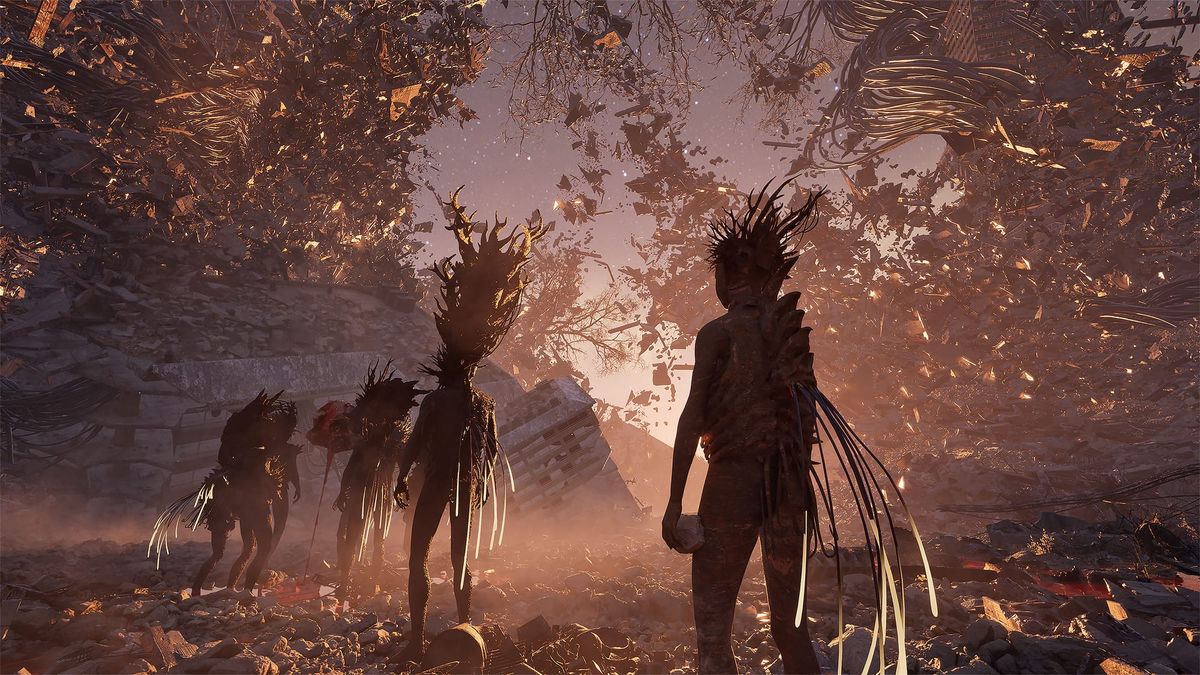
In her 2009 book Vibrant Matter, political theorist Jane Bennett challenged the modern notion of nonhuman substances as “passive stuff”—things that, by our standards, are “raw, brute, or inert.” This habit of compartmentalizing the realms of life and nonlife, she wrote, “feeds human hubris and our earth-destroying fantasies of conquest and consumption.” South Korean artist-filmmaker Eunjo Lee links these ontologies to our current screen-based era, where AI has simultaneously deepened and destabilized the divide between the organic and inorganic. Using computer graphics software such as Unreal Engine and Blender, she constructs darkly surreal 3D-animated worlds in which people, nature, and machines exist with equal subjectivity.
Such hybrid civilizations emerge in Lee’s Hesapia trilogy (2024–25). The first film, The Lullaby of the Ruins (2024), introduces a seemingly battered terrain inhabited by anthropomorphic creatures with antlers and luminous, cable-like quills growing out of their rusted skin. The episode centers on a child mourning a dead stone, dissolving any distinctions between humans and objects: from rocks and cords to blood and debris, everything bears vitality, and thus, everything is capable of dying. Throughout the series, the slow, rhythmic narration by Steph Hartop—delivered in both English and “uvaguv,” a fictional language—unfolds over an ethereal soundscape, conjuring an atmosphere that feels both ancient and futuristic.