Issue
Mumbai: “Subodh Gupta: A Fistful of Sky”
Subodh Gupta
A Fistful of Sky
Nita Mukesh Ambani Cultural Centre, Mumbai
Memory can often reside in the humblest of objects. A faded photograph, a chipped teacup, a tattered notebook, or, in Subodh Gupta’s case, kitchen utensils. On the first level of his solo exhibition “A Fistful of Sky” at the Art House at the Nita Mukesh Ambani Cultural Centre in Mumbai, visitors are greeted with a gleaming grid of low stools interspersed with steel crockery and cutlery. Titled School (2008), the installation evokes the artist’s childhood in the Indian state of Bihar, where communal meals were shared according to an understood etiquette of collective discipline. The work also recalls an earlier piece, 29 Mornings (1996), in which the artist had incorporated wooden seats known locally as patras. In School, however, Gupta casts the stools in brass, conferring a sense of preciousness on the utilitarian.
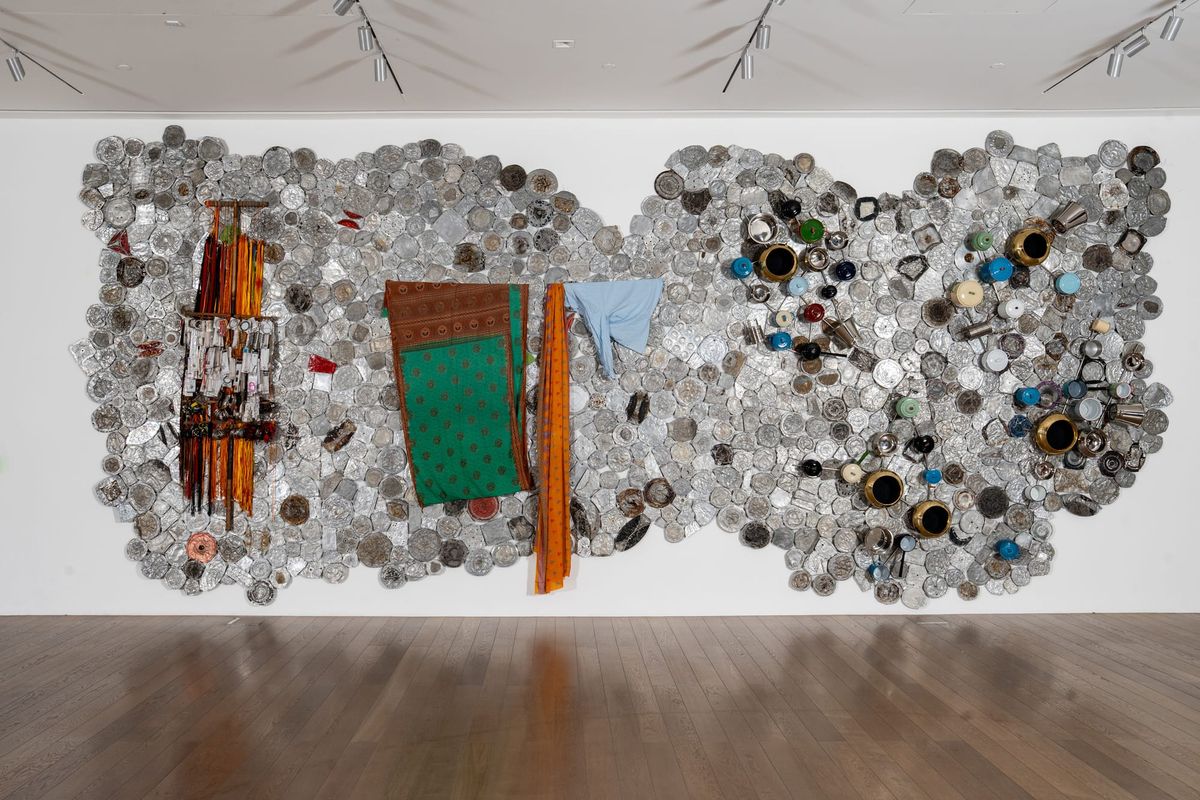
Gupta possesses the uncanny ability to turn the quotidian into something extraordinary. His characteristic move—magnifying or casting common implements to colossal scale—finds its origin, according to the wall text, in the roadside billboards that mesmerized him in his youth, where commercial imagery first revealed to him how the everyday could be rendered monumental. Curated by Clare Lilley, the former director of the Yorkshire Sculpture Park, and presented by Nature Morte, the exhibition eschews chronology. With few exceptions, most of the artworks in the exhibition are new. While School engages communal rite, several other works nearby extend the inquiry into the spiritual and cosmic. In Stupa (2024), Gupta gathers vessels from anonymous households to create Buddhist reliquary forms, paying homage to mundane household life. Across the room, Proust Mapping (2024–26) orchestrates second hand kitchenware into a vast constellation, enamel pots and pans and symbols of different faiths mounted together like an informal iconographic survey.