Issue
Milan: “Rirkrit Tiravanija: The House That Jack Built”
Rirkrit Tiravanija
The House That Jack Built
Pirelli HangarBicocca, Milan
Rirkrit Tiravanija creates interdisciplinary art whose meaning emerges from and relies on human engagement. You are invited to play, rest, eat, drink—always with other people, most of whom you haven’t met before. The unscripted, shared encounter with the other is the point; the artworks thus become sites for inquiry into cultural identity and the global structures underlying it. If this was radical in 1990, when the Thai artist first cooked and served pad thai to the public at Paula Allen Gallery in New York (untitled 1990 (pad thai)), it is especially relevant now in the age of social media and AI. “The House That Jack Built” at Pirelli HangarBicocca, Tiravanija’s first retrospective dedicated to his architectural and spatial research, demands a slow, meandering pace—the unhurried drift of a pre-networked sociality, a condition of being fully present and genuinely interconnected.
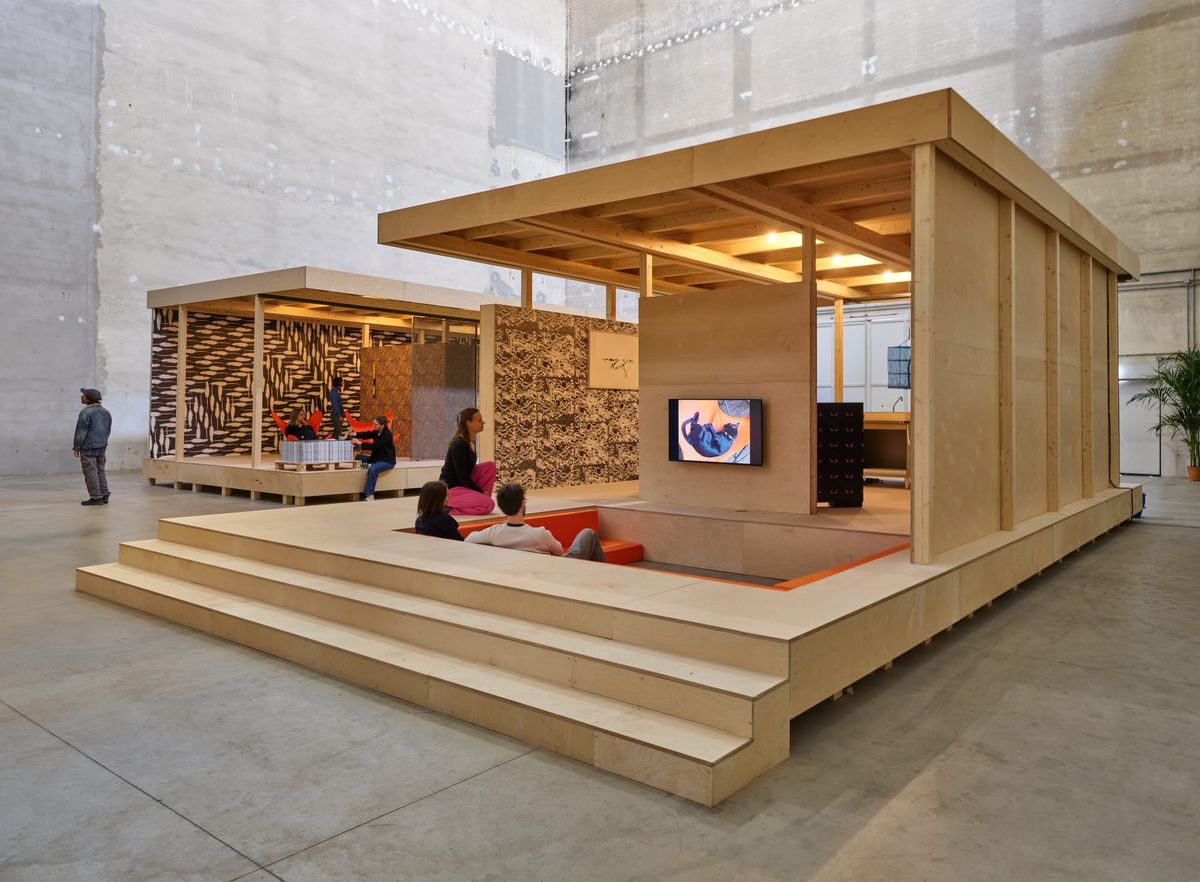
The tone is set by untitled 2026 (demo station no. 9) (2026), a wooden spiral platform that welcomes visitors at the entrance of the cavernous Navate area. Echoing Austrian American architect Frederick Kiesler’s avant-garde Rambühne (Space Stage) (1924), a freestanding theater that prefigures immersive environments, the work doubles as a community hub for local Milanese grassroots organizations that host daily activities here. The “demo” in the title conjures political protests, while “station” suggests a site of gathering. Together they highlight the political dimension of communal participation.