Issue
Dubai: “Araya Rasdjarmrearnsook: The Bouquet and the Wreath”
Araya Rasdjarmrearnsook
The Bouquet and the Wreath
Jameel Arts Centre, Dubai
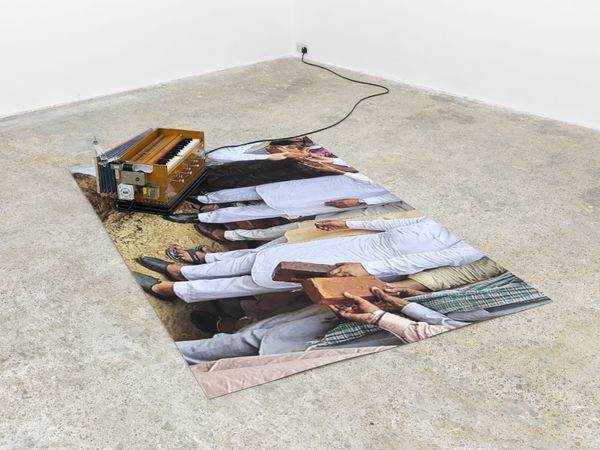
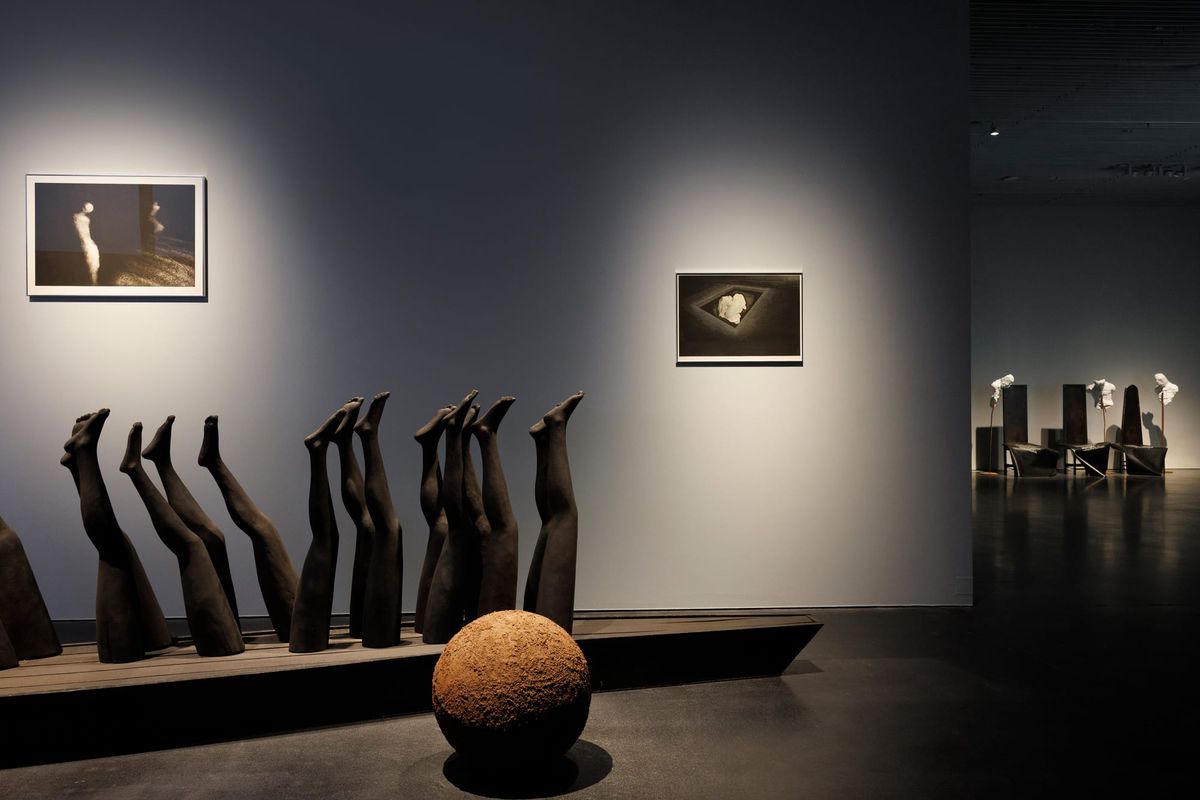
One of the most enlightening wall texts in “The Bouquet and the Wreath”—a two-part survey exhibition staged in Chiang Mai and Dubai showcasing key moments of maverick Thai artist Araya Rasdjarmrearnsook’s practice—is also the most indicative of her skill at employing duality to uncomfortable ends. Two sentences outline the story of an early print work which, after being sold, was soon returned: the collector had interpreted “a hill full of flowers” as bucolic, only to realize it was a funereal bouquet atop a coffin. The anecdote foregrounds the artist’s 45-year concern with mortality, grief, and ceremony, while pointing to the deceptively double role played by recurring elements in her practice—flowers (pastoral and funerary), beds (sites of respite and demise). It also frames the curious position of the viewer confronted with a practice that largely channels the morose: left in tense limbo, moved yet unsure of the mechanics by which this feeling arose. Much has been made of Rasdjarmrearnsook’s provocation—her use of human corpses, her challenges to the Western canon, her unapologetic figuration of the dying. What emerges from “The Wreath and the Bouquet,” though, is more the quiet resistance of a critical witness who takes in what society has cast off, leaving us to question our own position in this unresolvable equation.
The Dubai exhibition is intended as an “overlapping chapter,” in the words of the organizers, to the show of the same title held at MAIIAM in Chiang Mai—the artist’s city of residence—from July 2025 to May 2026. The two shows jointly dissect the artist’s deep entanglement with death, each injecting snippets of levity amid the gloom. However this second segment proposes a subtle alternative reading, one in which a dark yet sly humor permeates.