Issue
Ding Yi: Against the Image
On February 5, 1989, the “China/Avant-Garde” exhibition opened at the National Art Museum of China in Beijing. It was, by any measure, a watershed moment: it marked the culmination of the ’85 New Wave movement, the landmark staging of a generation’s artistic ambitions that gathered nearly everyone who would later become a canonical name in Chinese contemporary art. The presentation lasted two hours before a performance by Xiao Lu, in which she fired a real handgun into her own installation, forced its closure. Among the works on the walls were early paintings from Ding Yi’s Appearance of Crosses series, which he had only begun making in the previous year. They stood out from the rest of the works on view. In a room charged with expressionistic urgency and political grievance rendered through body and symbol, his canvases consisted of color organized around a schematic unit, stripped of narrative, ideology, and perhaps even the desire to be understood. This peripheral position has since characterized Ding Yi’s relationship to Chinese contemporary art.
During the opening week of the 61st Venice Biennale in early May, I met the artist at Fondazione Querini Stampalia, where he was preparing his solo debut in Venice. 33 years ago, in 1993, he participated in “Passage to the East,” a special exhibition organized by Achille Bonito Oliva for the 45th Venice Biennale. “Looking back, there was something essentially accidental about China’s presence there,” Ding Yi told me. “There was real excitement, but also a fundamental opacity in our relationship to what we were encountering.” He was 31 at the time. The distance between that first exhibition and his survey at the Carlo Scarpa-designed space of Fondazione Querini Stampalia could be quantified, for one, in three-plus decades. In another sense, it is the record of a practice built almost entirely from deliberate refusal.
Ding Yi was born in 1962 and came of age as the Reform and Opening-up policy began to loosen China’s cultural landscape. He enrolled in the design department of the Shanghai School of Arts and Crafts, a practical secondary school where the curriculum was grounded in the Bauhaus method because its primary objective was to package Chinese goods for export, which required engagement with international visual languages. Here, he encountered Yu Youhan, who became both a teacher and a friend. Through their conversations, Ding Yi developed the conviction that contemporary art was the path he needed to take.
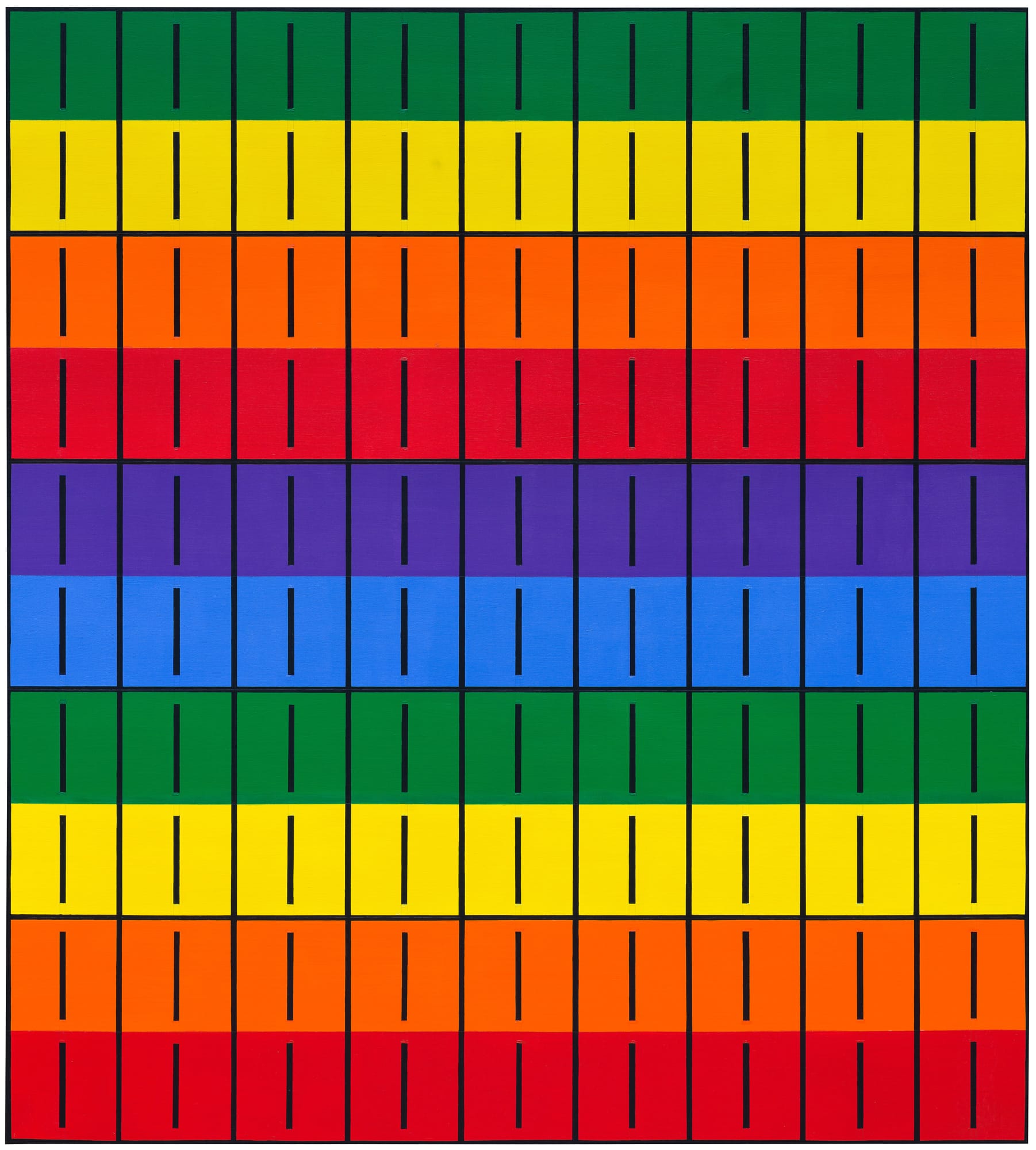
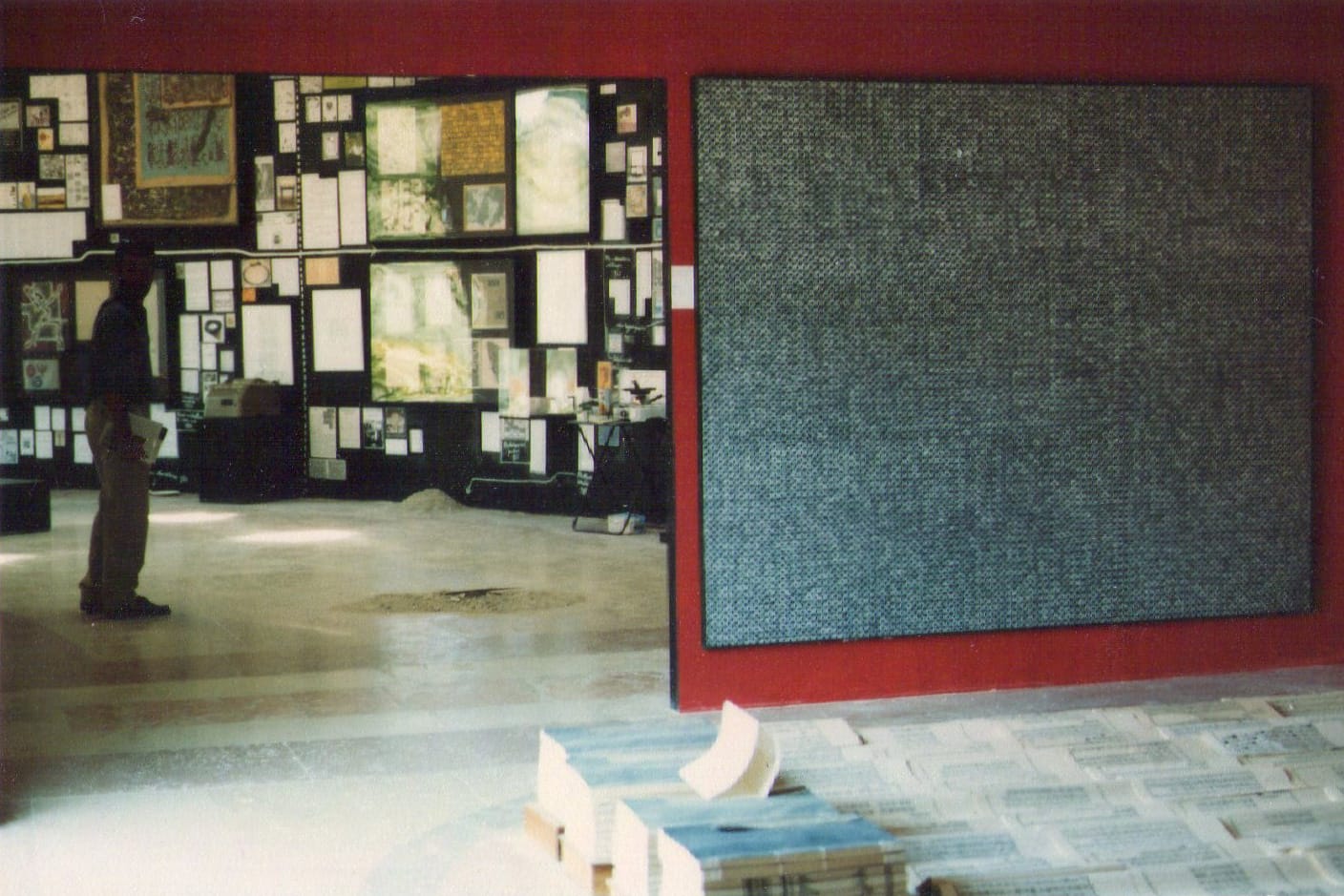
DING YI, Appearance of Crosses II, 1988, acrylic on canvas, 200 × 180 cm (left); and installation view of DING YI‘s painting hanging on the wall at the 45th Venice Biennale, 1993. Courtesy Ding Yi Studio (right).
After graduating in 1983, he was assigned to work in a toy factory. The prevailing social logic at the time was that wherever you were assigned, you stayed for life. Ding Yi remained there for two years, until he passed the entrance examination for the Shanghai Academy of Fine Arts and enrolled in its ink painting program. By 1988, after sustained reflection, he decided to leave both Chinese artistic tradition and Western modernism behind and start from scratch, focusing on the most rudimentary structure of color. It was then that he created his first Appearance of Crosses tableau, centered around the three primary colors.
The cross served less as symbol than schema, so blunt and arbitrary that meaning could not be built around it. The hard-edge “cutting lines” he had absorbed from his previous design work surfaced as a formal vocabulary whose purpose was simply to resist interpretation. As soon as a painting starts making sense, Ding Yi once said, it becomes an image. His work was formally committed to preventing that conversion: in a cultural climate where every mark was expected to carry ideological weight, his rational abstraction refused to mourn or protest, let alone signify. This insistence on a sign that generates no narrative and sentiment was, perhaps, in itself a declaration. He has described having, at that moment, a kind of private satisfaction, the feeling of having seen something others hadn’t yet—a blind conviction, even.