Issue
Brian Yue & Claire Bi: To Carry, Gracefully
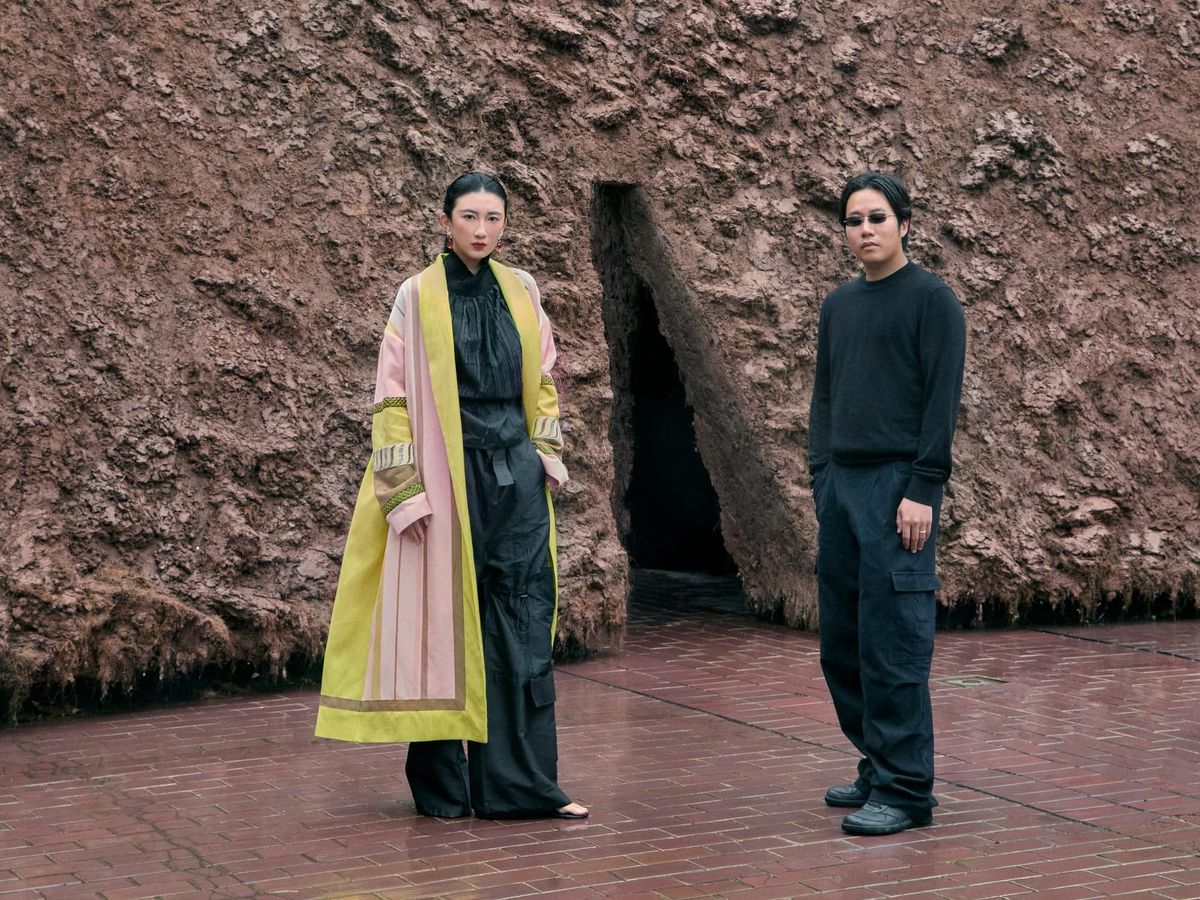
In July 2025, Claire Bi stepped off a 24-hour flight from Shanghai at São Paulo’s Guarulhos airport, where Brian Yue was waiting; he had flown in from London. Prior to this, the young professionals—she an educator and entrepreneur, he an architectural designer—had met three times, drawn together by shared interests in education, architecture, and the role of art spaces in public life. He took her to Sesc Guarulhos—a vast, glass-roofed civic center housing galleries, a theater, a library, swimming pools, and a gym, all freely accessible to the community. Inside was Maxwell Alexandre’s “Novo Poder: passabilidade”—more than 50 life-size figures painted on pardo paper, a brown packaging material whose name doubles as a Brazilian census classification for mixed-race identity. Alexandre paints Black bodies in everyday postures: walking, waiting, occupying space. Visitors moved among them, then went for a swim. “What is this place?” Claire exclaimed, delighted by the seamless interweaving of art and civic infrastructure.
Not long after, the two were planning a wedding as well as their private art foundation’s first physical home. Cheng-Lan’s Corner opened in March 2026 on Prince’s Terrace in Hong Kong’s Mid-Levels—a residential enclave that, unbeknownst to many, sits on a complicated legal history. In 1888, the colonial government legally designated the area as exclusively European, barring Chinese residents. To base a foundation here, dedicated to artists from the global majority—Filipino, Afro-Brazilian, Colombian, and beyond—is neither accidental nor ironic. “We were always conscious of the political history underpinning the locale,” Brian says. “In some ways it is a form of excavation, uncovering and reordering the logic of a place.”
The Corner
A corner, geometrically, is where two lines converge; architecturally, an “interstitial space formed by external factors, an existence inherently reflexive of the conditions around it,” as Brian puts it. For Claire, the resonance is more perceptual. “In the language of filmmaking, it is in the corners of frames where subtler tensions, quiet gestures, and overlooked presences reside,” she observes. “And the phrase ‘the corner of the eye’ evokes that fleeting peripheral space where something is perceived but not fully registered, sensed yet rarely acknowledged.”
The periphery is precisely what Cheng-Lan’s Corner seeks to illuminate—whether in terms of whose work is made visible or who feels licensed to walk through their doors. Less institution than threshold, it is conceived as porous—to experimental gestures, unexpected guests, and chance encounters that unsettle the line between exhibition and lived experience. “I like how the word ‘corner’ rolls off the tongue—it has a neighborhood ring to it,” says Brian. “We want someone passing by to wander in, and maybe start seeing things in a new perspective.”
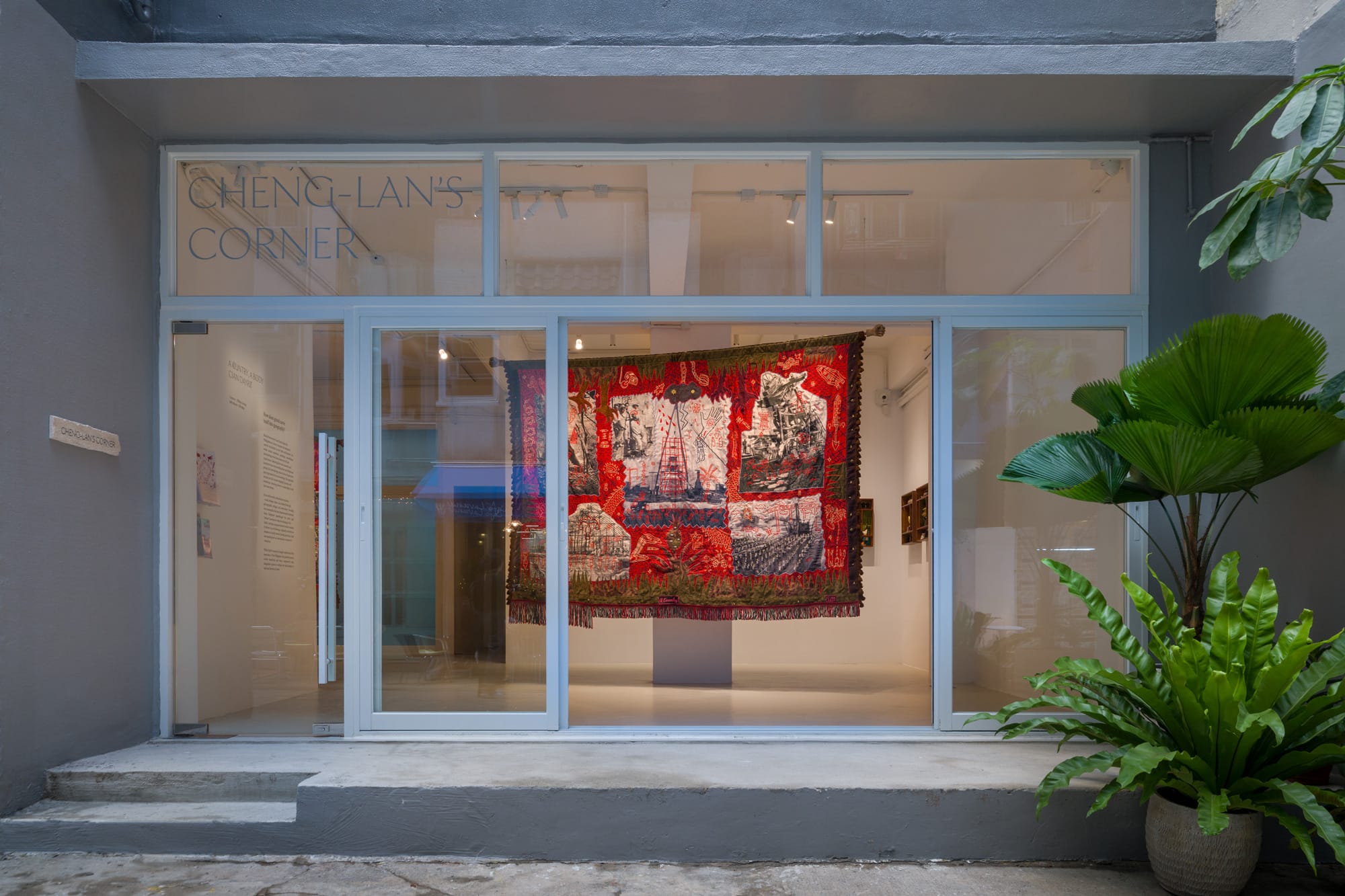
It’s a tall order, and the debate over which artist should inaugurate Cheng-Lan’s Corner went on for months. The couple’s instincts lean toward the research-heavy and concept-driven, but they knew the first show especially needed to strike a fine balance: accessible enough to start conversations, rather than shutting out those not yet versed in the language of contemporary art. Brian, who had long followed the work of Cian Dayrit, was convinced; Claire was initially hesitant. The Filipino artist’s unsparing work tracks histories of empire, entanglements of extraction, issues of labor and class struggle, and the contested maritime borders of the South China Sea—raising questions that, as Brian concedes, “could well be sensitive for audiences here.” The easier option would have been “an artist who paints pretty flowers.”