Current Issue
Tishan Hsu: The Human Inside
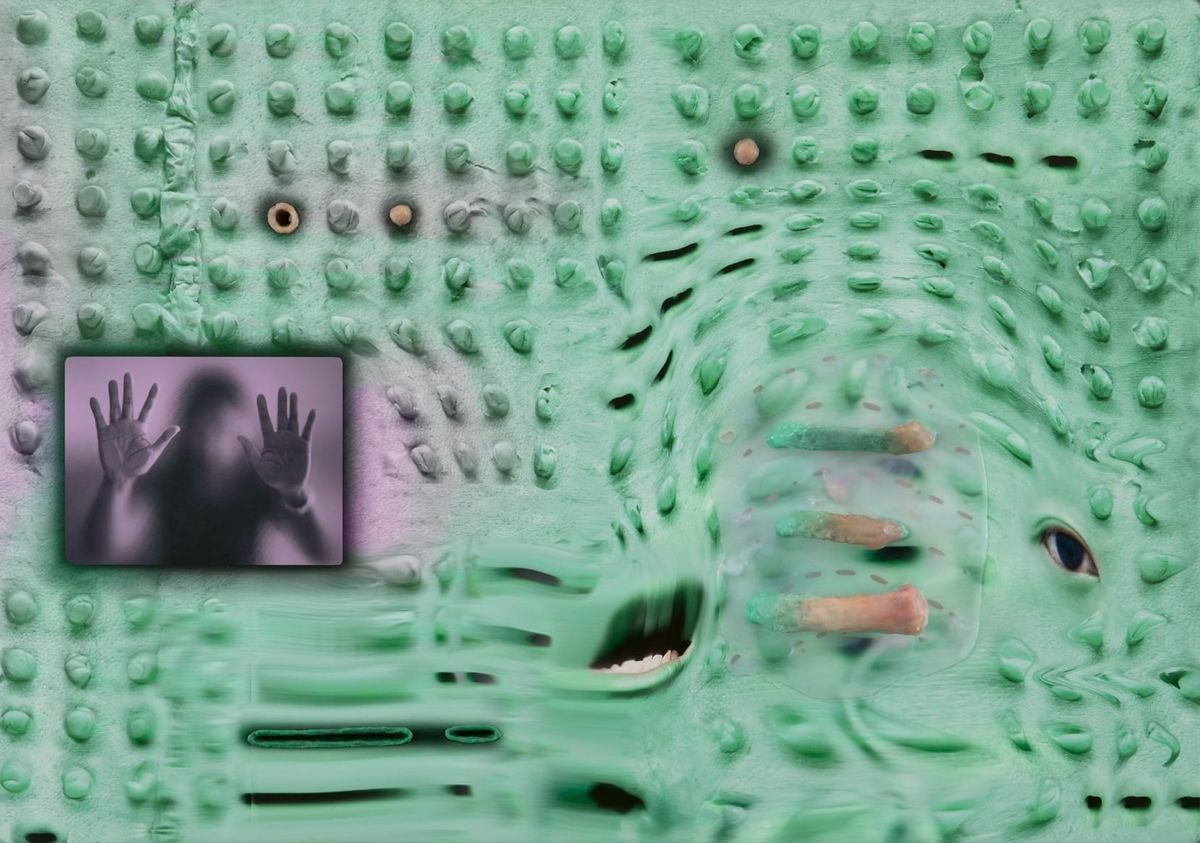
There is always something definitely nonhuman, yet almost definitely alive, inside the art of Tishan Hsu: a presence behind the screen, muffled yet persistent, pressing toward release. Across four decades, through a singular lexicon that fuses biomorphic and techno-machinic forms and textures, the 75-year-old artist has registered not simply the digital age’s effects on the body but its incursion into embodiment—the ways monitors, medical imaging, apparatuses of surveillance, and artificial intelligence enter perceptual and psychic life. After a long eclipse, his practice has, since 2019, drawn a surge of attention that casts him as prophetic—the rounded corners of his 1980s panels prefigure the iPhone, while Closed Circuit II (1986) all but forecasts the Instagram logo—an artist who apprehended, far in advance, a mode of human life inseparable from machinic mediation. That belated legibility should give us pause: if the early work has only recently become recognizable as portraits of techno-bodily entanglement, then the current vocabulary for Hsu’s recent explorations is almost certainly inadequate. What are his updated diagnoses? What new afflictions press against our skins and screens, asking to be named?
Born in Boston in 1951, Hsu spent his earliest years in Zurich, where his father was finishing an engineering dissertation, before the family moved through Ohio, Wisconsin, and Virginia. Hsu studied architecture at MIT, earning his bachelor’s in 1973 and his master’s in 1975, and took film and photography courses at Harvard’s Carpenter Center along the way. After moving to New York in 1979, he worked nights as a word processor at a law firm while devoting himself to his art. This is the artist’s most most-cited origin story: sitting before a screen for hours on end, he found that his physical body remained insistently, irreducibly present. His work has since set out to account for “this paradox between the illusionary world of the screen and the physical reality of [the] body.”1
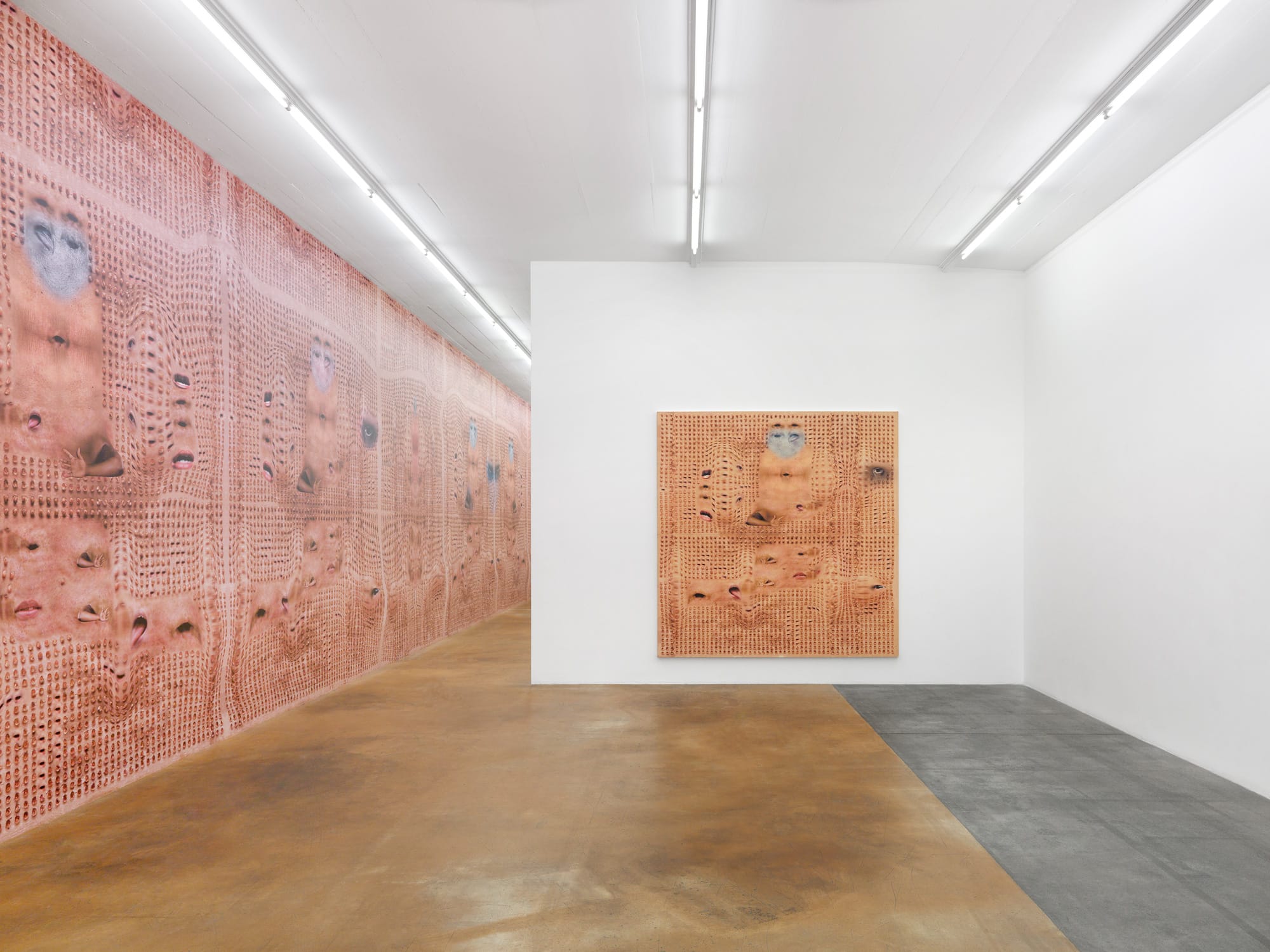
During the 1980s, Hsu exhibited at Pat Hearn Gallery (1985) and Leo Castelli Gallery (1987) and moved to Cologne in 1988 for a two-year residency. Upon returning to New York, he deliberately stepped back from the commercial circuit, taking up teaching to sustain a practice not beholden to the market, dedicated purely to research and experimentation. His techniques morphed in step with proliferating technologies of imaging and information, expanding from painting, relief, and sculpture to silkscreen and photographic reproduction, followed by digital image manipulation, wide-format and UV printing, silicone and large-scale installation, Mylar, moving image, and, more recently, generative AI.
These procedures accumulate rather than supersede one another, each giving new form and affect to the fleshly disturbances that relentlessly plague his surfaces. Across successive decades and devices, something continually opens, swells, reaches, and strains, exerting to become audible. To follow these symptoms is to approach technological change not through the succession of its machinery, but through the forms of embodiment it brings into being.
The Hole
The hole—at once wound, void, orifice, and origin—is among the oldest symptoms in Hsu’s vocabulary. The opening through which a body is breached, but also one through which it sees, breathes, feeds, and speaks—and indeed by which it first enters the world—it punctuates his practice from the outset. In Portrait (1982), created from oil stick, acrylic, enamel, and concrete on wood, disembodied eyes, a mouth, and indeterminate sinkholes drift among fleshy accretions; in Outer Banks of Memory (1984), Rapid Transit (1986), and Cell (1987), vents and darkened recesses evoke the intake slots of VCRs, computers, or automated teller machines. Elsewhere, illusion becomes incision: dents and divots puncture the tiled carapace of Heading Through (1984), while apertures riddle the lurid yellow Holstein-mottled body of Holey Cow (1986).
These early trompe l’œil paintings and sculptures develop mouths without faces, sockets without organs, cavities without bodies. It is the hole that brings an otherwise unnoticed boundary into view, making apparent skin and interface—two notions Hsu says “were essential to how [he] experienced the world as a member of the human species.”2 These openings repel and solicit in equal measure: ports awaiting insertion, lesions puckered or agape in silent screams, hovering in voids scored with the fuzzy grain of television static. Through such fissures, these strange techno-humanoid structures become sensate and vulnerable—susceptible to penetration, inflammation, and pain.
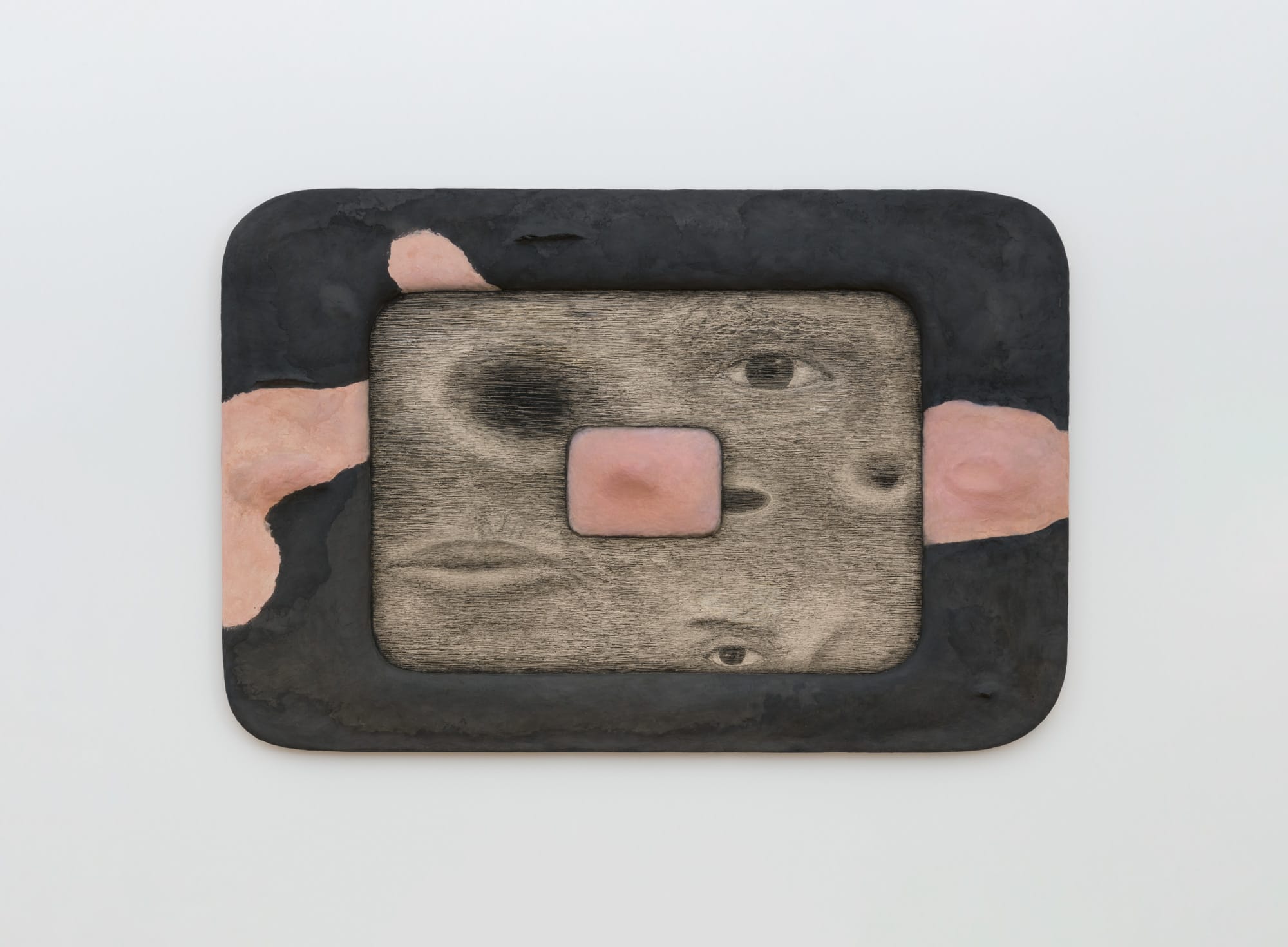
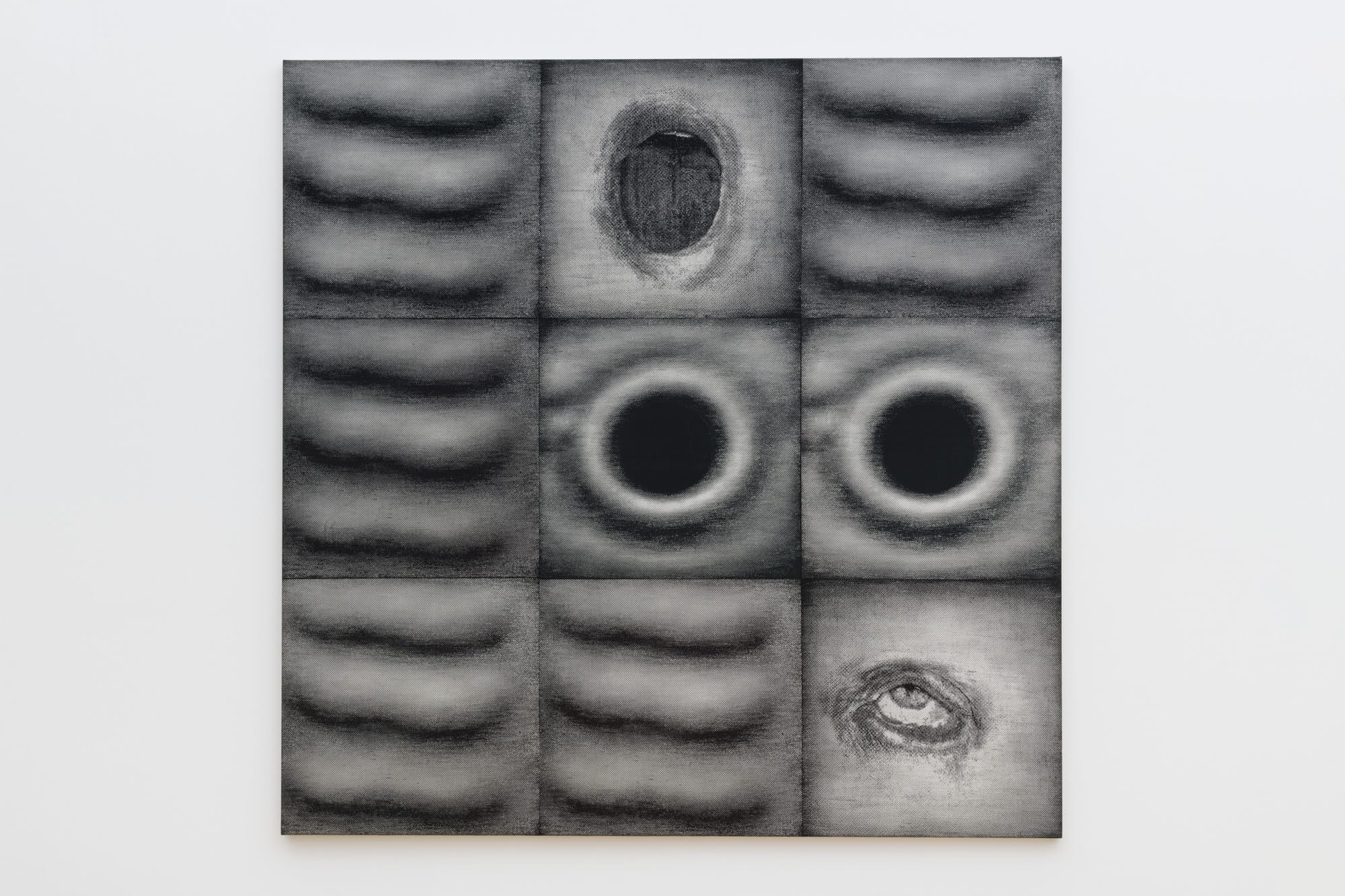
TISHAN HSU, Portrait, 1982, oil stick, enamel, concrete on wood, 144.8 × 221 × 15.2 cm (left); and Cellular Automata 2, 1989, silkscreen ink on canvas, 208.3 × 208.3 cm (right). Copyright the artist and Artists Rights Society, New York. Photos by Jeff McLane. Courtesy the artist; Empty Gallery, Hong Kong; and Lisson Gallery.
Toward the end of the decade, biomedical imagery entered the work after experiences with family members in hospitals exposed Hsu to advances in clinical technologies. Around this time, he was told that he himself would eventually need a kidney transplant. The hospital had become, in his words, “the most radical site for what we’re doing to our bodies.”3 Such questions unfolded against the AIDS epidemic and mounting restrictions on reproductive autonomy, the body increasingly subject to scrutiny and control; in parallel, his processes began to absorb the technologies through which the body was recorded and abstracted. For Cellular Automata 2 (1989), he photographed hand-painted images, translated them into a dot-screen matrix, inserted images from medical textbooks, and repeated the units in silkscreen. The resulting surfaces emanate a new sterile register that is uncannily more visceral: amid fissures resembling folds of tissue or lacerated flesh, two chasms evoke cosmic abysses or enlarged gunshot wounds. It’s not the Bullet but the Hole 2 (1991) literalizes the association: a forensic photograph of a bullet wound nestles adjacent to modules of necrotic, wrinkled protrusions.
Each aperture posits an interior only to withhold access, reversing the direction of surveillance: we look in only to encounter darkness, along with the sensation of something looking back out. Nor can we tell whether these perforations were inflicted from the outside or forced outward by something within. Wound and orifice are indistinct—the former presumes the violation of a body once whole; the latter reveals that no living body is ever closed. Jacques Lacan’s troumatisme—a neologism joining trou, “hole,” to traumatisme—names trauma not as injury befalling a constituted subject, but as a constitutive incompleteness around which meaning must be called forth. The subject does not precede the wound but takes shape around it, producing identity at the edge of what remains unassimilable.
Hsu’s holes invite a related reading, delineating the portals through which a body receives the world—and one that is increasingly computational. In order to communicate, transact, or be diagnosed or seen, the contemporary body must open itself to systems that translate sensation into signal and corporeality into information. Such mediation grants connection, visibility, and agency even as it violates control and autonomy. Hsu localizes that constitutive breach to the interface between human and machine, skin and screen: to the passage whereby the self is subjected to—and brought into new modes of subjectivity by—machinic legibility.