Current Issue
Mao Yan: Layering Time
Born in 1968 in Hunan, Mao Yan is among the most singular painters of his generation in China. His portraits are instantly recognizable: solitary figures rendered in a pale, almost spectral blue-gray, set against grounds of the same washed-out tone, their faces turned toward us yet withholding, caught in a mood of atmospheric disinterest. There is no story or setting—only a presence and a slow, imperceptible settling of time upon the surface of the canvas.
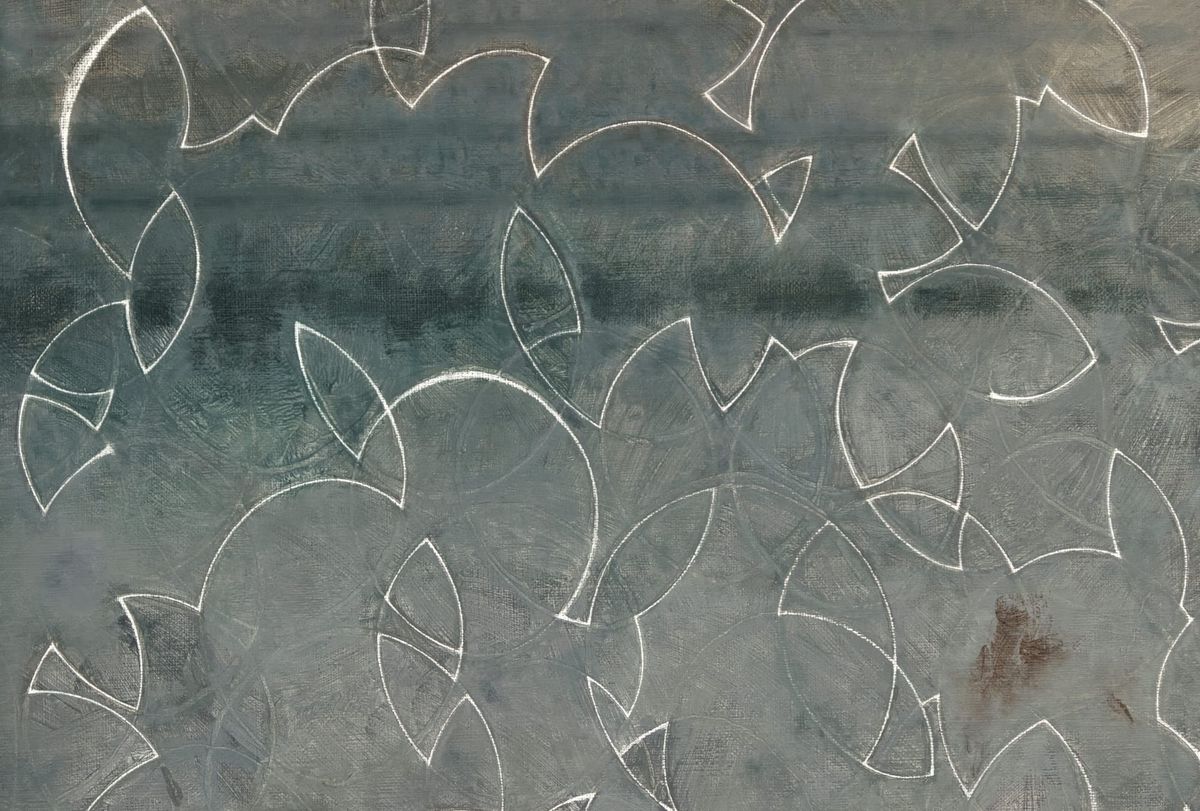
That same ethereality carries into his abstract paintings. This December, Mao will unveil a new body of work at Beijing Commune. Drawn from the same muted blue-gray palette, these works feature dense fields of faint, overlapping forms, by turns surfacing and receding across each canvas. They feel like the inward counterpart of Mao’s figurative work: depictions of the human psyche, and of duration itself. Across both bodies of work, figurative and abstract, Mao is after the same thing—a way of making time visible. Ahead of the exhibition, he sat down to speak about the discipline of slowness, his distrust of fluency, and how a painting comes to hold time and feeling of its own.
I want to start with Thomas. In the 1990s, when much of the Chinese art scene was absorbed in questions of identity—what symbols, what gestures might mark a work as distinctly “Chinese”—you went another way. You chose a face detached from that milieu, and stayed with it for more than a decade. There is something monastic in returning to a single subject again and again, like a monk reciting the same sutra. What kept drawing you back to that one face?
The Chinese art world shifted rapidly in the ’90s. Almost overnight we were exposed to Western contemporary art on a massive scale, and we started absorbing it. Many Chinese artists stepped directly onto the international stage, and virtually everyone faced the same question of identity. It had probably always been there, but it had never pressed on us so urgently. I felt it too, and it unsettled me, because painting had suddenly become an overwhelmingly grave matter—something you had to rethink from the ground up.
I was neither especially receptive to these changes nor eager to join them. If anything, I had grown weary of my own earlier figurative work and portraits, but I had no desire to grab hold of an overt symbol of “Chineseness” to lean on. I had always painted what I loved; I did not feel any compulsion to do otherwise.
Everyone else was rushing to secure an individual language or signifier—all the more so because several peers had already broken through to a larger platform abroad. How one reacted was ultimately a matter of temperament. My own initial reaction was discomfort, followed by an instinctive resistance, or at least hesitation, toward any new current. If I had not thought something through properly, why remake myself overnight? At that time, reinvention almost invariably meant a kind of self-negation. It was pervasive, and I resisted it. For a period I felt quite low, uncertain of which direction to take. In a sense, I avoided the question entirely, coasting on inertia. However moved I was by the radical developments in others’ work, I had no answer of my own, so I stayed passive.
Looking back now, I have come to realize that a great deal of artistic behavior, my own included, is not the prescience we like to imagine. Quite the opposite. What I recognize in myself is a kind of afterknowledge—an understanding that arrives late. If I could not produce an immediate response, why force one? Why force a change? That is the explanation I have arrived at in hindsight.
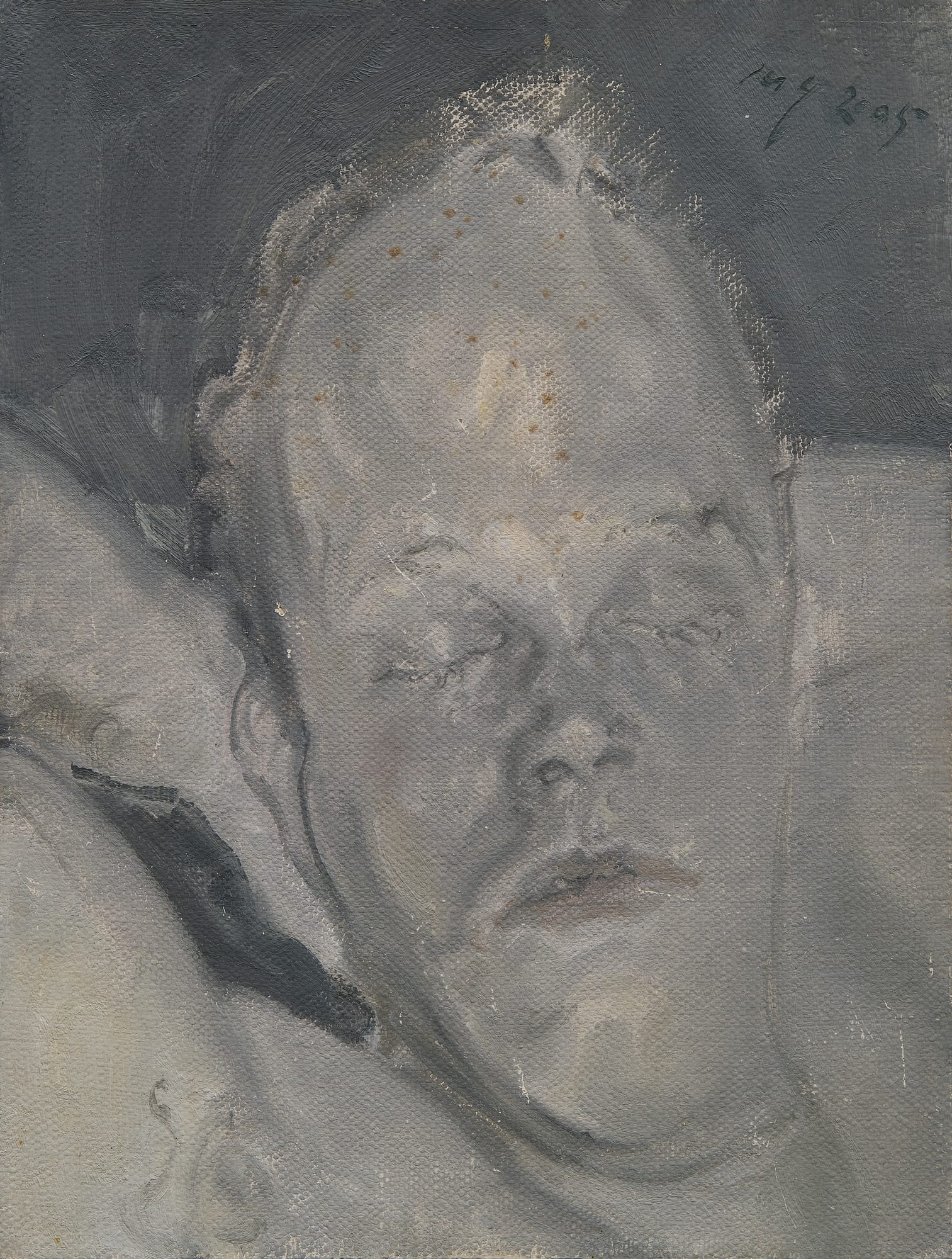
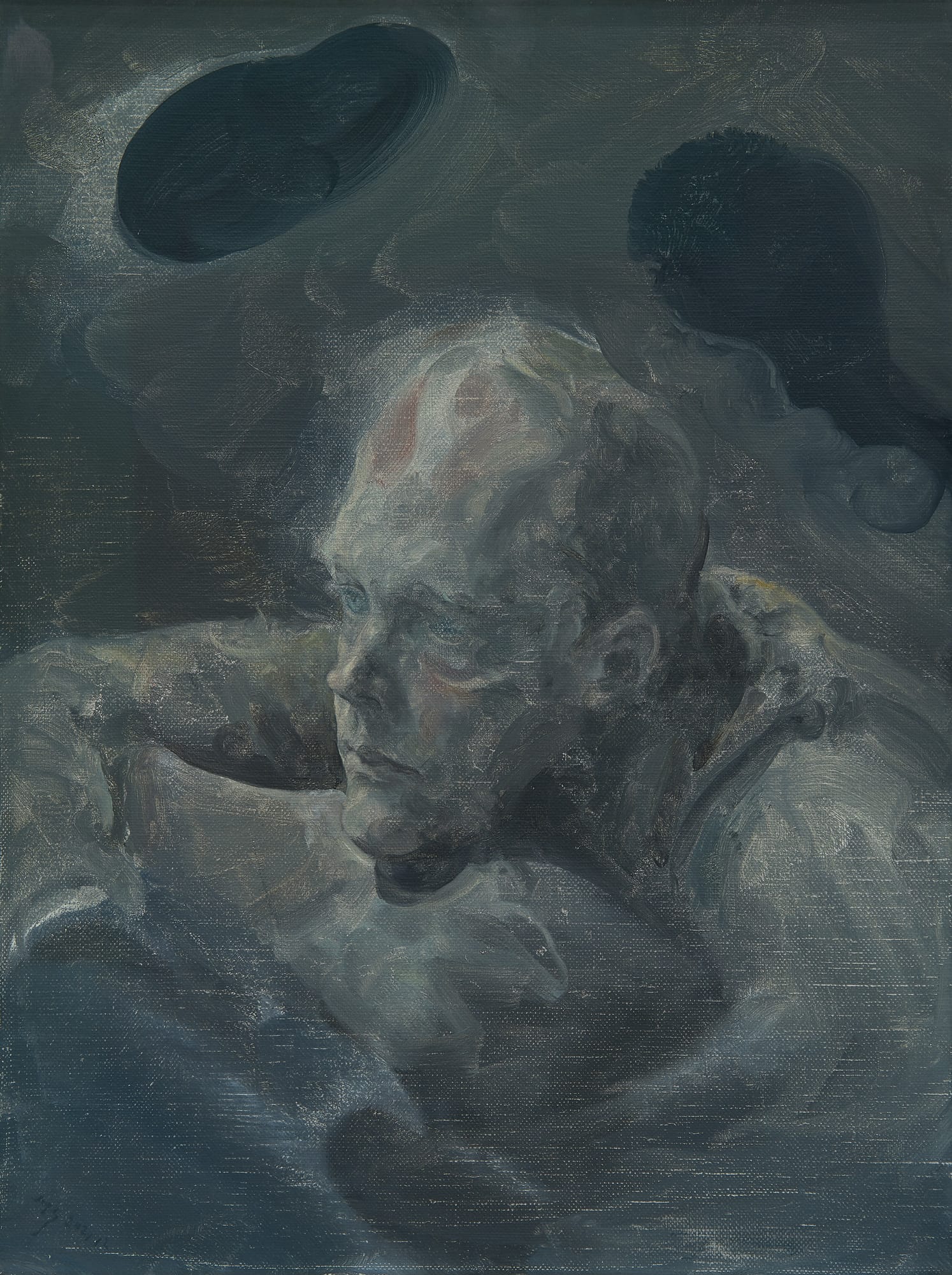
MAO YAN, Small Portrait of Thomas, 2005, oil on canvas, 36 × 27.8 cm (left); and Small Thomas, 2021, oil on canvas, 30 × 40 cm (right). Courtesy the artist and Beijing Commune.
Your figures often appear detached from worldly circumstance: suspended outside of time, place, or narrative. What are you looking to access within a face?
In the Thomas series, I didn’t want the work to signal any explicit direction, least of all that of its immediate moment. Given what we had lived through, our generation was acutely sensitive to the idea of the zeitgeist, and I personally came to detest it—this insistence that art must embody the spirit of the age seemed completely unecessary to me.
So in the early Thomas paintings, I stripped everything away. He is bare-chested, often with no clothes. I removed rings, jewelry, everything. I concentrated on the figure’s head and bust. Once I narrowed the frame to that, I realized I could dispense with background and setting as well. I wanted no narrative cues. I wanted all painterly tension to converge on a single face: its micro-expressions, its structured presence, its shifting sensations. At one point, I decided even an undershirt carried too many social connotations. So I threw all of it out and went back to the most fundamental act of painting: fixing upon one person’s features and painting it, over and over.
Thomas was a friend, and I had painted friends before. After completing the first portrait in the late ‘90s, I felt something was finished and immediately began a second. It happened naturally; I was not conceiving a formal “series.” But pursuing this made me quite marginal. Curatorial invitations went almost exclusively to works bearing legible Chinese iconography. When Western institutions selected Chinese artists, I had little prospect of inclusion. Curators might admire the work, but it did not conform to what the international art world expected of an artist from China. Friends also questioned why I persisted in painting a foreign face that had nothing to do with China.