Issue
Inside Burger Collection: Felipe Baeza: Material Memory, Irreverent Bodies
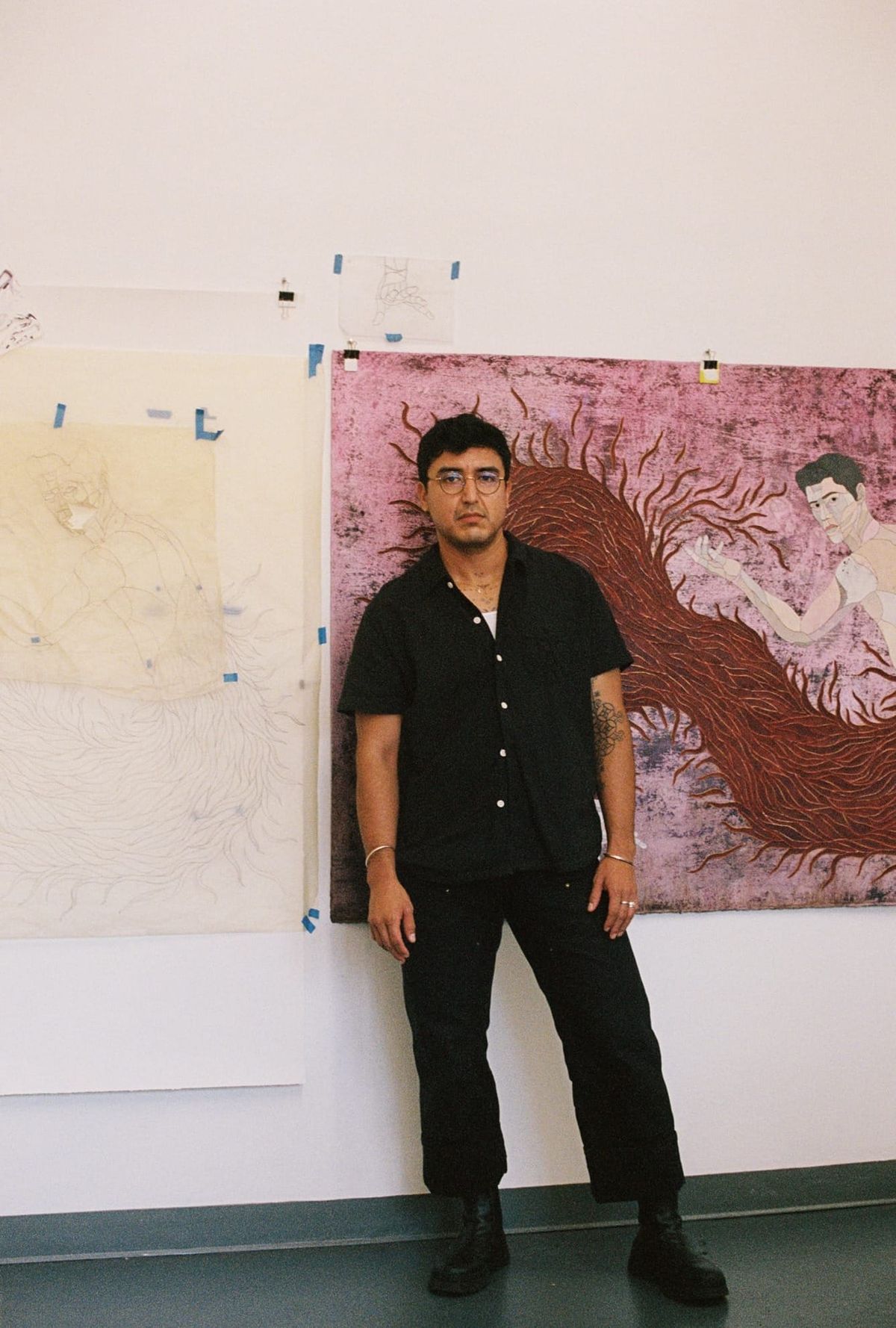
“Anima,” Felipe Baeza’s first institutional exhibition recently held at the Print Center New York, brought together more than 40 works on paper created over the past 15 years. These works defied the coherence of a survey. Ethereal figures surfaced and receded across paper that had been sanded, cut, and layered, tracing a path of evasion and instability through printmaking methods that were both traditional and expansive. The show clarified the material weight of Baeza’s practice. His 2025 exhibition at kurimanzutto, “To feel a then and there,” centered queer and migratory modes of becoming that resist any fixed sense of becoming. In this show, his unruly figures refused the need to belong, carving out lighter modes of being to survive the weight of systemic oppression in the US. In recent works, glass has also emerged as a material through which Baeza explores these fugitive beings through sculptural forms that remain fluid and unpredictable.
What happens when a practice grounded in transience enters a permanent space—in this case, the Burger Collection? In a conversation that took place over Zoom in January and February, Baeza and I set out to investigate the “material memory” of his practice across those three sites: an institutional survey, a commercial show, and an art collection.
Materiality: The Essence of Printmaking
Your recent show “Anima” at the Print Center New York was a survey of 15 years of work. How did seeing pieces from 2011 change your perspective on the more hybrid bodies you are creating today?
When I look at works from 2011 today, I no longer see them as self-contained objects but as generative experiments that allowed later forms to materialize. Revisiting those early pieces underscored how persistent certain concerns have been in my practice, even as materials and formal strategies have shifted. While I once understood them through the lens of hybridity, I now think of them more as amalgamated forms or vessels rather than hybrid bodies. The language has evolved accordingly. The figures I am working with today feel more expansive in their instability, but the impulse toward fragmentation, layering, and refusal was already present in earlier works.
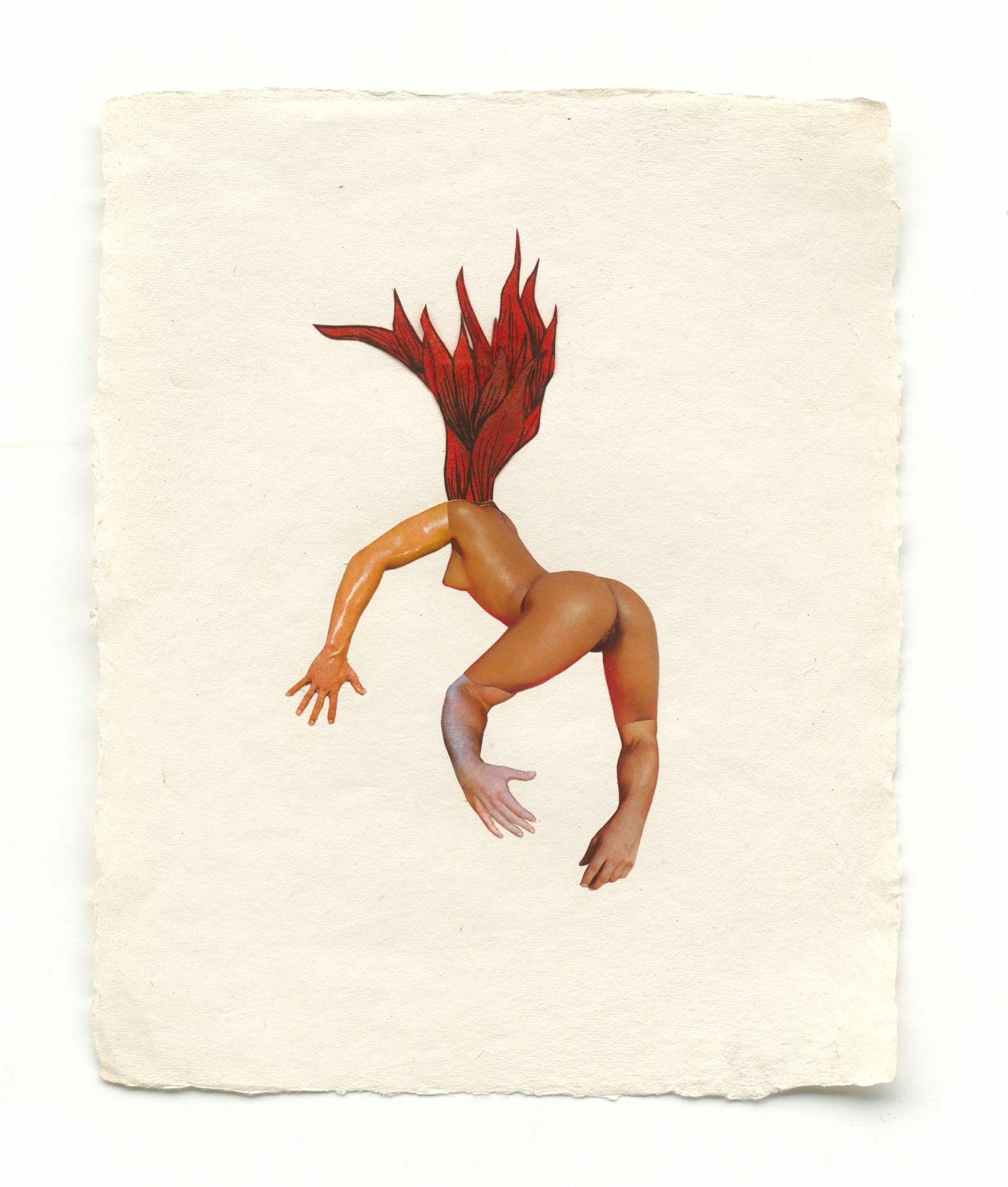
Revisiting those works showed me that my practice isn’t oriented toward clarity but toward the deepening of a visual language that consistently resists fixity. For instance, a flame-like motif in early pieces—such as Anima (2011)—reappears in shifting forms, somewhat unconsciously. In hindsight, that piece feels like a breakthrough: I was already thinking along these lines, I moved away from it for some time, and eventually came back to it. In that sense, the work now reads as a kind of future vision.
You have described your process as a deliberate form of erosion. Do you find that the abrasive act of sanding down paper frees the image from its immutable state of being?
I would agree. For me, sanding has become a gesture of destabilizing the material surface. Paper is typically understood as something that preserves and stabilizes an image, and abrasion interrupts that expectation. When I sand, carve, or distress the surface, I allow the image to release certainty and to reveal something else. As the surface registers touch, pressure, and time, the work shifts from preservation toward vulnerability. The image is no longer fixed, but instead hovers in a state of becoming and dissolution.
Sanding also makes the surface more porous, so that gesture and material transformation remain visible instead of being concealed beneath a façade that’s finished. You can see this in Sonder (Sylvia W.) (2025): the paper takes on a leather-like quality—sturdy, yet worn down to expose its layers. This is only a reproduction, but in person, the work gradually reveals itself. There is also a subtle translucency in the varnish, where the background and foreground begin to merge, vying for attention. Ultimately, what shines through is the gaze—the eyes.