Issue
Editor’s Letter: The Pangs of Promises
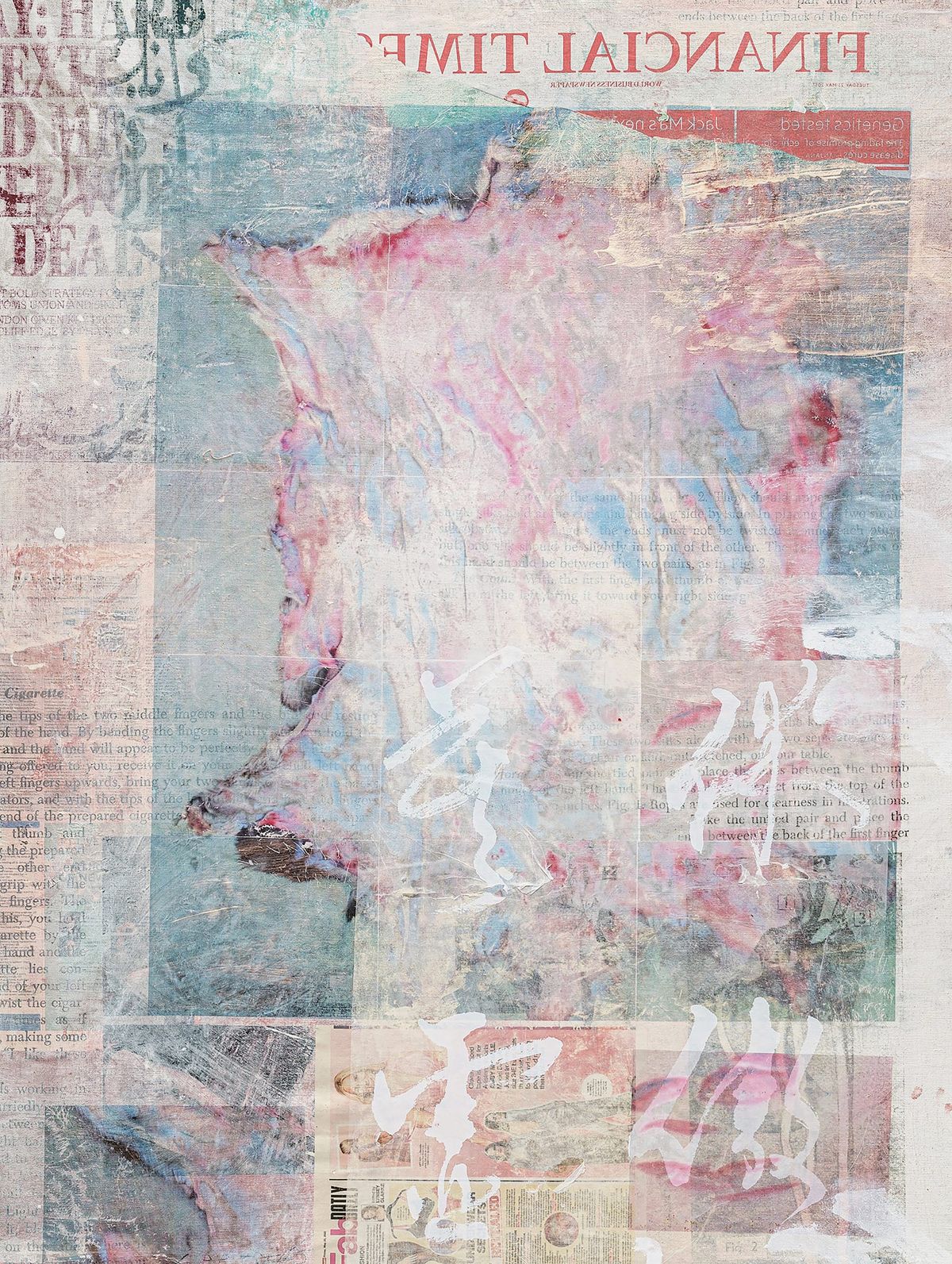
Amid the hustle and bustle of the post-pandemic economy, we find ourselves contending with uncertainties about how to find our way among the multilayered, complex madness of the world today. We live in an era of deepfakes, echo chambers, rabbit holes, and disappearing history. To what degree then might art serve as a conduit, a vehicle, or even a mouthpiece for our collective desires, or as a way to understand, or even escape, the chaos, and find elements of reality that we can grasp?
For our cover feature this issue, ArtAsiaPacific assistant editor Anna Lentchner scrapes back the myriad layers of political engagement and deep historical resonances that are built up—both literally and figuratively—on the large canvases of Malaysian-born British painter and performance artist Mandy El-Sayegh. By way of the late sociopolitical theorist Frantz Fanon’s notion of “violence which is just under the skin,” Lentchner ties together El-Sayegh’s own struggles with physical health to her efforts to tie together the ideas and philosophies that underscore the continued repression of the powerless.
History as a mirror that reflects our present as well as our future is how Thai artist Pratchaya Phinthong views the world, as Singapore-based writer Yvonne Wang discovers in our second feature. Phinthong, whose work has explored epidemics, military coups, the legacies of past wars, has been described as an “alchemist” of conceptual art, who, according to Wang, creates works that “serve as portals to diverse places, ideas, and objects . . . intricately weaving these elements into thought-provoking narratives that explore global systems, power dynamics, and their far-reaching effects.”
One of the artists featured in Up Close also embraces the ramifications of spurious global machinations. Inside the black box of Hong Kong’s Empty Gallery, James T. Hong’s seven-hour long, three-channel video installation Apologies (2012– ) compiled the screentime of numerous politicians—from the 1970s through United States presidents, Asian leaders, the Pope, and Canada’s Justin Trudeau—performing scripted mea culpa after mea culpa in a deadening supercut. Meanwhile, Nguyen Trinh Thi’s newly commissioned post-cinematic sound installation merges footage from classic films with actual field recordings of Vietnam’s highlands and music by Indigenous musicians. Also riffing on classic film tropes, this time from the horror genre, is the latest film work of Heecheon Kim, who explores the encroachment of technological decay on daily life in the two-channel Studies (2024). As AAP’s deputy editor HG Masters writes, “It is not only in the glitch that technology’s promise collapses in on itself.” Elsewhere, Inside Burger Collection dives into the multidisciplinary practice of the Hong Kong-based artist Wu Jiaru, whose work looks at everything from the digital realm to cultural shifts in the cities of the Pearl River Delta.
In our Profiles, we look at the practice of Anicka Yi, who is holding her first major solo exhibition in Korea at the Leeum Museum of Art in Seoul, and her interest in the posthuman landscape of 21st century life. Contributor Valentina Buzzi met with Yi, who told her: “We’re moving toward a time where distinctions between organic and synthetic, human and nonhuman, will become increasingly irrelevant.” The issue’s second profile explores the filmmaker Chan Hau Chun’s documentary practice as she narrates the inter-generational struggles of those families, like her own, who “touched base,” or arrived in Hong Kong as quasi-legal immigrants, and have remained on the margins of this fast-paced city ever since.
This issue, our new column Legacy examines the enduring Japanese photographer Eikoh Hosoe, who passed away in September at the age of 91. With his singular ability to capture the human body, as space of performance and site of the erotic, Hosoe infamously photographed numerous postwar, countercultural luminaries, including butoh founder Tatsumi Hijikata and controversial author Yukio Mishima. In Dispatch, Sheau Yun Lim explores the artistic legacies of Penang and discovers its contemporary precedents. The Point, picking up where last issue’s report on the recent closure of an LGBTQ+ exhibition in Istanbul left off, explores sacred spaces in Tokyo that serve as points of refuge and creativity for local queer communities. For New Currents we turn our attention toward emerging artists that are set to feature in the 11th Asia Pacific Triennial at the Queensland Art Gallery | Gallery of Modern Art, including Brisbane-based artist Sancintya Mohini Simpson and Mumbai-based Rithika Merchant. Over in Previews we look ahead at six upcoming events, from painter Julie Mehretu’s solo exhibition at the Museum of Contemporary Art Australia in Sydney to the 2024 Asian Art Biennial in Taichung.
From Gwangju to Hong Kong, Barcelona to Paris, our Reviews this issue take in Ayoung Kim’s latest commission, Art Labor’s solo exhibition at Para Site, Wu Tsang’s new video work, and a survey of the late David Medalla, while critic Richard Vine send a barbed missive from the 15th Gwangju Biennale. And last but not least, for Where I Work, Brian Haman pays a visit to the Vienna studio of Chinese sculptor Ma Jia, whose large-scale industrial works are a wry comment on labor and commerce, and a critique of everything from Chinese communism to Austria’s history of profiting from Russian oil.