Issue
Editor’s Letter: Moveable Feasts
Our daily lives are increasingly digitized via virtual and simulated experiences. Note the wave of “immersive” exhibitions featuring large projections of famous images (sometimes animated) in place of actual artworks, or interactive light and video experiences. Some professional and amateur creators are exploring the potential of AI text- and image-generation programs, while others have focused on low- or no-tech approaches to art-making, valuing process over product, visceral experiences over high-resolution jpegs.
As a prelude to the 60th Venice Biennale in April, ArtAsiaPacific’s March/April issue spotlights two artists whose new projects take an experimental approach to materials and exhibition-making, seeking to engage viewers in the tactile, the odorous, the unpredictable, and even the organic in vivo.
For our cover Feature, associate editor Alex Yiu spoke with Trevor Yeung about the development of his practice over the last decade, from his early sculptural installation works featuring fish, seashells, and houseplants, to his more recent evocation of a notorious gay cruising site in London’s Hampstead Heath. As Yeung has progressively expanded his object-making practice to environments evocative of saunas, hotel rooms, and the forest at night, the Hong Kong-based artist explores themes of intimacy, solitude, and care with humans, plants, and animals alike.
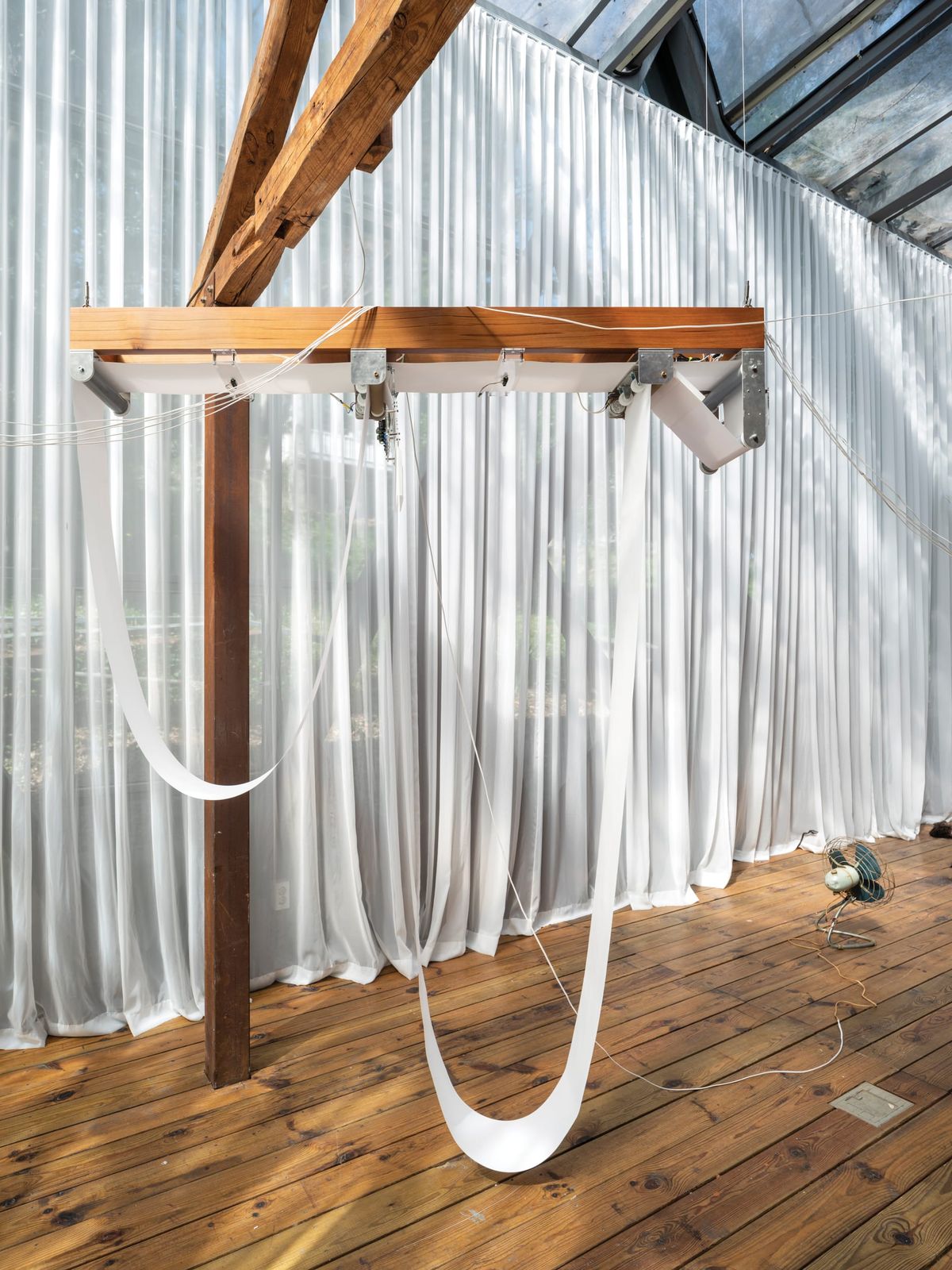
Our second Feature is an interview with Yuko Mohri, who is representing Japan at the Venice Biennale in 2024. Speaking with deputy editor HG Masters, Mohri recounts her plans for the pavilion before flying to Venice to search for materials and inspiration from the site and its environs. With her interest in experimental music and art, Mohri creates installations that rely upon, and reflect, the physical conditions of the site—leaks, humidity, or temperature—often incorporating electrical devices and high-maintenance machinery, in collaboration with the artworks’ caretakers.
A focus on sculptural practices continues in Inside Burger Collection, where Asymmetry Art Foundation’s head of programs Nick Yu examines the surreal, life-like objects of Robert Gober in relation to the practices of Hong Kong artists Angela Su and Jes Fan, as well as comparing Gober’s painting series with the late Martin Wong’s paintings of prison inmates. In Up Close, we spotlight a recent video about lithium mining and ethnic minorities in China by Liu Chuang; a new photo series by Hoda Afshar about the resilience of Iranian women; and Natascha Sadr Haghighian’s amorphous, antimonument installation at the Taipei Biennial 2023.
For Profiles, Singapore desk editor Yvonne Wang spent time with Robert Zhao Renhui in a secondary forest ahead of his latest project’s debut in the Singapore Pavilion at Venice, where he portrays the wildlife and ecology of previously damaged or degraded landscapes. A similar fascination with the natural world runs through the works of Geraldine Javier, who recounts to Manila-based writer Portia Placino about her recent works featuring imagery of plants and insects, as well as her evolving views on death. A pair of Essays spotlight evolving concepts of identity, from queer spaces in the Philippines to a recent exhibition at the Singapore Art Museum that explored concepts of personhood in an era defined by AI. Our New Currents spotlights Yokohama Triennale participant Vunkwan Tam, as well as Fuyuhiko Takata and Kara Chin, who will be showing in the Discoveries sector at Art Basel Hong Kong.
Elsewhere in the issue, we preview six national pavilions and collateral exhibitions debuting in Venice in April. While preparing new work for the curated section of Adriano Pedrosa’s main exhibition for the Venice Biennale, Hong Kong- and Berlin-based artist Isaac Chong Wai recounted the influence of Käthe Kollwitz’s figures on his own practice for our One on One. Also in Berlin, writer and theorist Ana Teixeira Pinto analyzes the German government’s increasing policing of artistic expression, particularly around topics related to Israel and Palestine, and the impact of censorship on artists and cultural institutions for The Point. In Dispatch, Jennifer Yang brings readers up-to-date on the many developments in Eora/Sydney, ahead of the 24th Biennale of Sydney, which kicks off in March.
Our reviews span from Seoul to Los Angeles, covering many major retrospectives of late 2023, including the touring survey of Hiroshi Sugimoto and Paul Pfeiffer’s first midcareer survey. Finally, for Where I Work, Matt A. Hanson visits the Istanbul studio of Deniz Gül, whose sculptural practice retains strong connections to the artist’s interest in languages as systems continuously being built up, dismantled, and reconfigured by us all. Like many of the artists in this issue, Gül works with physical materials that reflect the current conditions of “psychological or social space” in the real world that, despite emerging virtuality, connect us to one another.