Issue
Art Fair Report: Regional Strengths
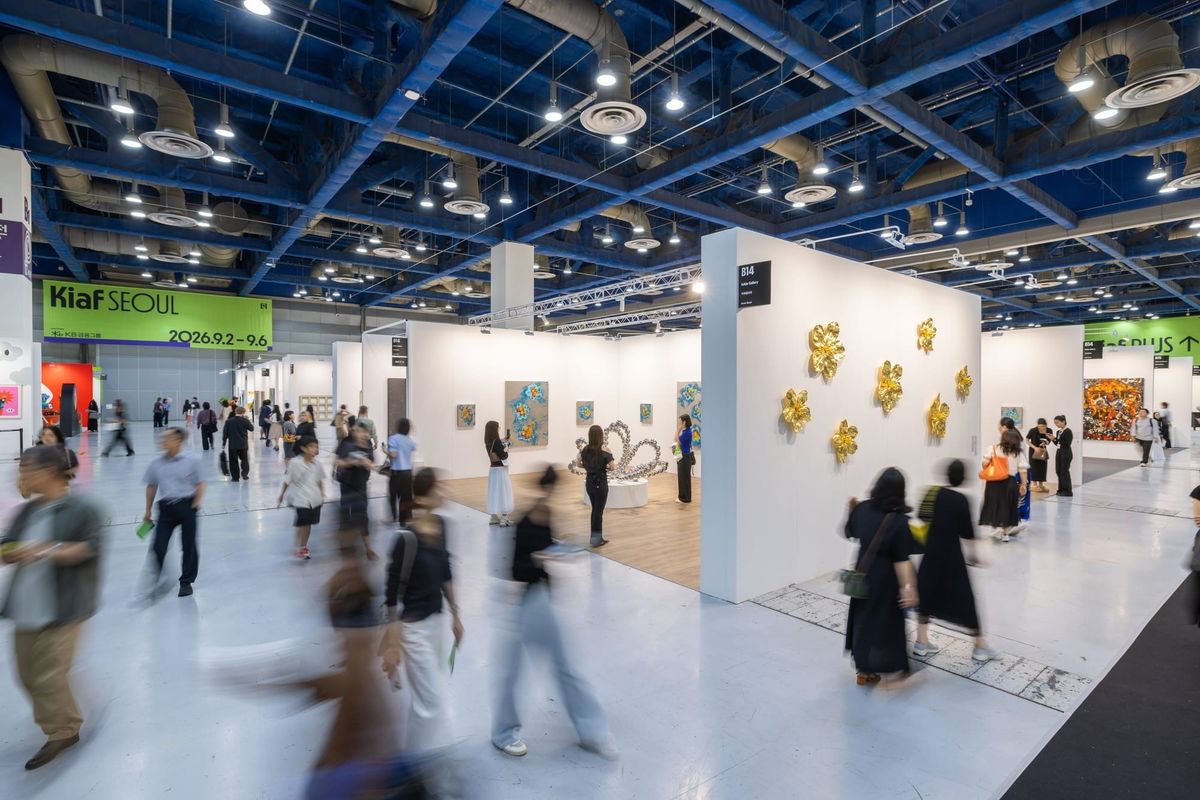
KIAF AND FRIEZE SEOUL
This year’s Seoul art week felt more crowded than ever. Running concurrently, Kiaf and Frieze Seoul shared the calendar with the Busan and Gwangju Biennales, giving collectors additional reasons to visit.
Kiaf returned for its 25th edition, its largest at 175 galleries, concluding its first five-year partnership with Frieze. The milestone arrives against a softening market: Korea’s art sales peaked near KRW 1 trillion (USD 743.8 million) in 2022 and have since fallen roughly 25 percent to around KRW 615 billion (USD 457.5 million).
At Kiaf, Dansaekhwa and postwar abstraction dominated. PYO offered Park Seo-Bo’s Ecriture No. 33-23 (2021) at roughly USD 190,000. Gallery Hyundai showed Lee Ufan’s Dialogue (2019), Kim Whanki’s Untitled (1970), and several 1990s Nam June Paik installations priced between USD 221,000 and 369,000. Its total sales reportedly exceeded KRW 1.2 billion (USD 892,600). Kukje Gallery anchored the upper end with Park Seo-Bo’s Ecriture No. 170606 (2022) and a rare Yoo Youngkuk oil canvas, Work (1979), which changed hands in the KRW 600–720 million (USD 450,000–540,000) range.
At the lower end were figurative, pop-derived works. Hakgojae presented Kim Jae Yong’s brightly colored Donut Fear sculptures (USD 50,000–80,000). Arario showed Lim Nosik’s hazy, violet-grey canvases, including Wildflower – Landscape 58 (2026), priced at roughly USD 8,760. Whitestone placed paintings by Aruta Soup, whose recurring, often bandaged rabbit motif draws on graffiti and club culture.
While Kiaf foregrounded domestic galleries, Frieze Seoul drew major Western dealers, including Gagosian, David Zwirner, and Hauser & Wirth. Kukje still claimed the week’s top result: a 1971 painting by Yoo Youngkuk sold in the KRW 2.2–2.5 billion range (roughly USD 1.6–1.8 million). The price was reported to be the highest ever paid at the fair for a work by a Korean artist since Frieze launched in Seoul in 2022. Other Kukje sales included Ha Chong-Hyun’s mixed-media work Post-Conjunction 21-512 (2021) for USD 253,000–303,600; an acrylic on ceramic by Park Seo-Bo, Ecriture No. 220611 (2022), for USD 250,000–300,000; and Suki Seokyeong Kang’s mixed-media work Mat #24-10 (2023–24) for USD 100,000–120,000.
White Cube sold Park Seo-Bo’s Ecriture No. 221121 (2022) for USD 300,000 and Ecriture No. 070909 (2007) for USD 190,000. Pace moved several pieces, among them Lee Ufan’s With Winds (1987). Lehmann Maupin dedicated its booth to Do Ho Suh’s thread drawings, coinciding with his survey at the National Museum of Modern and Contemporary Art, Korea, and sold three works by Kim Yun Shin, whose recent exhibition at the Hoam Museum of Art had raised her profile.
Frieze’s “Focus” section gathered smaller and mid-tier local galleries with experimental programs, including N/A, Pipe Gallery, and Foundry Seoul, which devoted its booth to Omyo Cho’s amorphous sculptures. The inaugural “Spotlight” section foregrounded overlooked 20th-century artists: Ames Yavuz showed Po Po’s conceptual pieces produced during Myanmar’s political isolation and censorship, while BAIK presented Han Youngsoo’s black-and-white photographs of postwar Seoul. Yoshiaki Inoue Gallery paired Etsuko Nakatsuji’s paintings with a suspended installation, positioning her as a forerunner of postwar Japanese installation art, while Tansbao Gallery and Art Exposure offered modernist canvases by Lain Singh Bangdel and Reba Hore, respectively.
The fairs pursue different ambitions: Kiaf consolidates Korea’s domestic ecosystem, while Frieze connects Korea to international dealers. Comparisons with Hong Kong persist: Art Basel’s Asian flagship draws a cross-border collector base Seoul has yet to match. But Seoul offers a different density, evident beyond the fair floor. “Neighborhood Nights” drew a broad public into galleries, museums, and after-hours events. In Hong Kong, satellite programming remains largely the preserve of professionals and VIPs. Seoul’s energy is more diffuse, connected to the cultural export engine carrying K-pop, K-drama, and K-fashion abroad.
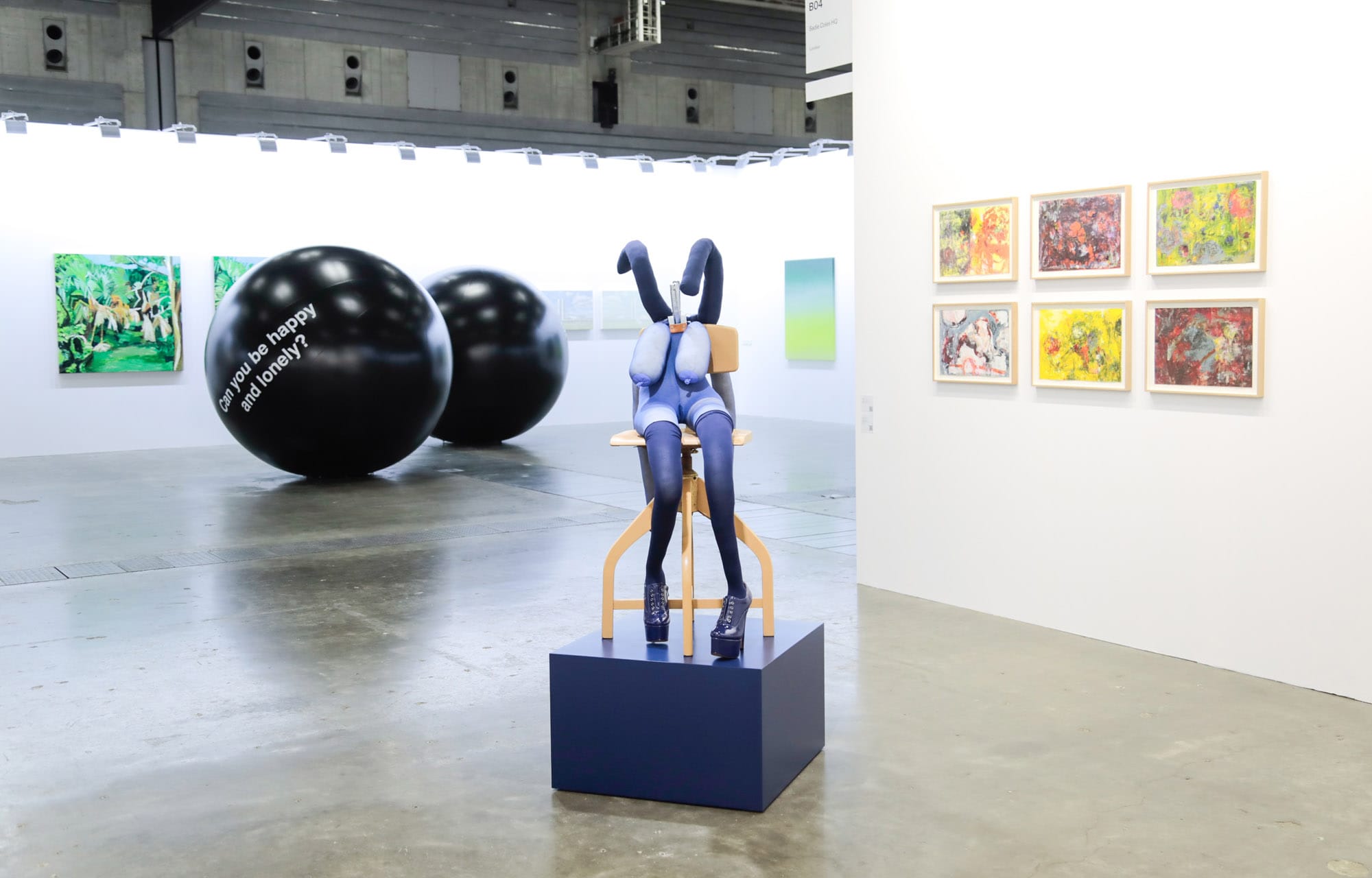
TOKYO GENDAI
After Seoul, artgoers trickled into Japan for Tokyo Gendai, held September 11–13 at Pacifico Yokohama with 69 regional and overseas galleries. Its fourth edition comprised five sectors: the main Galleries section; Hana (“Flower”), dedicated to emerging or midcareer artists; Eda (“Branch”), highlighting historically significant names; Tane (“Seed”), featuring NFTs, film, VR, and other tech-driven projects; and the inaugural Miki (“Trunk”), focusing on paper-based and printed works.
Returning international galleries included Sadie Coles HQ, which showed British artist Sarah Lucas’s stuffed-nylon sculpture Blue Bunny (2025) and Japanese painter Yu Nishimura’s dreamlike portrait Diffraction (2026). Pace, whose Tokyo space survived its global downsizing, staged a solo presentation of American artist Lauren Quin’s vibrant tableaux, most of which sold within the first day.
Tokyo-based returnees included CON_, A Lighthouse called Kanata, Taka Ishii Gallery, TARO NASU, and KOTARO NUKAGA. The latter sold more than 20 works, including two of Keita Morimoto’s neon-drenched canvases capturing Tokyo’s urban alienation, each priced between USD 40,000 and 60,000. CON_ devoted its booth to Yukino Yamanaka’s figurative paintings, selling more than five for under USD 10,000 each. Predominantly modest prices and a focus on younger artists gave new buyers a lower-risk entry point.
Japan defied the global downturn in 2024 with a two-percent increase in art sales, retaining its position as the second-largest market in Asia. Growth slowed by one percent in 2025, likely reflecting rising fuel and freight costs and a chronically weak yen. Nevertheless, a robust institutional infrastructure, younger high-net-worth domestic collectors, and foreign dealers’ sustained engagement have helped the market hold steady.
Tokyo Gendai has adapted accordingly. Last year, it moved to autumn to align with the Korean fairs and attract more American and European visitors deterred by Japan’s summer heat. Next year, it relocates to Ariake GYM-EX, a former 2020 Olympic arena, with new dates—November 4–7, 2027. The more central venue and overlap with Art Week Tokyo signal an effort to cultivate an internally coordinated program.
ART JAKARTA
Art Jakarta’s 16th edition, held October 2–4 at JIExpo Kemayoran, drew a record 41,646 visitors, up from approximately 38,000 last year. The roster held steady at 75 exhibitors, while international participation dipped from 35 galleries to 33—the first decline since the fair resumed after the pandemic in 2022.
Indonesian galleries were prominent in “Spot,” the sector for oversized installations, where themes of kinship and land contributed to a political register beyond the spectacle of scale. ROH paired Albertho Wanma’s The Nature Womb (Karwar Series) (2024), which draws on the ancestral statues of Papua’s Biak people, with Budi Santoso’s Mother Trees (2026)—totemic forms whose stacked heads and raised fists suggest solidarity. SAL Project mounted Angki Purbandono’s Berbunga-bunga: Tribute to Red Cross Movement in South Papua (2026), a towering bamboo cross honoring communities who erect wooden crosses to protest plantations and food estates. ara contemporary presented Nguyễn Phương Linh’s Pulse 1 and Pulse 2 (both 2026), PVC sheets printed with digital images that evoke flesh and landscape, related to her presentation in the Uzbekistan Pavilion at the Venice Biennale.
Accessible prices offered multiple entry points for collectors. ara brought 21 artists, with prices ranging from USD 300 for S. Urubingwaru’s small oils to USD 17,000 for Nazif Lopulissa’s nearly three-meter Drinking Seawater (2023). Sullivan+Strumpf offered a selection of Wisnu Auri’s mixed-media vignettes at USD 1,100–1420 alongside Dawn Ng’s Tender Eruptions (2026), priced at USD 58,000. Intergenerational breadth was present at Gajah Gallery, whose 18-artist booth included Mangu Putra’s hyperrealist Stage (2025) alongside his son Jemana Murti’s 3D-printed reworkings of Balinese motifs. Among the 19 first-time exhibitors were Seoul’s BHAK, Kyoto’s YUMEKOUBOU, Tokyo’s Misako & Rosen, and Hong Kong’s PHD Group. Their arrival replenished a roster that lost Kaikai Kiki Gallery, Tina Keng Gallery, and Manila’s The Drawing Room.
Government-funded sections broadened participation: “Korea Focus,” supported by South Korea’s culture ministry, expanded from 12 to 14 young galleries, while the new “AJ Scope,” backed by Indonesia’s Ministry of Culture, brought six independent art market initiatives from across the country to Jakarta. These efforts positioned the fair as a collaborative platform seeking to deepen engagement both at home and abroad.