People
The Essential Works of Yin Xiuzhen
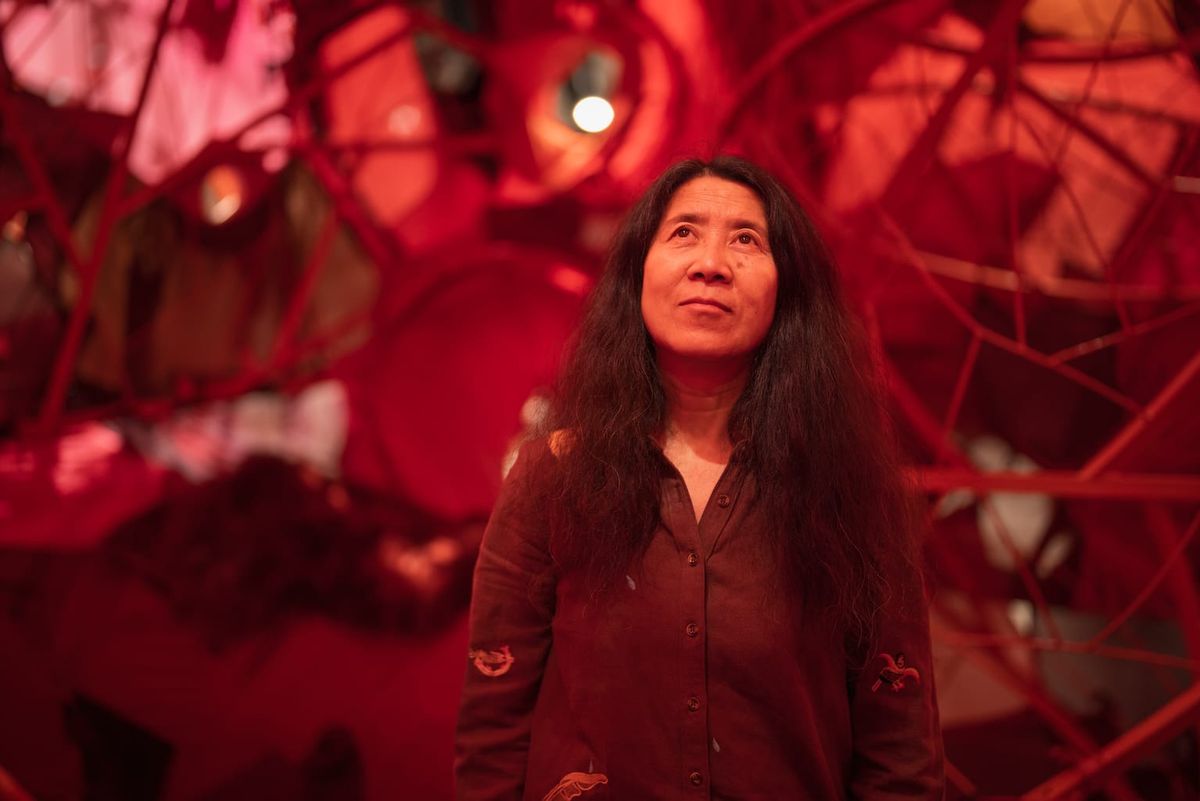
Born in 1963 in Beijing, Yin Xiuzhen has been a pivotal figure in Chinese art since the 1990s, working across performance, sculpture, and installation. Drawing on the vertiginous urban transformation of contemporary China amid globalization, she transforms everyday materials, personal belongings, and found objects into monuments of collective memory and cultural identity.
After graduating from the Fine Arts Department of Capital Normal University in Beijing in 1989, Yin emerged alongside a generation commonly described as the second wave of Chinese contemporary artists, including Yu Hong, Song Yonghong, Wang Jinsong, and her husband Song Dong. Against the backdrop of rapid marketization, tightening political control, and the erosion of socialist ideals after 1989, the ’90s saw a pervasive existential crisis among artists and cultural practitioners. The grand narratives and gestures that characterized first-wave works—such as Xu Bing’s Book from the Sky (1987–91)—began to lose their resonance. In response, the emerging generation turned toward experimental practices in private spaces, exploring more intimate and immediate concerns, including the fragility of personal identity. This shift culminated in what art historian Gao Minglu termed “Apartment Art” in China, of which Yin, originally trained in oil painting, became an early and influential practitioner.
Beginning with the personal and collective impact of Beijing’s urbanization, Yin’s practice expanded to encompass broader themes such as globalization, environmental crisis, and questions of resilience and spirituality. Her signature use of discarded clothing, household ephemera, and industrial materials has remained strikingly consistent, even as the scale and ambition of her projects have grown. Following the recent closing of her solo exhibition, “Yin Xiuzhen: Heart to Heart” at London’s Hayward Gallery, we revisit some of her milestone pieces.
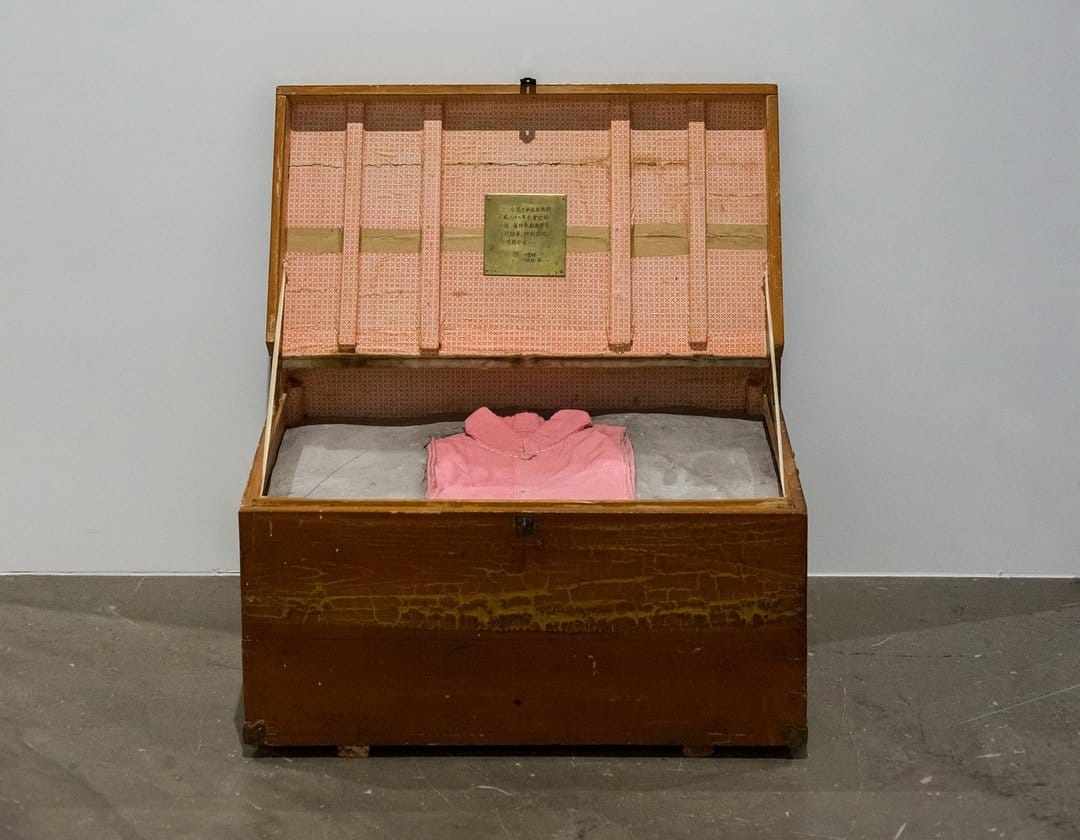
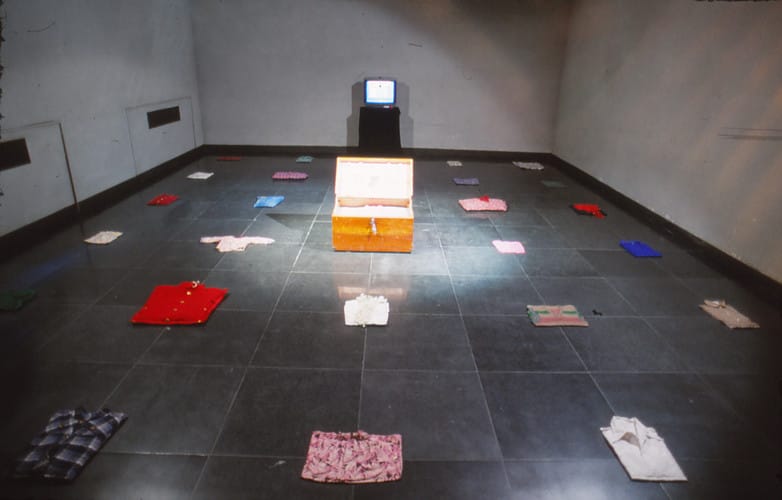
Detail of YIN XIUZHEN’s Dress Box, 1995. M+ Sigg Collection. Copyright the artist. Courtesy M+ Museum, Hong Kong (left); Installation view of YIN XIUZHEN’s Dress Box, 1995, at Beijing Contemporary Art Museum, 1995. Courtesy Asian Art Archive, Hong Kong (right).
Dress Box (1995)
Dress Box (1995) is an early work incorporating three elements that would recur throughout Yin’s practice: clothes, suitcases, and cement. Clothing, in particular, has become central to her material language. Growing up in a working-class family during the Cultural Revolution and unable to pursue formal artistic training until college, Yin channeled her creative impulses into sewing and knitting. Over time, she came to regard clothing as a “second skin” that carries experiences and memories, and to value what she calls “the soul of the textiles” as a way of understanding the world. For Dress Box, first presented at the Beijing Contemporary Art Museum in 1995, Yin collected garments she had worn over the past 30 years, folded them into compact rectangles, stitched their edges shut, and packed them into an old suitcase made by her father, which she then sealed shut with cement. The performance-installation, completed through a double act of closure—sewing and sealing—becomes a symbolic entombment of her past, memorializing personal history while preserving the textures of lived experience. It also marks her decisive embrace of experimental practice, breaking away from the conventions of academic oil painting and studio-based practice.
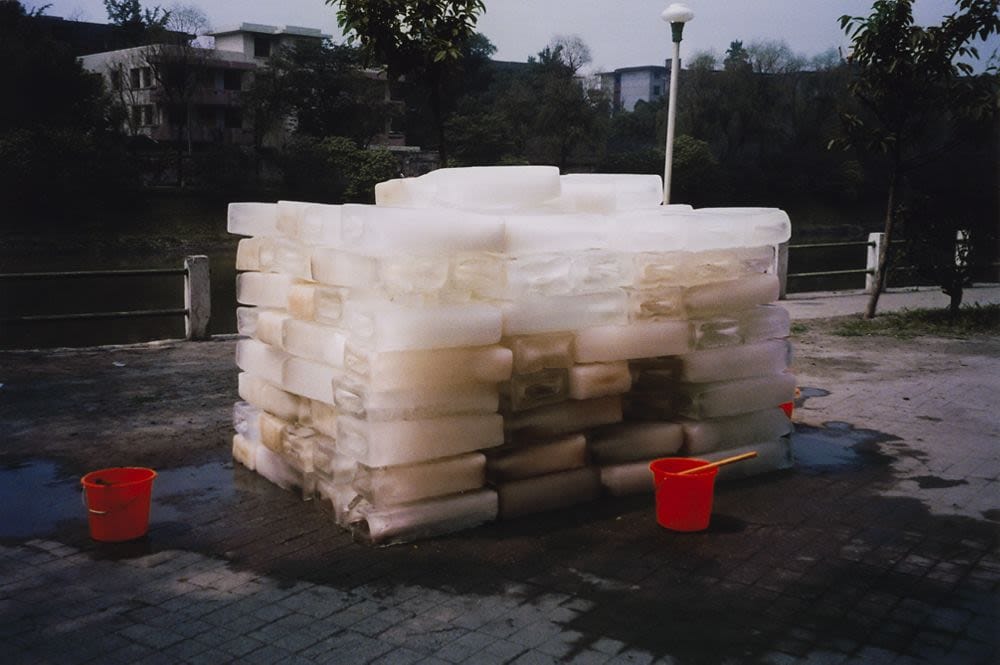
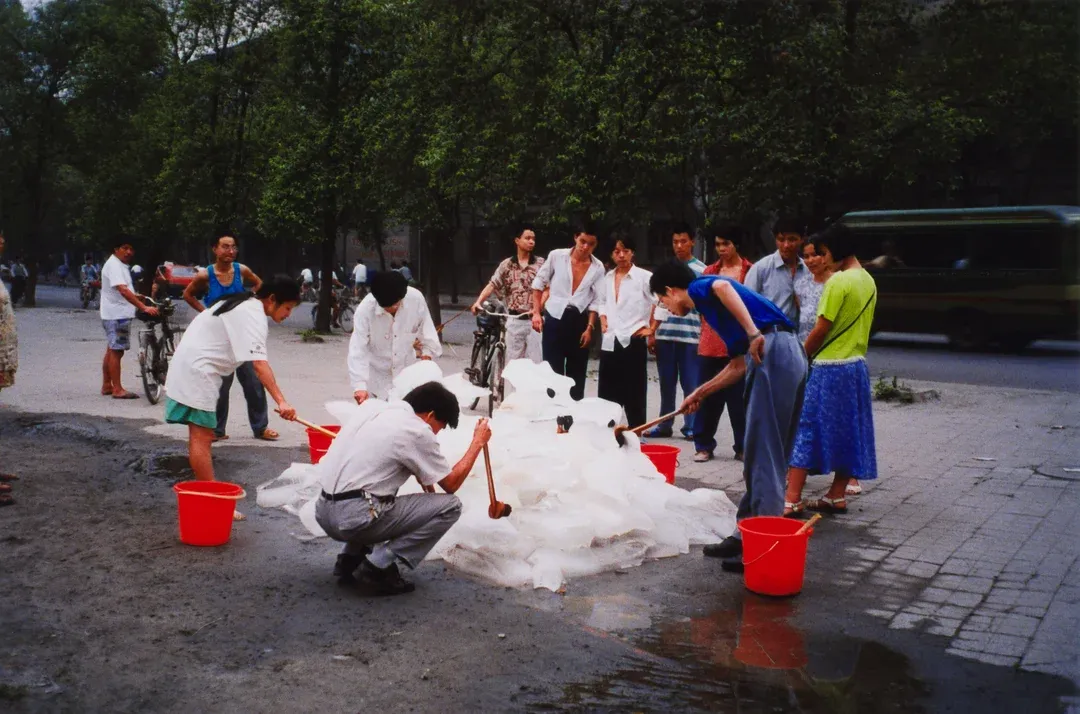
Photo documentations of YIN XIUZHEN’s Washing River, 1995, performance. M+ Sigg Collection. Copyright the artist. Courtesy M+ Museum, Hong Kong.
Washing River (1995)
Washing River (1995), a performance staged in Chengdu, is one of Yin’s earliest works of explicit social critique. The Chinese title hinges on a subtle linguistic ambiguity: is one washing something in the river, or attempting to wash the river itself? On the banks of Jin River (formerly Funan River)—once regarded as Chengdu’s “mother river,” yet carrying 80% of the city’s wastewater at the time—Yin stacked ice blocks frozen from its polluted water and invited passersby to wash them in the same murky current. The action is deliberately paradoxical and futile: an attempt at purification performed using the very agent of contamination. However carefully the ice is handled, its melting is inevitable. The tactile encounters foreground the limits of individual agency and the contradictions embedded in modernization.
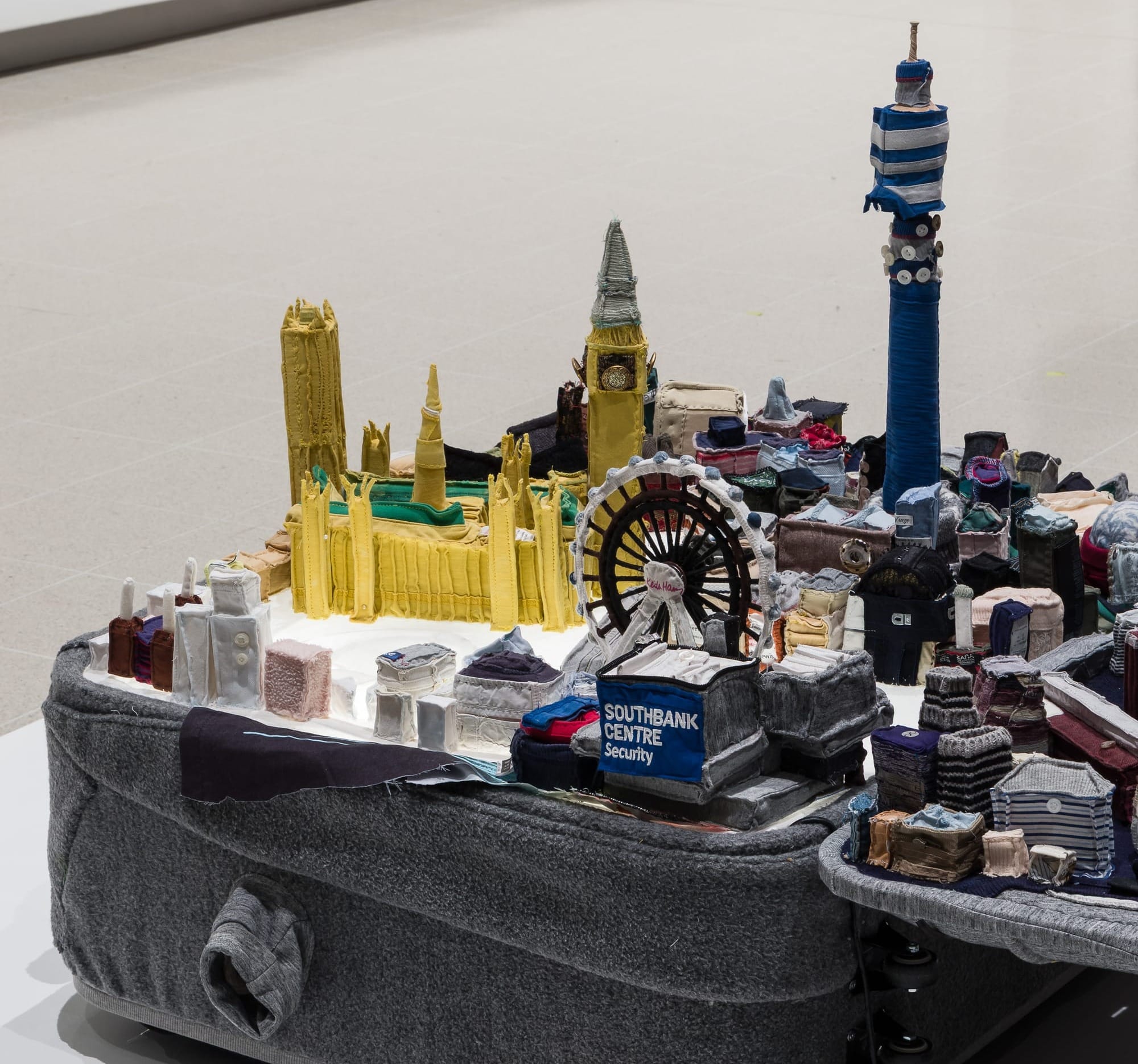
Portable Cities (2001– )
Each work in the series Portable Cities (2001– ) presents a miniature urban landscape constructed from secondhand clothing worn by local residents, along with assorted mass-produced items, all packed into a suitcase and often accompanied by city soundscapes. The suitcase functions both as a container of memory and a vehicle of displacement, staging the tension between mobility and rootedness. Yin began the project with Portable City: Beijing (2001), transforming citizens’ used clothing into soft sculptures that echo her hometown’s skyline. Compared with earlier works such as Ruined City (1996), which mourn the erasure of the capital’s old landscape and cultural memory, Portable Cities reflects a more ambivalent—if not in a way acquiescent—attitude toward the forces of globalization. To date, Yin has completed 46 iterations of the series, spanning cities in China and around the world, with the latest, Portable City: London (2025), commissioned for the Hayward Gallery retrospective.
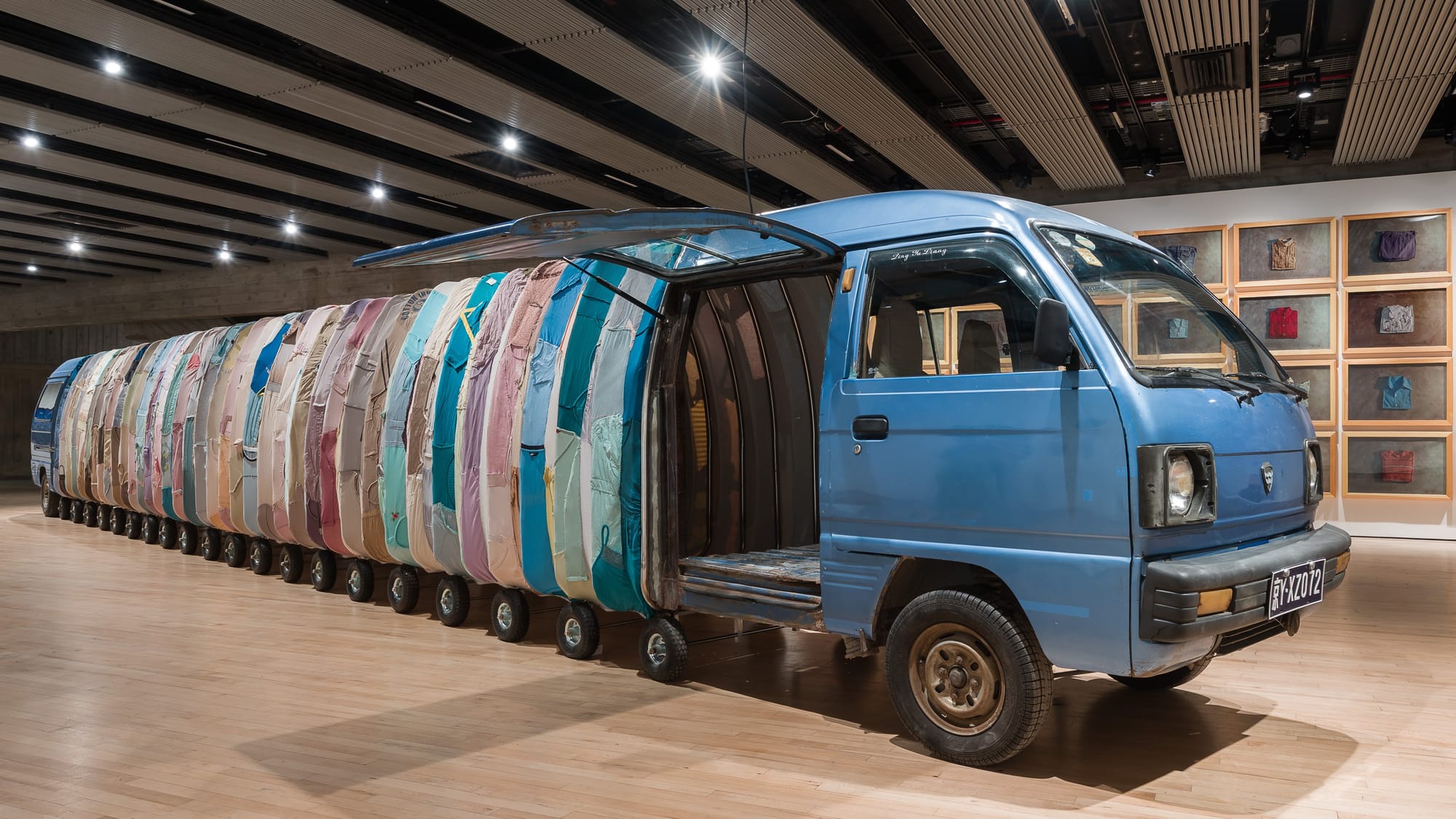
Collective Subconscious (2007)
Yin is adept at selecting emblems rife with social meaning. For her, public transportation condenses key motifs: progress and memory, potential and pressure, collectivity and individuality. First unveiled in 2007 in Beijing and later shown internationally, Collective Subconscious reimagines the xiao mian, a once-ubiquitous Chinese minibus nicknamed “a small loaf of bread” for its shape. Yin sourced a retired vehicle, sliced it into sections, and reassembled it using discarded clothing from ordinary citizens, the fabric acting as flexible seams that join and elongate the form. The resulting 15-meter-long xiao mian stretches through the gallery like a portal to a shared past; accompanied by a soundtrack of nostalgic pop songs, it transports viewers not to a literal ’90s Beijing, but to a shared interior landscape of memory.
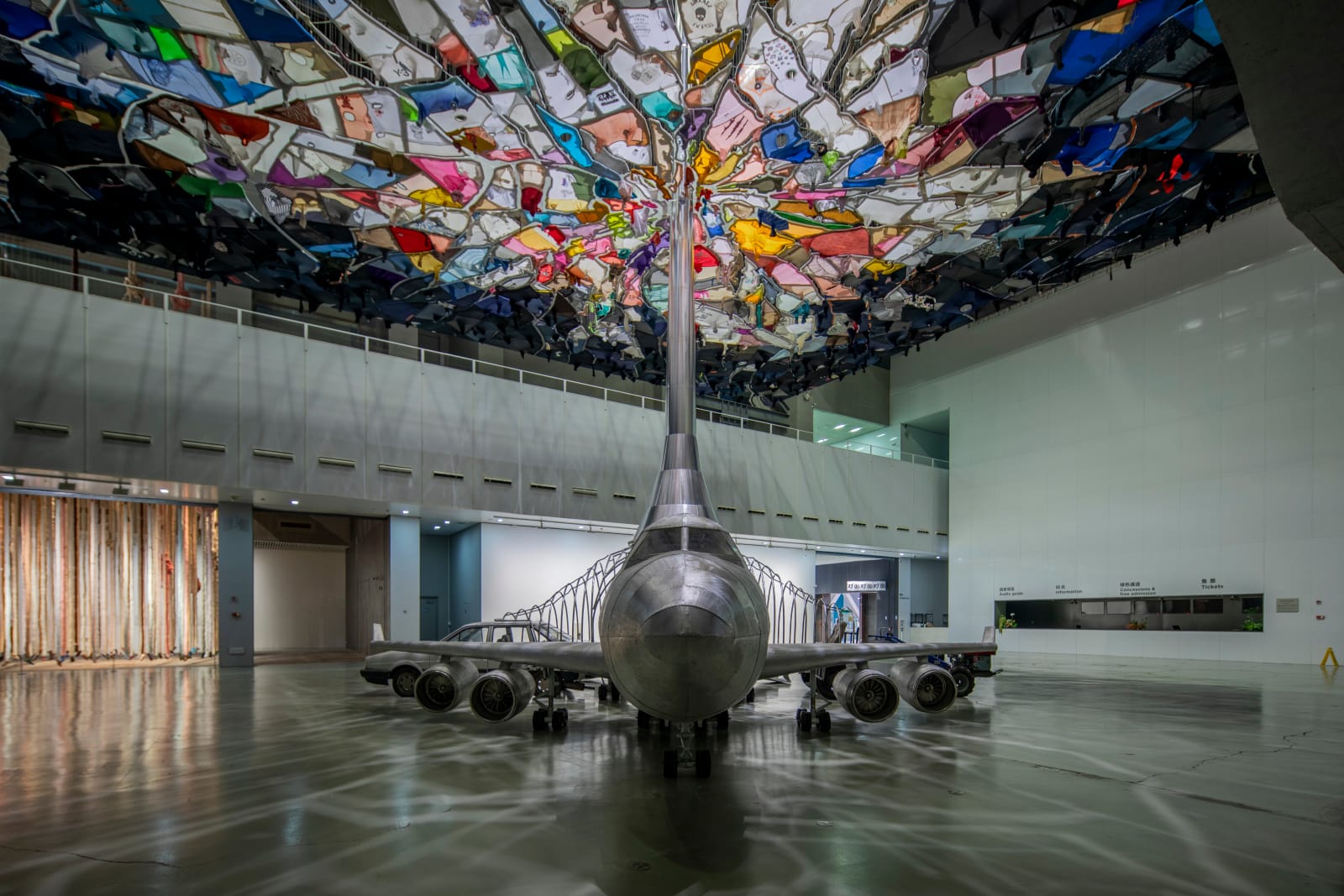
Piercing the Sky (2008–24)
In her 2024 solo exhibition at Shanghai’s Power Station of Art, Yin presented one of her most ambitious installations. Composed of three works—Sky Patch (2024), Piercing the Sky (2024), and Flying Machine (2008)—the ensemble reflects on modernity’s aspiration to conquer the sky through the ancient tale of the goddess Nüwa mending the heavens. Reconfiguring Flying Machine, originally assembled from an agricultural walking tractor, a Shanghai Santana sedan, and a simulated Boeing 747 passenger aircraft that evoke China’s state power and shifting demographics, Yin replaced the tent-like white canopy with a 15-meter-high metal spike. The structure recalls a rocket, gesturing toward an expansive, upward trajectory into the universe. Yet its thrust is directed toward something precarious: a “sky” patched together from more than 1,000 pieces of donated clothing. If the machine stages propulsion, the mosaic registers accumulation of the trivial: bodies, histories, and lived time. What is pierced is not an abstract firmament but a fragile surface of collective experience—one that resists transcendence even as it is subjected, again and again, to the violence of ascent.
Yuqian Fan is an editorial assistant at ArtAsiaPacific.