Issue
Words, Languages, Voices: Theresa Hak Kyung Cha
It’s almost inconceivable in the 2020s for any Asian American, or anyone studying or working in the fields of literature, gender studies, and contemporary art in the US, to not have encountered the name of multidisciplinary artist and poet Theresa Hak Kyung Cha (1951–1982). In the last five years, her works have been on constant rotation in group exhibitions around the world, including at M+ and Para Site in Hong Kong, and at the 2022 Whitney Biennial in New York; the latter included a live marathon reading of her book Dictee (1982), published mere days before her death and now in its fifth printing. Yet somehow, even with the frequent and international presentation of her work, her status as a creative remains somewhat cultish, unlike Francesca Woodman (1958–81) and Ana Mendieta (1948–85), who were of similar age, living in New York around the same time and making similarly transcendent art—until their lives, too, were tragically cut short.
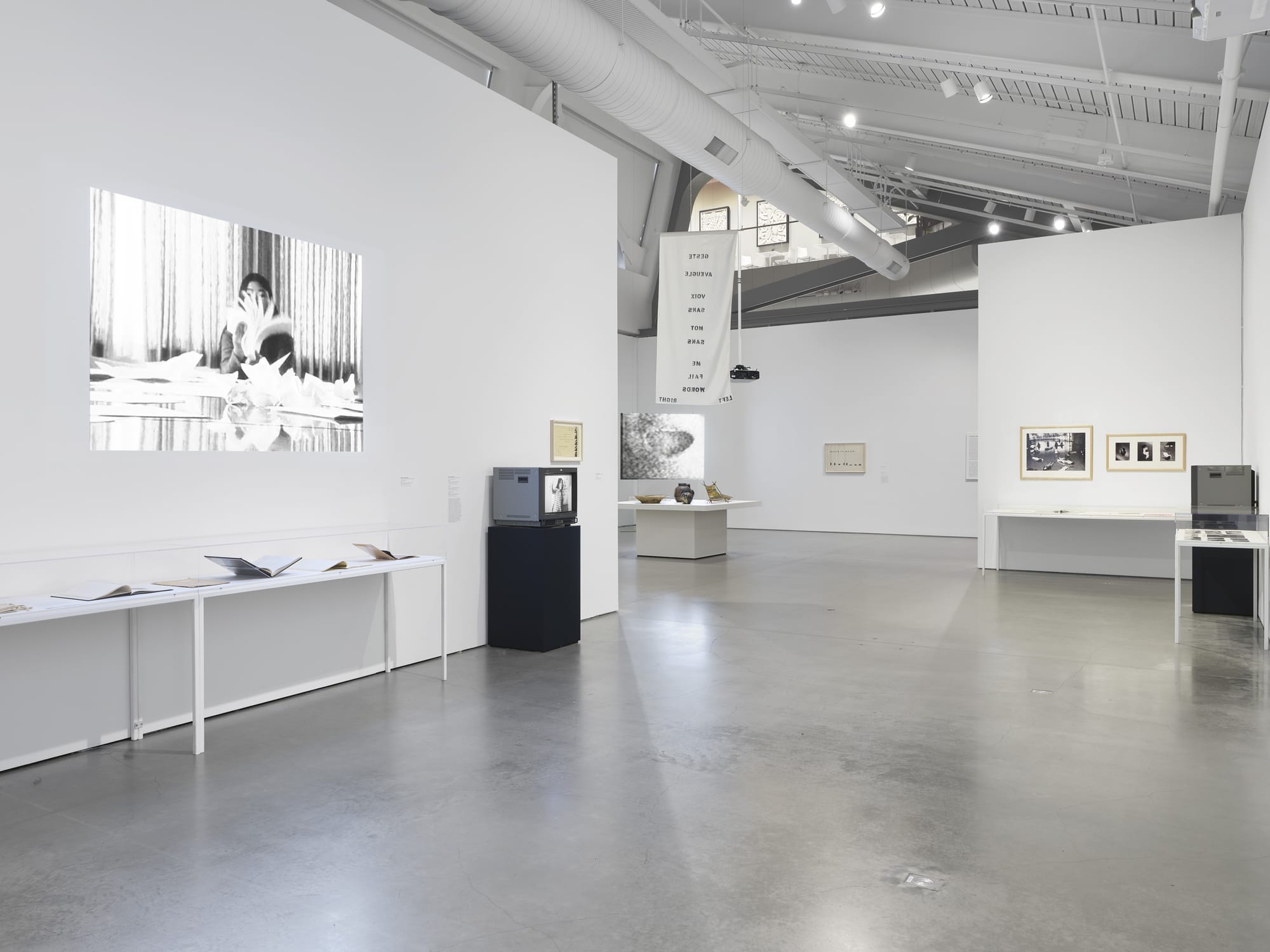
This spring, the Berkeley Art Museum and Pacific Film Archive (BAMPFA) mounted “Multiple Offerings,” a new survey of Cha’s works and legacy—its first retrospective for the artist since “The Dream of the Audience” toured three continents over four years a quarter century ago. This new exhibition brought together more than 100 of Cha’s artworks and archival materials, including videos, documentation of performances, mail and book art, as well as notebooks, artist statements and instructions, and ephemera. The curators also paired these with the works of her mentors and peers at the University of California, Berkeley (UC Berkeley), and those made by different generations of artists inspired by her practice, including Renée Green, Na Mira, Cecilia Vicuña, and Cici Wu, among others. “Multiple Offerings” will travel to Artists Space in New York in late 2026, symbolically retracing Cha’s journey relocating from the Bay Area to New York. It feels appropriate; at the time of her death, Cha was working on a group exhibition at Artists Space that opened a month after her passing.
Not quite a Renaissance woman, Cha has always been difficult to pin down in a category. “Multiple Offerings” acknowledged this by taking its title from Cha’s 1978 artist statement, “Multiple Telling with Multiple Offering,” and adopting the same open-ended, non-hierarchical logic. Walking through BAMPFA’s ambitious presentation, I couldn’t help feeling like I was inside a Cubist portrait that wants to show different sides of a figure simultaneously, even though any categorization would reduce her to the five blind men trying to describe an elephant to each other in the ancient Chinese parable.
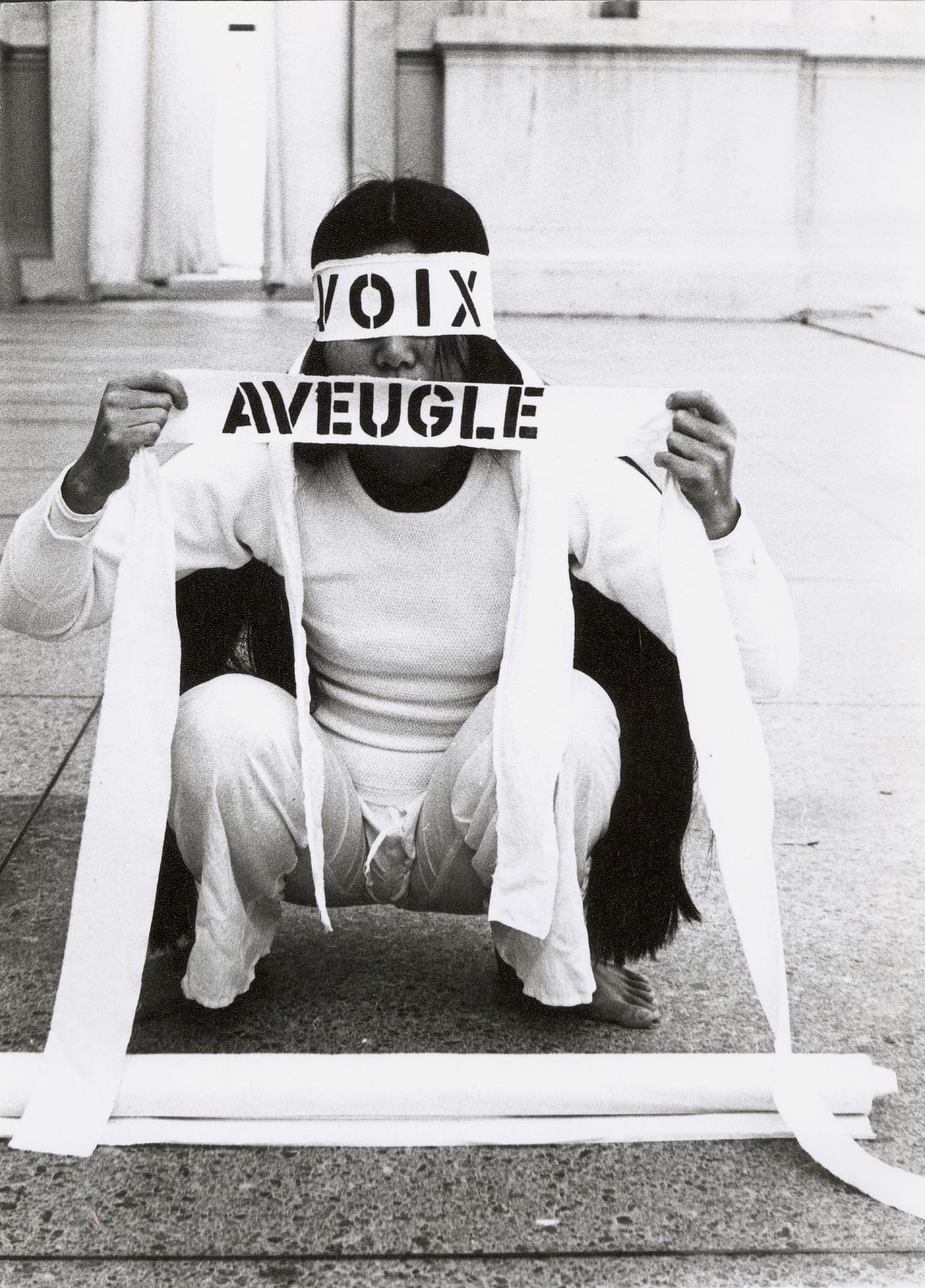
I overheard someone explaining Cha as a performance artist to a fellow visitor—perhaps because they were looking at photo documentation and props from an early performance she did while a student at UC Berkeley. In a series of black-and-white photographs, Cha performs Aveugle Voix (1975), her long black hair, like a waterfall, draping over her white clothes as she squats and presses strips of white fabric—hand-stenciled with the French words aveugle (“blind”) and voix (“voice”) in black ink—over her eyes and mouth, as if staging a protest or carrying out a shamanistic ritual. White is the color of mourning in Confucian society, and in the early 20th century it became a symbol of political resistance, not just for the suffragettes in Europe but also for Koreans under Japanese occupation (1910–45).
Cha’s family history is reflected in her work at almost every turn. Aveugle Voix is only one such example. Her use of family photos in Chronology (1977); her collaborations with her younger sister Bernadette in the video Permutations (1976) and with her younger brother James on the unfinished film White Dust from Mongolia (1980), made when they returned to Korea for the first time after immigrating to America; stories in Dictée; and her Korean text-based works, which often begin with 아버님 (abeonim, “father”) and 어마님 (oemanim, “mother”), together paint a portrait of a tight-knit family that endured and survived. Cha’s parents’ families fled from the Japanese-occupied Korean peninsula, only to end up in the Japanese-controlled puppet state Manchukuo in China. The third of five children, Cha was born in Busan after her family left Seoul to be further from the crosshairs of the Korean War. Eventually they immigrated to the US in 1962, first to Hawaiʻi and finally to the Bay Area in 1964. The blindness and voicelessness she referenced are not just a sense of displacement, but the lived experience of an immigrant family whose sense of self was hindered by language and cultural barriers, where both the present and the future were uncertain and precarious.
This struggle for belonging permeates Cha’s work, which plays with the ambiguity within language—what is held in common and in contrast, the past refracted in the present. Her early work Mouth to Mouth (1975) probably best captures this foreignness of language. In the grainy black-and-white video, Cha mouths eight Korean vowels while the camera is trained on her mouth alone; the footage looks like an ultrasound of an opening and closing valve. In “Multiple Offerings,” this video was shown side by side with a work on paper by the same title, “spelling” out each pronunciation in Hangul, their similar forms turning clockwise like a volume dial on an old TV set.
ㅏㅑㅜㅓㅕㅡㅗㅛ
(a, ya, u, eo, yeo, eu, o, yo)