Issue
Up Close: Yu Nishimura
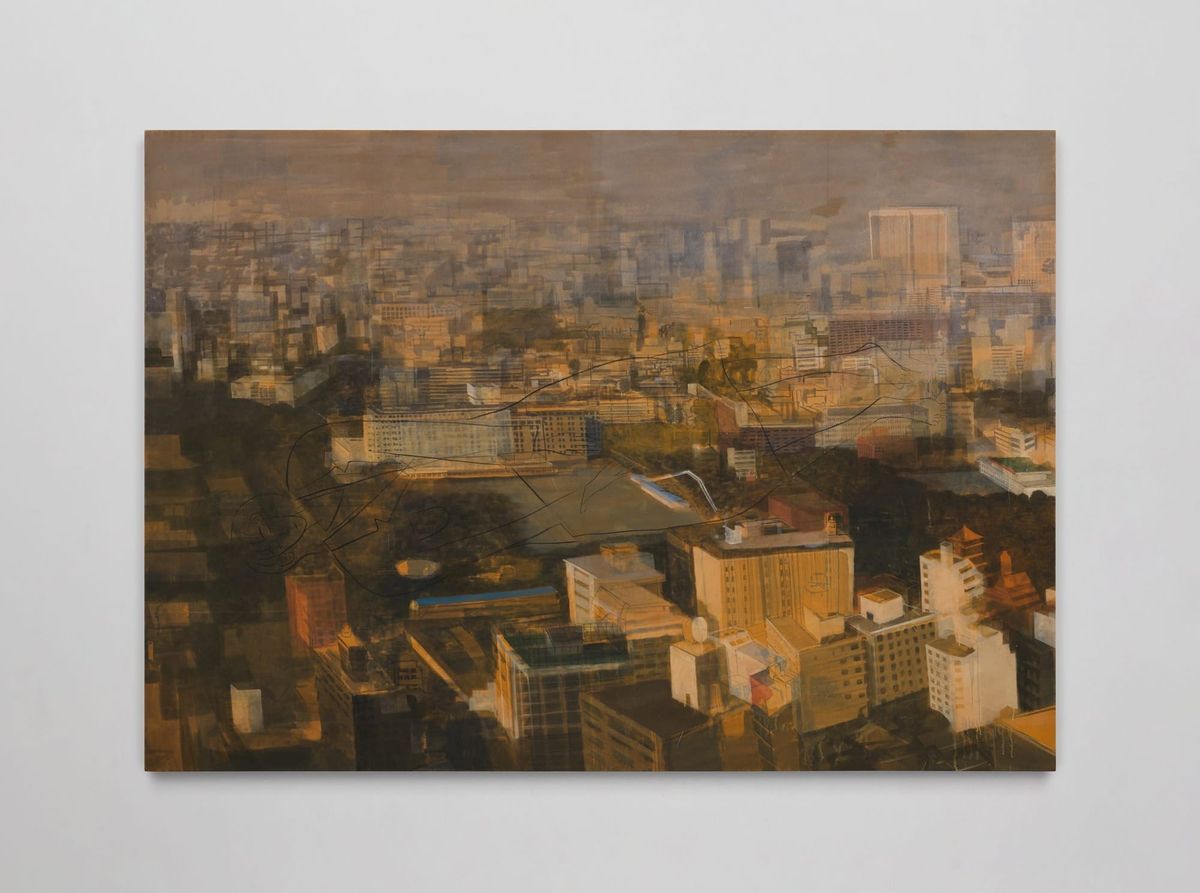
Yu Nishimura’s Hours (2026) holds time itself—not its passage, not its rhythms or intervals, but its elusive, mercurial presence. From the vantage of a low hilltop, a city stretches across the vast canvas, unplaceable yet familiar, unfurling languidly toward a diaphanous skyline. The light could be dawn or dusk; it bathes a cluster of buildings in the foreground in a honeyed glow. Directly beyond, at the center of the tableau, an empty football pitch carves a clearing of silence through the thicket of trees and buildings; further out, the cityscape resumes, drifting from mere anonymity to total abstraction, architecture and foliage bleeding into one another and receding into a vista of bruised violets and mauves. The eye is drawn repeatedly to this blurred, beautiful, formless horizon; one thinks of Cézanne’s Mont Sainte-Victoire (1886–87), also set high in the frame and luminescent in twilight tones.