Issue
Stanford: “Miljohn Ruperto: Animal, Vegetable, nor Mineral”
Miljohn Ruperto
Animal, Vegetable, nor Mineral
Cantor Arts Center, Stanford
Mar 12–Sep 14, 2026
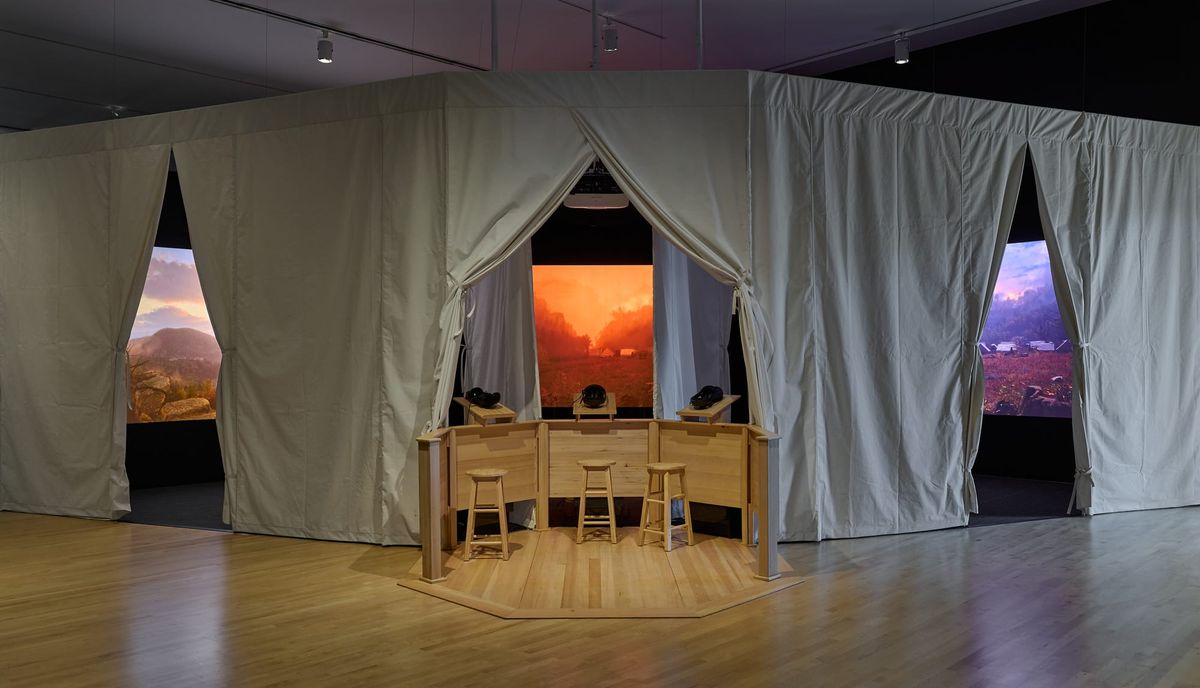
In Miljohn Ruperto’s Mineral Monsters (2014), animated minerals shimmer and shift as you move your head—caught in a perpetual vibration produced by parallax, the optical effect that makes an object appear to jump between your eyes. Look with one eye, and the segment settles. Look with both, and it lives in motion. “There are no mineral monsters,” according to philosopher Georges Canguilhem, who argued that monstrousness is constructed through our own definitions of normality and our tendency to anthropomorphize and project intentions of threat onto nonhuman matter, simply through the act of looking. Ruperto contends that our perception of the world derives from the preconceptions we write onto it.
On a large monitor, a digital simulation titled Fathoms (Tartarapelagic) (2025–26) unfolds. Luminous creatures morph in real time, grotesque and unnerving, their forms never stilling—these oceanic beings were imagined by generative AI, drawn from discoveries in the Clarion-Clipperton Zone, a submarine region in the Pacific Ocean, whose abundant mineral deposits have made it a target for commercial deep-sea mining. The computational system spawning these abominable specimens runs on the resources (nickel, cobalt, copper) harvested from the very same zone, where the original species reside. Ruperto creates monstrosities that materialize from their own extraction.