Issue
New Currents: Soe Yu Nwe
In an elegant Venetian salon, a monstrous green mass unfurls: its center splits wide open, revealing a flesh-colored, vulviform passage framed by vine-like tentacles that appear to twist, ripple, and contort. On view at “The Spirits of Maritime Crossing 2026” during this year’s Venice Biennale, Snake Woman, Shigaraki (2024) is something between plant and animal, but also unmistakably human—an organism in constant mutation, never fully settling into any one element. This unruly condition of hybridity defines Soe Yu Nwe’s practice.
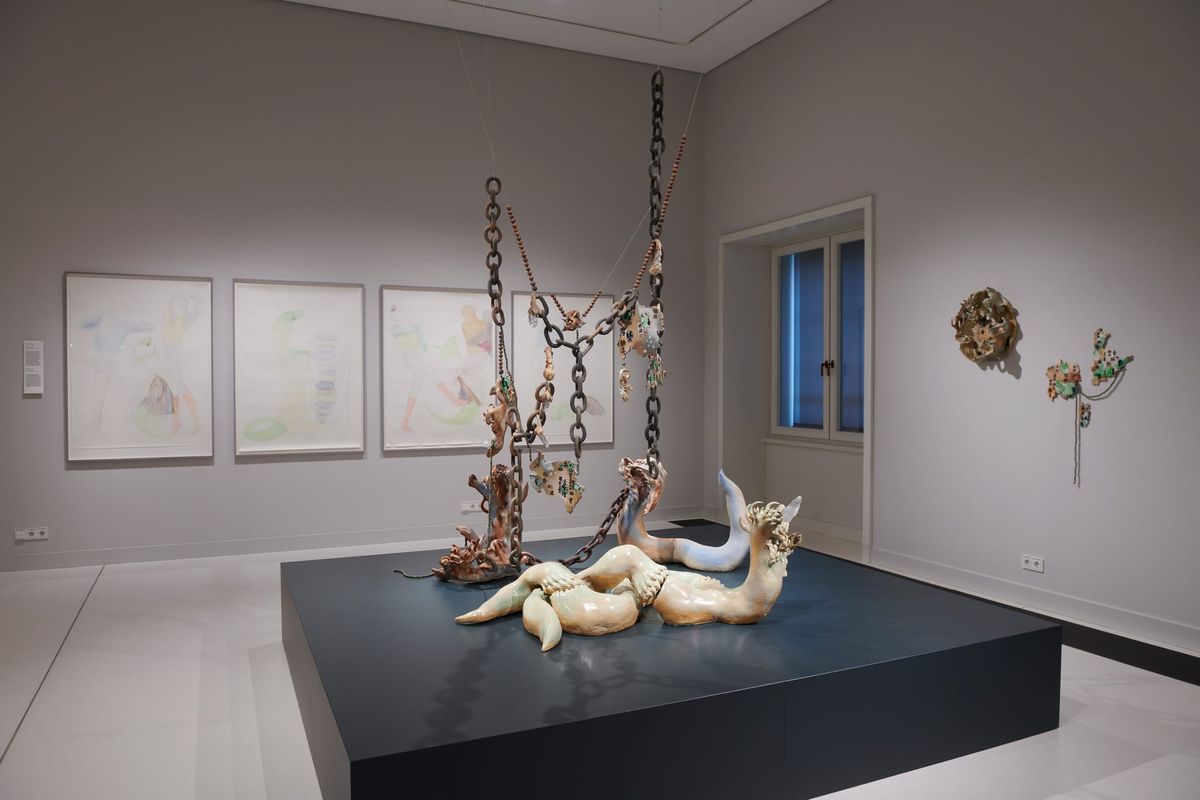
A third-generation Chinese immigrant raised in Myanmar, the artist creates ceramic sculptures inspired by her diasporic heritage, as well as the flora, fauna, and female deities from Buddhist mythology. Her glazed stonewares, often abject yet strangely sensual, operate in a simultaneous state of rupture and latency, bondage and release: in one piece, the head of a placidly smiling goddess bursts through a serpent’s body; elsewhere, a figure—half woman, half tree—lies in a birthing position, her womb shattered while her right leg is bound by a fired clay chain. The latter motif recurs throughout Nwe’s oeuvre, alluding broadly to the patriarchal shackles of Burmese religious conservatism, and, in a more culturally specific sense, to Myanmar’s erstwhile military dictator Than Shwe, who was said to be haunted by the legendary naga queen in his dreams and ordered her statue to be handcuffed nightly.