Issue
Editor’s Letter: When Categories Collapse
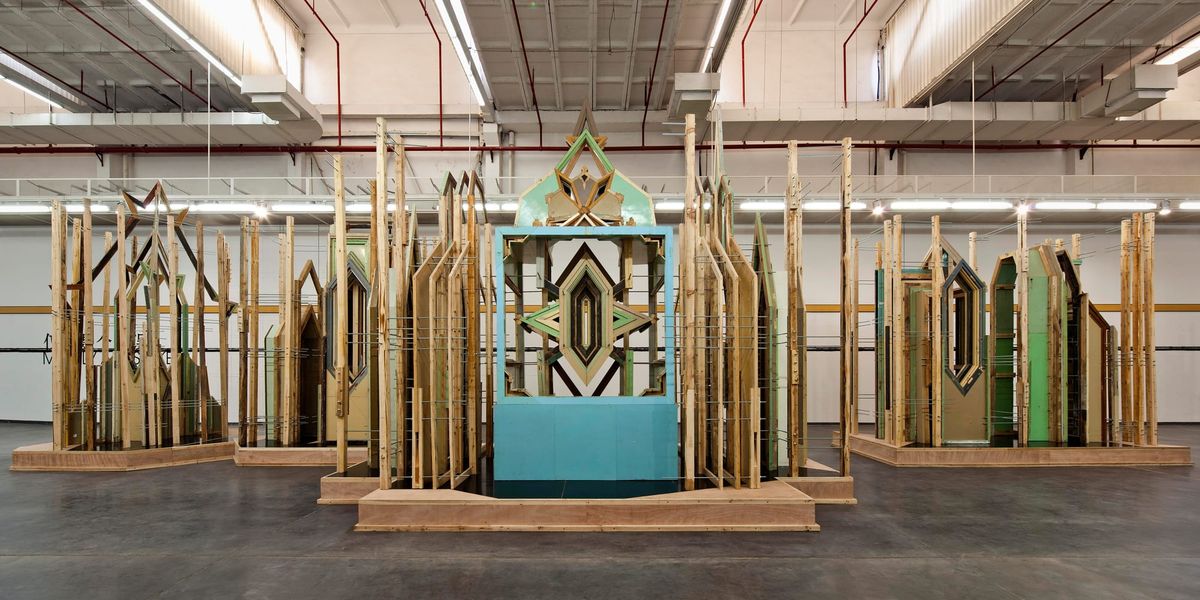
Art, like history and the body, has ceased to remain within fixed boundaries. Borders strain to contain these unruly forms, but fail. ArtAsiaPacific’s September/October issue looks at artists working in that unsettled space, where categories begin to dissolve: the city becomes material, the self a sculpture, language a weapon, memory an architecture.
We begin with the wide-ranging practice of Liu Wei, whose work is featured on our cover. Born in Beijing in 1972, Liu came of age amid the turbulence of China’s Reform and Opening-up policy, which ushered post-Cultural Revolution urbanization across the country. For decades, he has transformed the debris of modernity into something at once satirical and searching: dog-chew cityscapes, stone-like minimalist structures created from books, monumental assemblages of dissected electronics and discarded appliances. AAP managing editor Michele Chan visited Liu in his vast studio complex in Beijing, where he moves effortlessly among videos, photography, paintings, sculptures, and installations. There, she considers what the public might expect from his prestigious Genesis Façade Commission on The Met’s Fifth Avenue exterior this September.
Our second Feature highlights Haneyl Choi, who approaches the body and its social scripts with a different kind of irreverence. His enigmatic, spare sculptures, which combine 3D-printed figures with industrial materials, explore queer identity through a Korean cultural lens. Ahead of the artist’s major institutional exhibition at the Art Sonje Center in Seoul, which opens in October, guest contributor Cusson Cheng revisits his early shows from 2018 to 2022, tracing the turning point that reshaped both Choi’s life and practice.
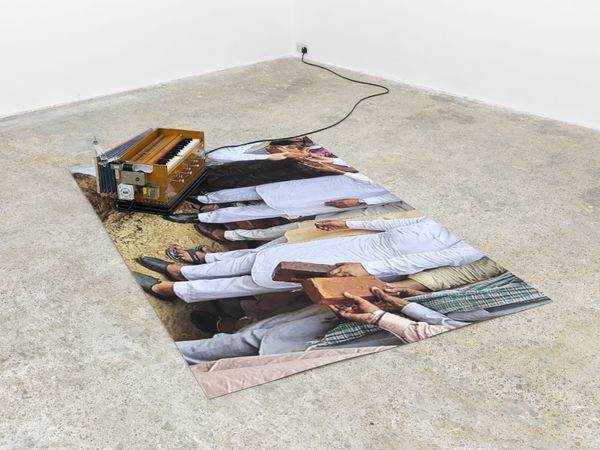
In Up Close, we spotlight three artists—Lawrence Abu Hamdan, Lap-See Lam, and Yu Nishimura—whose latest projects examine the thresholds of perception. For Inside Burger Collection, art historian Annie Ochmanek sits down with art patron Monique Burger and curator Olivia Shao to talk about the latter’s exhibition, “Form, Shadow, Motion: Selections from the Burger Collection,” which opens at New York’s The Drawing Center in October before traveling to the Asia Society Hong Kong Center next year.
In the Essays section, Kelly Ma reflects on the complicated legacy of the multidisciplinary artist and poet Theresa Hak Kyung Cha, who tragically died at the age of 31 in 1982, shortly after the publication of her acclaimed Dictee. Across films, performances, artist books, and writing, she resisted linear narratives while returning to questions of exile, matrilineal memory, and the difficulty of speaking across cultures. Ma delves into this body of work, probing how it made Cha both an essential and still-contested figure for writers, artists, and scholars of diaspora, gender studies, and literature.
In Profiles, AAP associate editor Louis Lu speaks with Singaporean artist-filmmaker Ho Tzu Nyen, whose practice draws on the myths, histories, and spectral politics of Southeast Asia. They discuss his vision as artistic director of the 16th Gwangju Biennale, which unfurls in a city whose history of democratic struggles continues to resonate. In Australia, Sydney desk editor Johanna Bear met with Sumakshi Singh as she set up her new thread installation, Threshold (2026), at the Art Gallery of New South Wales, to understand how the Indian artist transmutes personal grief into delicate, luminous architecture.
Elsewhere in the issue, our reviews span Seoul to Stanford. Curator, writer, and educator Eungie Joo offers a long-form assessment on the 59th Carnegie International. In Where I Work, AAP visited Ai Weiwei in his Berlin studio, where prototypes for his recent commission in Ukraine sat alongside his immense collection of buttons, which appeared as new pieces in “Button Up!” at Factory International in Manchester. In Dispatch, British Palestinian writer Selma Dabbagh finds contemporary Arab London in a moment of renewal. For The Point, Umer Butt of Dubai’s Grey Noise describes gallery ownership as the opposite of its imagined glamor: “precarious, emotionally demanding, and profoundly vulnerable.” Finally, for One on One, Indonesian artist Citra Sasmita speaks of her admiration for her teacher, Mangku Muriati—a maestra of Kamasan wayang painting—and how Balinese spiritual traditions have influenced her artistic ethos. Across these pages, art refuses to inhabit a single time, place, or form, remaining porous to what has been, what is, and what might yet emerge.
Elaine W. Ng is editor and publisher of ArtAsiaPacific.