Issue
150 Dispatch: London
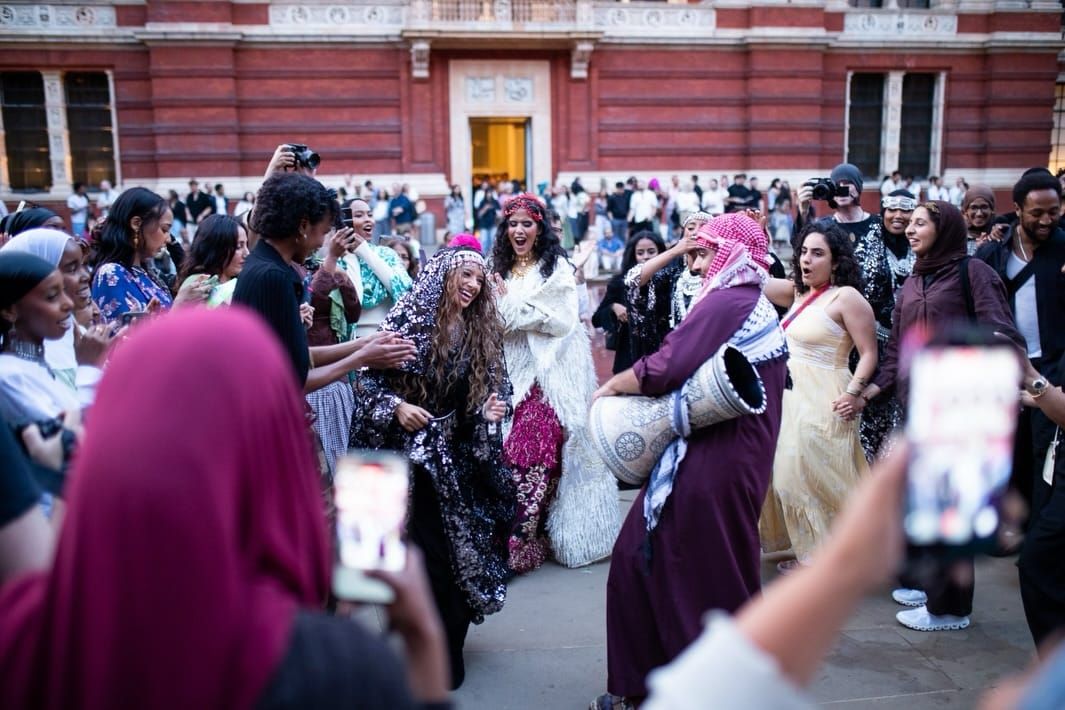
In the noughties, if you were interested in (or from) the Arab world, there wasn’t much going on in London if you weren’t religious. Aside from mosques, Quranic schools, and bookshops, there were few places to go. If not exorbitant, restaurants had strip lighting, plastic flowers, and huge portions. Political events were held in uncomfortable, unheated rooms with few refreshments, and much speechifying.
Leighton House in Kensington has been showcasing the Arabesque through an Orientalist lens since 1929, though it was a static museum space before its renovation and postcolonial gestures. Saqi Books, an independent publisher founded in 1983, had a distinctive double-fronted bookshop in Westbourne Grove next to Kufa Gallery that was a solitary haven between worlds. I would browse for hours just to hear Arabic spoken around me. I longed for secular spaces that mediated between Arab and European cultures—intertwined for centuries but presented as antithetical to each other since Dante and the Crusades.
In 2026, the scene could not be more different. Contemporary Arab London is not only thriving, but it is cool. I stress here the adventurous, autonomous associations of the word “cool.” It has politics at its heart, at a time when “Arab,” “Muslim,” and “Palestine” are all terms that can trigger policing, censorship, and surveillance by the UK government. Even though crackdowns are less severe than in Germany, the chances of Palestine-related events being canceled have been high, particularly in the wake of October 7, 2023. This gives the art organizations that foreground Palestine a robustness, defiance, and purpose lacking in other establishments, whose stark double standards on Ukraine and Gaza have vitiated the cultural integrity that they claim to uphold.