People
Potatoes Grow on Trees: Hu Yinping Replants Meaning in Making
Over the past decade, Beijing-based artist Hu Yinping has run “Hu Xiaofang,” a semi-fictional company that operates through real contracts, real wages, and the crocheting labor of women in rural China. What began as a way to honor her mother’s working hours has grown into a loose-knit collective that produces woolen hats, household items, uniforms, and even weapons, while redistributing income and attention to those written out of official histories.
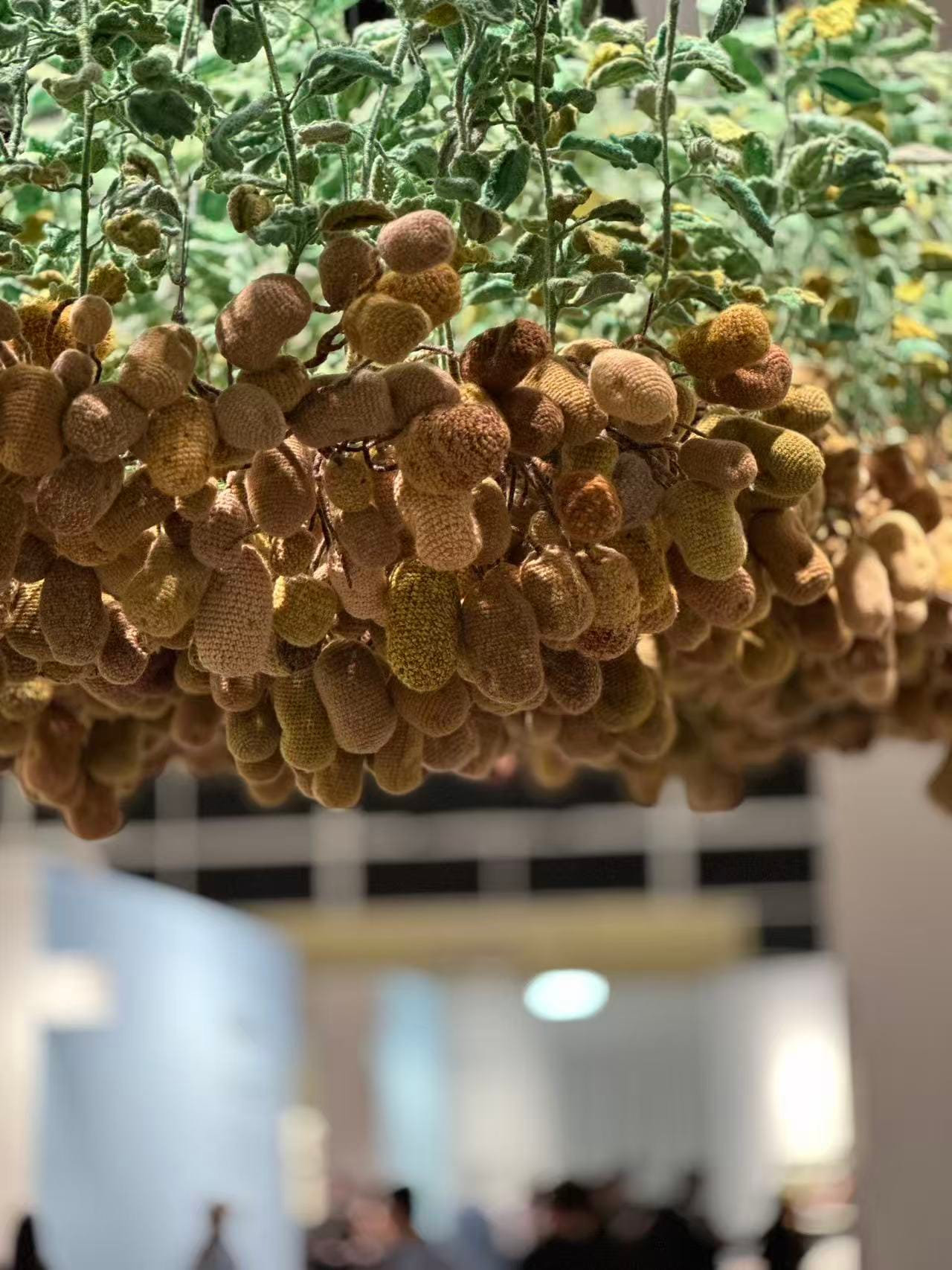
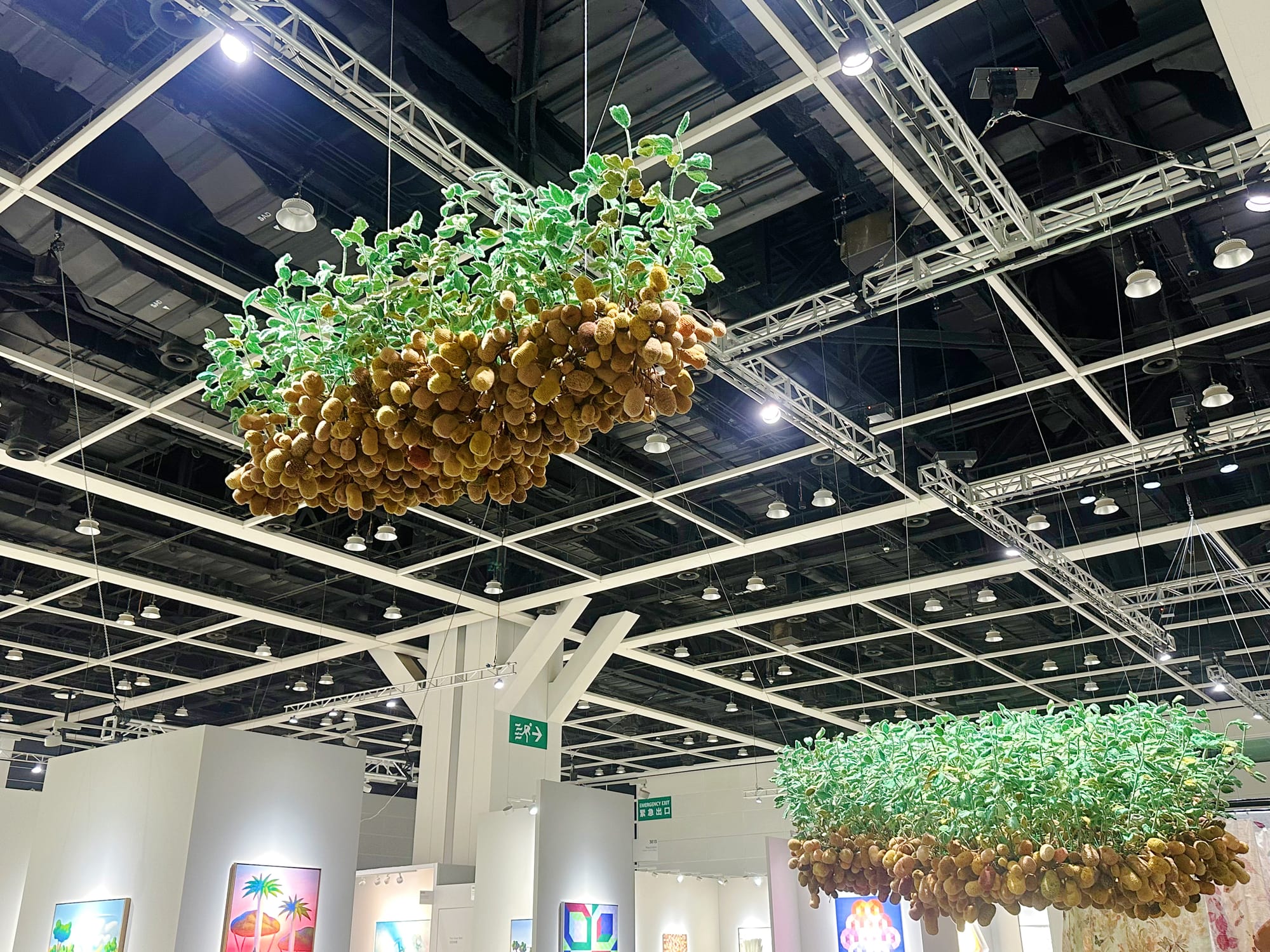
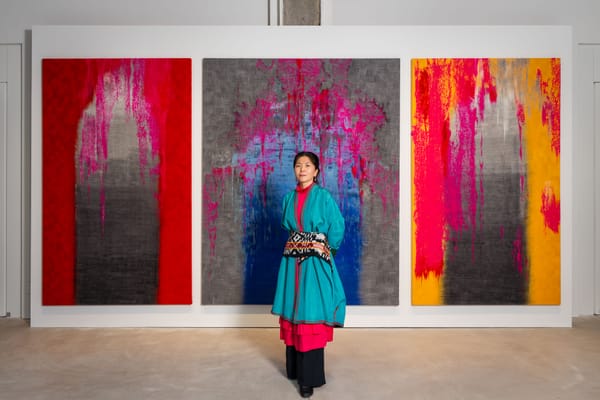
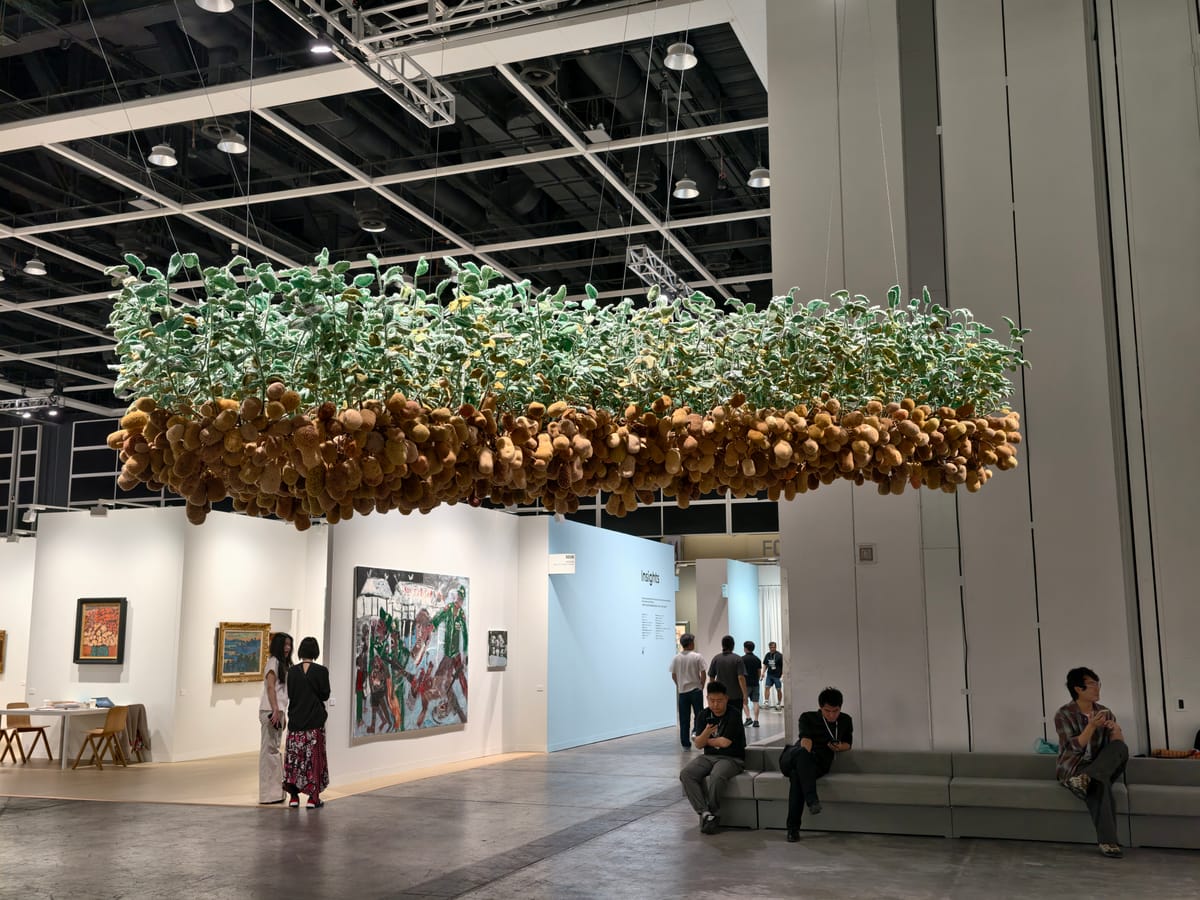
Installation views of HU YINPING’s Potatoes Grow on Trees, 2025, mohair, cotton thread, iron wire, dimensions variable, at Art Basel Hong Kong Encounters 2026. Courtesy the artist.
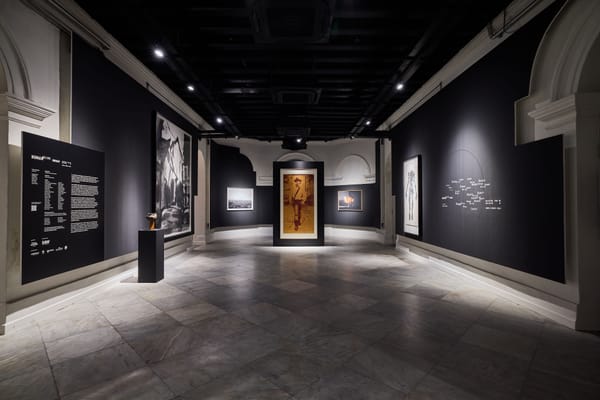
This March in Hong Kong, Hu presents CV (2024–) at Tai Kwun Contemporary, Soul Bottles (2025) at the Centre for Heritage, Arts and Textile (CHAT), and Potatoes Grow on Trees (2025) in Art Basel Hong Kong’s Encounters sector. Speaking with ArtAsiaPacific, she reflects on a practice that moves between village homes, museums, and now the highly financialized space of an art fair.
Let’s begin with the idea of the self—or, more precisely, of how one introduces oneself. In CV, currently on view at Tai Kwun, you invited members of the “Hu Xiaofang” collective—founded over a decade ago as an enterprise that channels economic support to women in rural China through textile work—to crochet their own curriculum vitae. Can you walk me through how you conceived of this work?
People like you and me may be very familiar with the idea of a curriculum vitae, but this is not the case for women in the Hu Xiaofang collective. Most jobs they have held throughout their lives have never required a résumé. Their work has always taken the form of invisible labor, and they themselves remained invisible too. I wanted not only to make them visible, but to invite them to make themselves visible.
The women in Hu Xiaofang are mostly older workers whose labor has been quietly discarded in China’s transition from the planned economy to the market‑oriented era. These are women squeezed on the one hand by family duties and dominant structures of production on the other. I invited them to use this “surplus” time in their lives to crochet their own “curriculum vitae”—to weave together a record of the work they have done, and the lives they have lived.
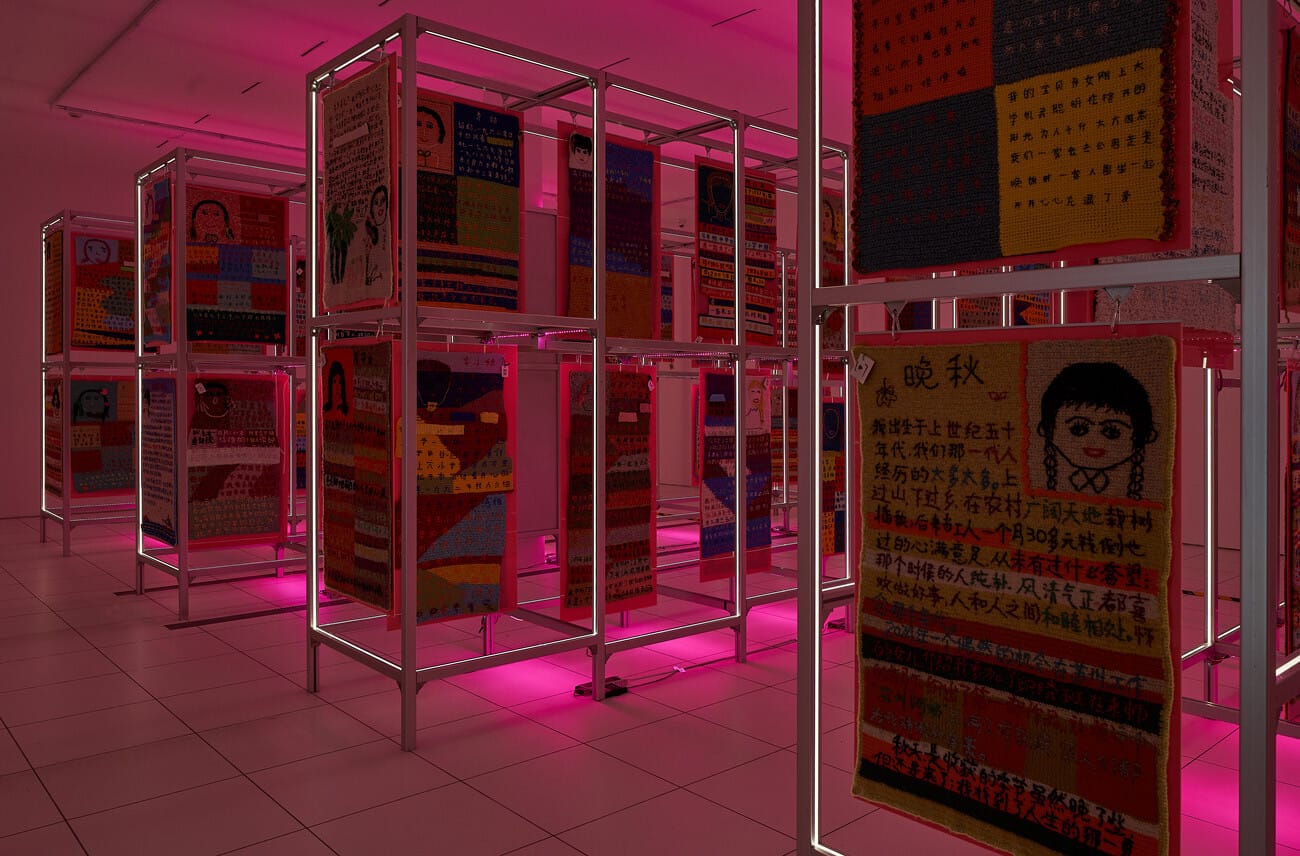
Installation view of HU YINPING’s CV, 2024– , wool yarn, cotton thread, long-thread mohair, dimensions variable, at “Hu Yinping: You Can Start Anytime” at UCCA Dune, 2025. Courtesy UCCA.
The work reads as a mural of portraits, a collective biography, an archive, or even a memorial. When you first invited the women to participate, what guidance or instructions did you give them?
The only instruction I gave them was to be truthful. I did not provide a template—they were free to decide what to include and how to crochet it. For those who do not read or write, others stepped in to help, and everyone threw themselves into the project. They had a strong desire to express themselves—or to introduce themselves.
There was one unexpected participant: the cleaning auntie who happened to be on duty in the workshop that day. After watching the other women so eagerly record their lives, she grew determined to take part and asked to join, eventually making a CV of her own.
The Hu Xiaofang collective has been active since 2015. More than a decade on, have aspects of the aunties’ lives—or your entanglement with them—emerged that you could not yet perceive in the project’s early years? Were there stories or moments that shifted how you understand kinship, shared authorship, or the meaning of making?
The kinship that formed goes beyond blood ties. At first I just wanted to document my mother’s life, but as more people joined, the power relations, emotional currents, and forms of identification within this community revealed themselves to be far more organic and complex than I ever could have imagined.
Stories are always unfolding, and a certain degree of tension is inevitable. At home, each woman is the CEO of her own family—they are used to calling the shots. “Collective creation” does not mean smoothing over reality in the name of harmony. There is productivity in difference, conflict, reconciliation, and non‑reconciliation. Each woman carries a great deal of wisdom—their knowledge is deeply embedded in their bodies and experiences.
Once, before an exhibition in Paris, a series of complications pushed me close to breaking point and I wanted to abandon the project altogether. But then, at a serendipitous moment, I saw the women—across different generations—crocheting, laughing, chatting, and singing together. There was so much joy and concentration in their labor, and in their being together. In that moment, I was reminded of why the work is worth carrying on.
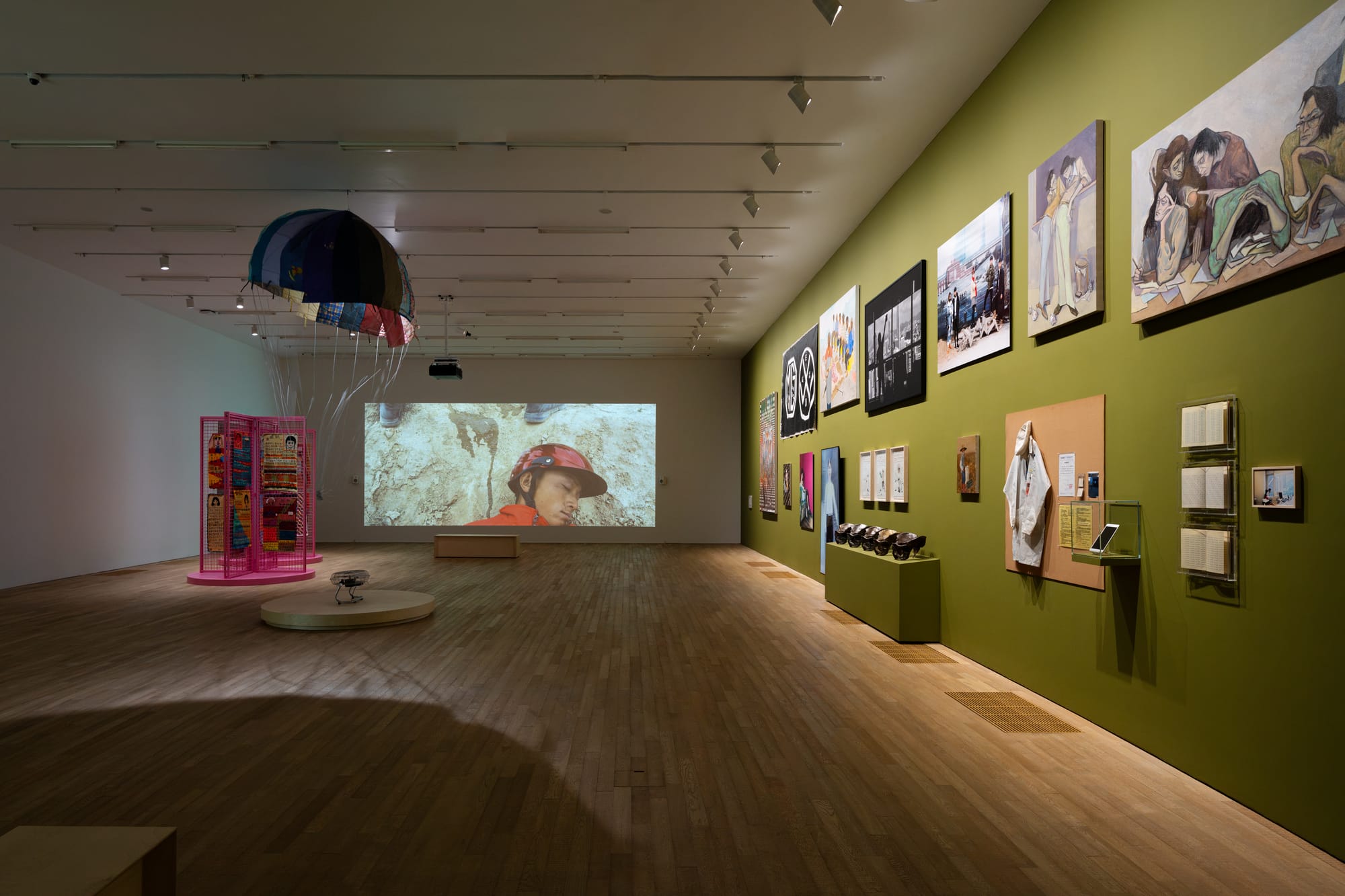
“Hu Xiaofang” has been described as a company, a cooperative, and a fictional persona that can shelter people, allowing them the liberty to act differently than they normally would. In the context of your presentations in Hong Kong this month, what kinds of encounters and conversations does this persona—or corporate structure—make possible?
Hong Kong has no countryside, and no “aunties” in the same sense as in rural China. The city does, however, have a long textile history, and perhaps this might resonate in its own way. More importantly, however, for the Hu Xiaofang collective, the core material is not yarn but the modern corporate system itself. Presenting the labor of women from a small town in Sichuan within Hong Kong’s post‑industrial context brings with it a particular set of expectations and frictions, opening space to rethink who counts as a worker, and what kinds of labor and lives are allowed to appear.
Walk me through your presentation at CHAT. The objects in Soul Bottles are extraordinarily intricate. How did you conceive and develop them with the Hu Xiaofang community?
This is a work about afterlives, and, in a sense, about utopia. I shared the myths and legends from different continents with the knitters and invited them to imagine and crochet their own versions of “paradise.” In that sense, I am handing them the power of future imagination and allowing energies to connect across time and space.
During the installation of Soul Bottles, my friends and I came up with an alternative title: Everyone Loves Heaven. It has a slightly melancholic tone—a dream of ideal world that exists elsewhere from the one we inhabit now.
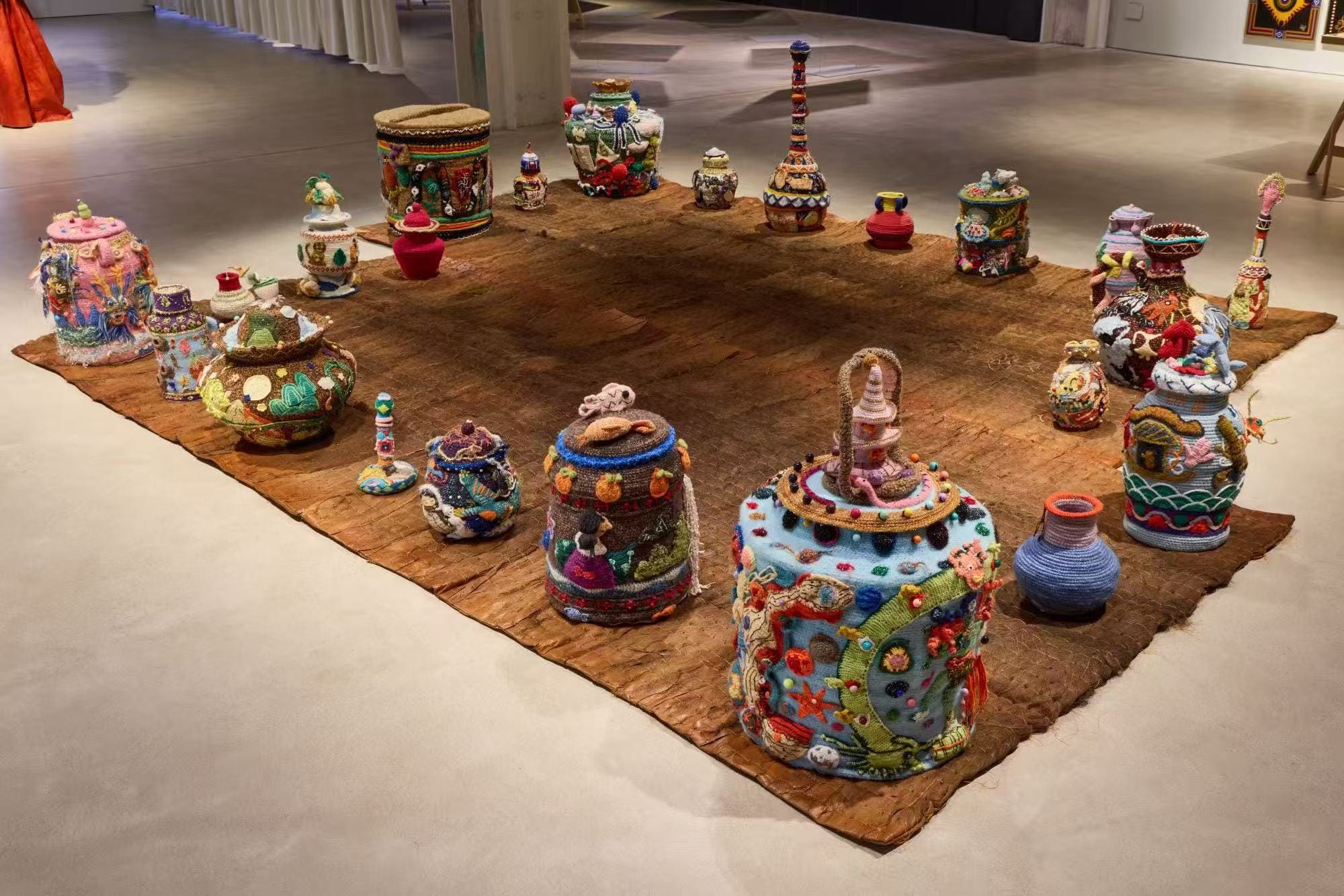
I ended up modifying the installation onsite. At first, I planned to place all the jars in the center, but once I began to think of each one as a container for a soul, the ethics of spacing became a core issue. I wanted to treat every soul equally by distributing floor space as evenly as possible. For me, installation does not begin with aesthetics but with concepts; the central area is conceived as an abstract space, and behind that abstraction lies imagination.
This month, your practice is placed in dialogue with histories of women’s labor and industrial production in Asia. Is there anything from Hong Kong’s textile history that you would like viewers to bear in mind when they encounter your work?
I have never situated my practice within a grand global history of textiles—what interests me is forms of hidden labor. When audiences in Hong Kong see the work, I hope they can sense just how much labor remains invisible in society. My own capacity is limited—within those limits, I can only bring a certain number of people into visibility through my work. Still, I hope it has some effect, and that art, as a medium, can extend empathy outward.
At Art Basel Hong Kong Encounters, Potatoes Grow on Trees is presented, for the first time, within the highly financialized space of an art fair. What feels most different to you—either in how the work behaves, or in how people approach it?
The Hu Xiaofang collective is something that grows. The real site of the work is not the white cube; each exhibition is just one slice of an ongoing practice that continues in the aunties’ homes, in different forms of social cooperation, and in the minds of viewers who stop to think and care. What appears in different venues is only its materialized form.
Installing Potatoes Grow on Trees in Art Basel Hong Kong feels like transplanting it into a different ecosystem, where it becomes a kind of “heterogeneous plant” rooted in the soil of capital. The main shift is from “display” to “intervention”: it is not a straightforward commodity waiting to be priced and sold, but perhaps a small “event.” People’s gaze, confusion, discussion, indifference, even disdain all become part of how the work produces meaning.
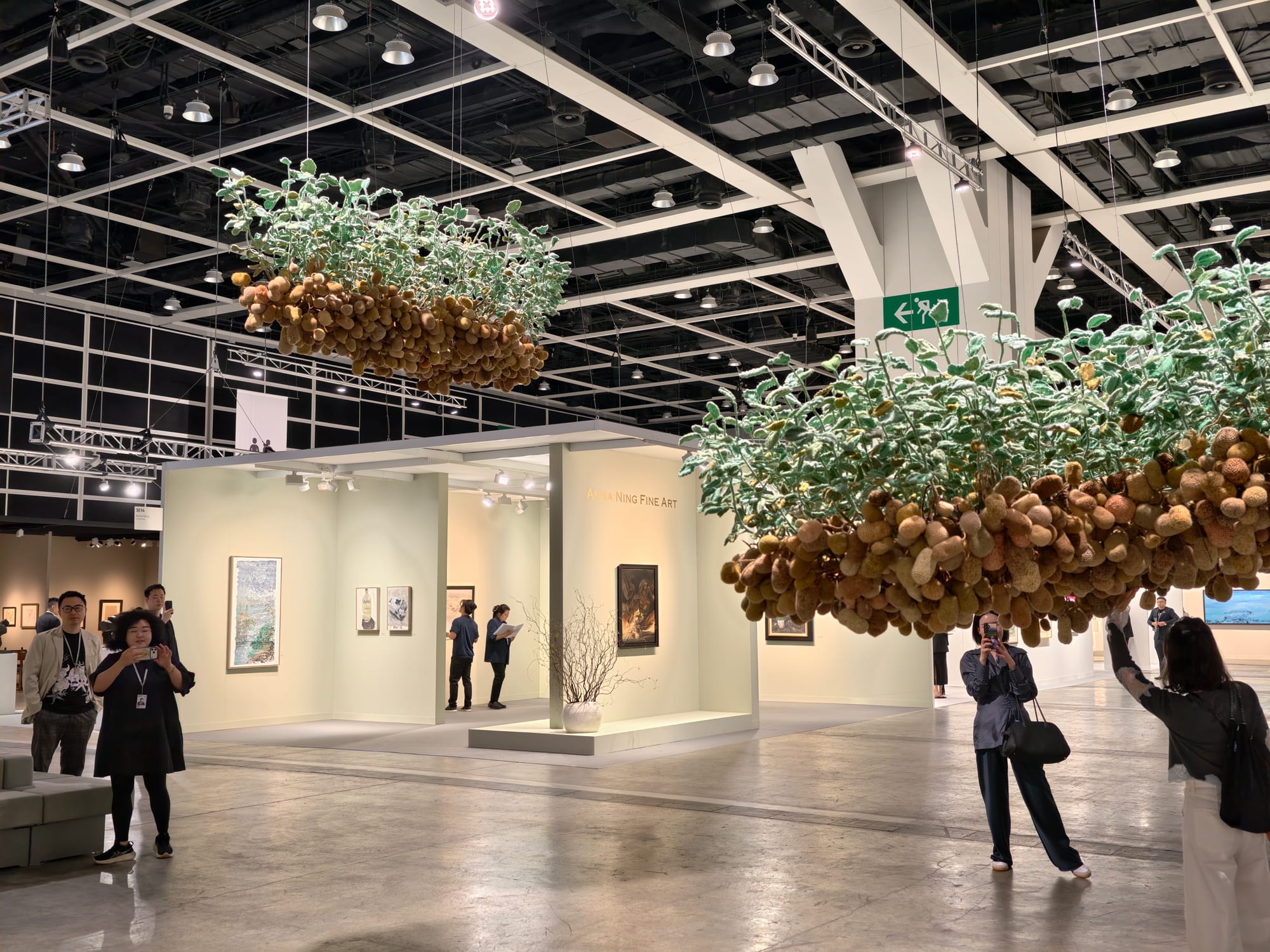
In a space oriented toward rapid transactions, my hope is that the work briefly interrupts the flow, even if just for a few minutes, prompting viewers to pause and think about agriculture, the relationship between city and land, and questions about growth and nature. I like art that operates like a “slow knife”—it only needs to plant questions and twist perception for just a split second. The real force of the work lies in a weight of time that cannot be compressed, remaining, for viewers, just out of sight.
Over the years, works by the Hu Xiaofang collective has moved through village homes, studios, and museums across the world. How do the aunties themselves respond to seeing their work circulate through such different environments? Have their reactions ever shifted how you install or narrate the work?
They do not know what art is—art is too small for them. They care more about life itself. For example, if working in the collective can give them another point of support in life, a bit more possibility, or even simply create more occasions for communication and connection, that is their meaning and purpose.
In fact, the Hu Xiaofang collective is less about making any single auntie visible, and more about helping people see those around them more clearly through these women. I do, however, try my best to organize trips for the aunties who participate in Xiaofang. We are currently arranging for some of them to travel to Australia to visit an exhibition.
Your work has been framed as an “economy of knitted relations,” in which care and obligation circulate alongside hats, uniforms, and now potatoes. Where do you see your practice pushing back against this language of “care” or “community”—toward something more difficult, or less easily celebrated?
I recognize that there is a kind of “structural violence” at the heart of this practice, because in a certain sense the modern corporate system is its artistic material. I have no wish to quarantine the aunties from contemporary art’s complex discourses, but I am also not trying to train them as artists—that work belongs to museums and academies. I do not want to romanticize “care,” because real care inevitably involves this original‑sin‑like complexity and moral dilemma. For me, it is more important to be honest and to live as fully as possible. The further you are from “art” as a label, the closer you may, in fact, be to it.