Shows
Lawh Wa Qalam: M. F. Husain Museum in Qatar
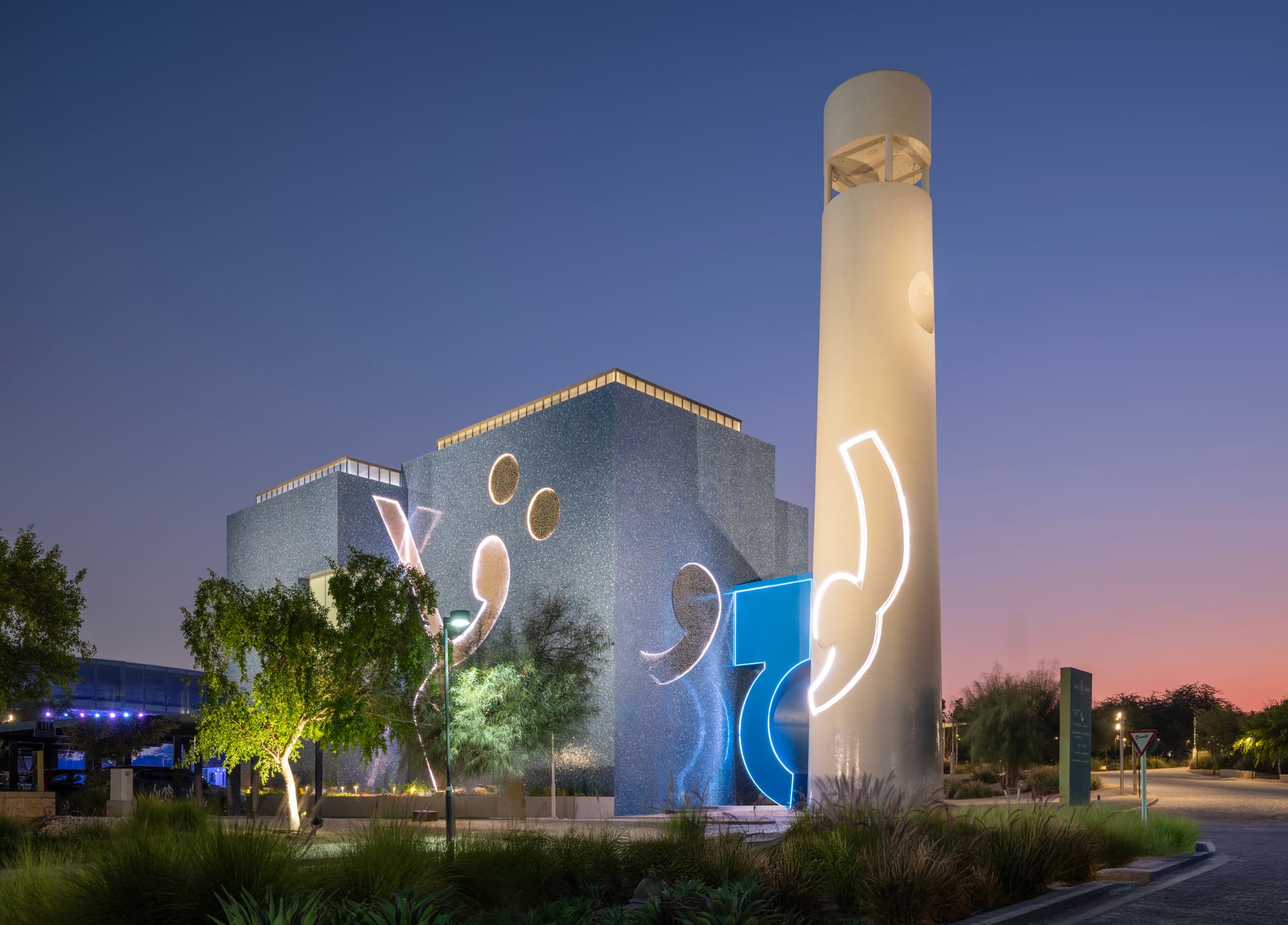
It stands out like a bolt of blue in a sand-colored cityscape. The Lawh Wa Qalam: M. F. Husain Museum in Doha’s Education City opened its doors to the public on the November 28. Billed as the world’s first institution dedicated to the celebrated Indian modernist Maqbool Fida Husain, it is also the only museum in the Gulf that is devoted to a single artist.
The architectural concept for the building was designed by none other than Husain himself in 2008, three years before his death. He considered it an artwork in its own right and titled the building the M.F. Husain Art & Cinema Museum. The sketch was intended for his patron, Her Highness Sheikha Moza bint Nasser, Chairperson of the Qatar Foundation. The drawing depicts a blue building with a white minaret-like tower and an overarching canopy, spread over a cluster of houses. On the structure’s façade, the words Lawh Wa Qalam, which translate as “The Canvas and the Pen,” are written in calligraphic flourishes. In the margins are details about what Husain hoped the building would house: the main rectilinear structure for painting, photography, and sculpture; the tower for photography and graphics; and the cluster of houses for a cinema, library, and theater for the performing arts.
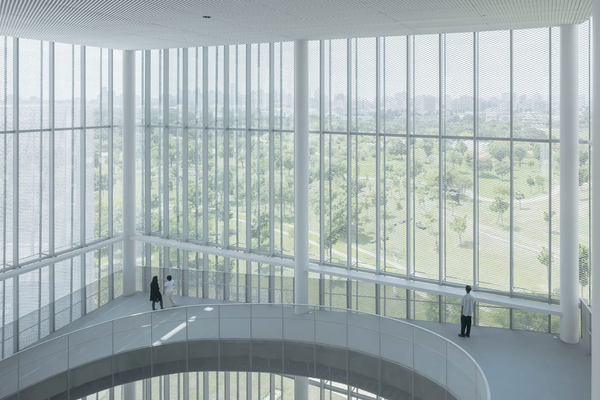
The artist’s dream has been posthumously realized by the Qatar Foundation and the Indian architect Martand Khosla of Romi Khosla Design Studios. Spread over 3,000 square meters, it offers a glimpse into Husain’s prolific practice from the 1950s until his death in 2011. For Khosla and his team, the real challenge lay in whether to read and translate the sketch metaphorically or literally. While a literal reading ultimately won out—preserving Husain’s essential forms and spatial division—the team developed an architectural language rooted in tropical modernism, a style Husain himself had embraced in his Indian years. The approach allowed for a syncretic mélange of South, Central, and West Asian influences. Examples include the blue ceramic tiles covering part of the exterior facade. The museum is divided into two blocks, one blue and the other grayish-brown, connected by a central staircase at the heart of the space.
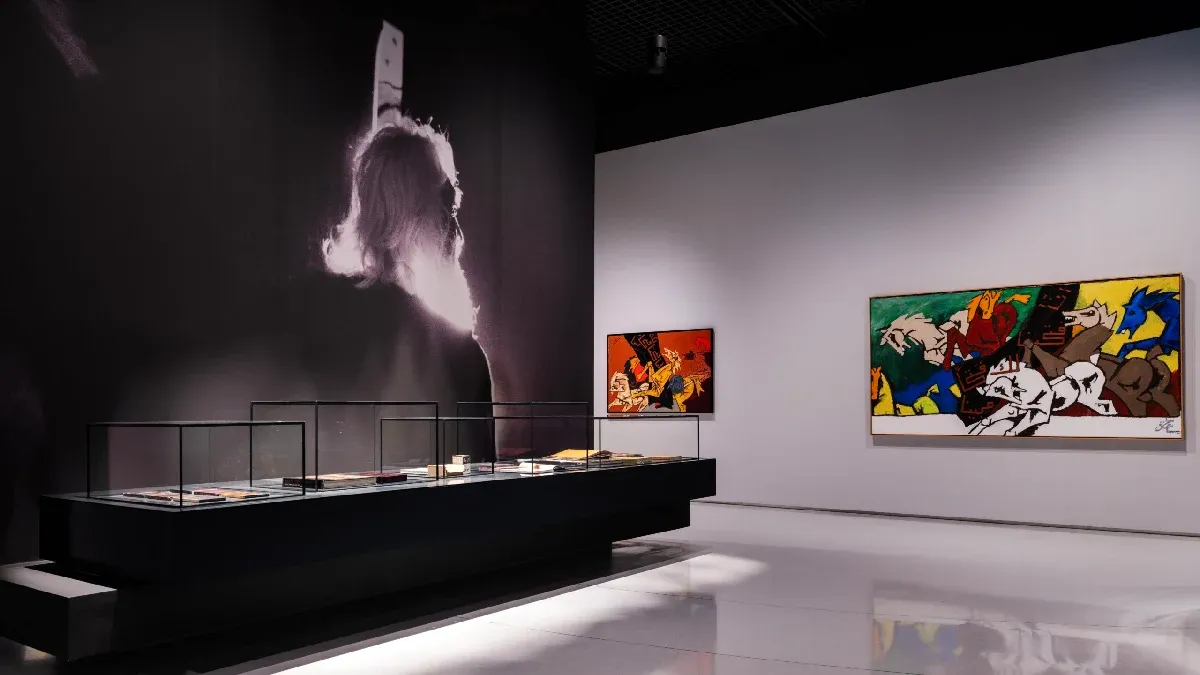
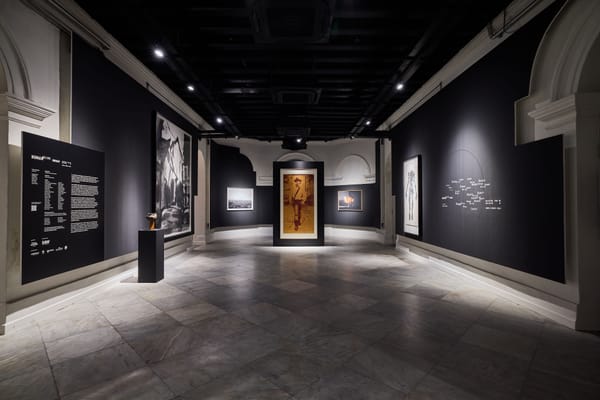
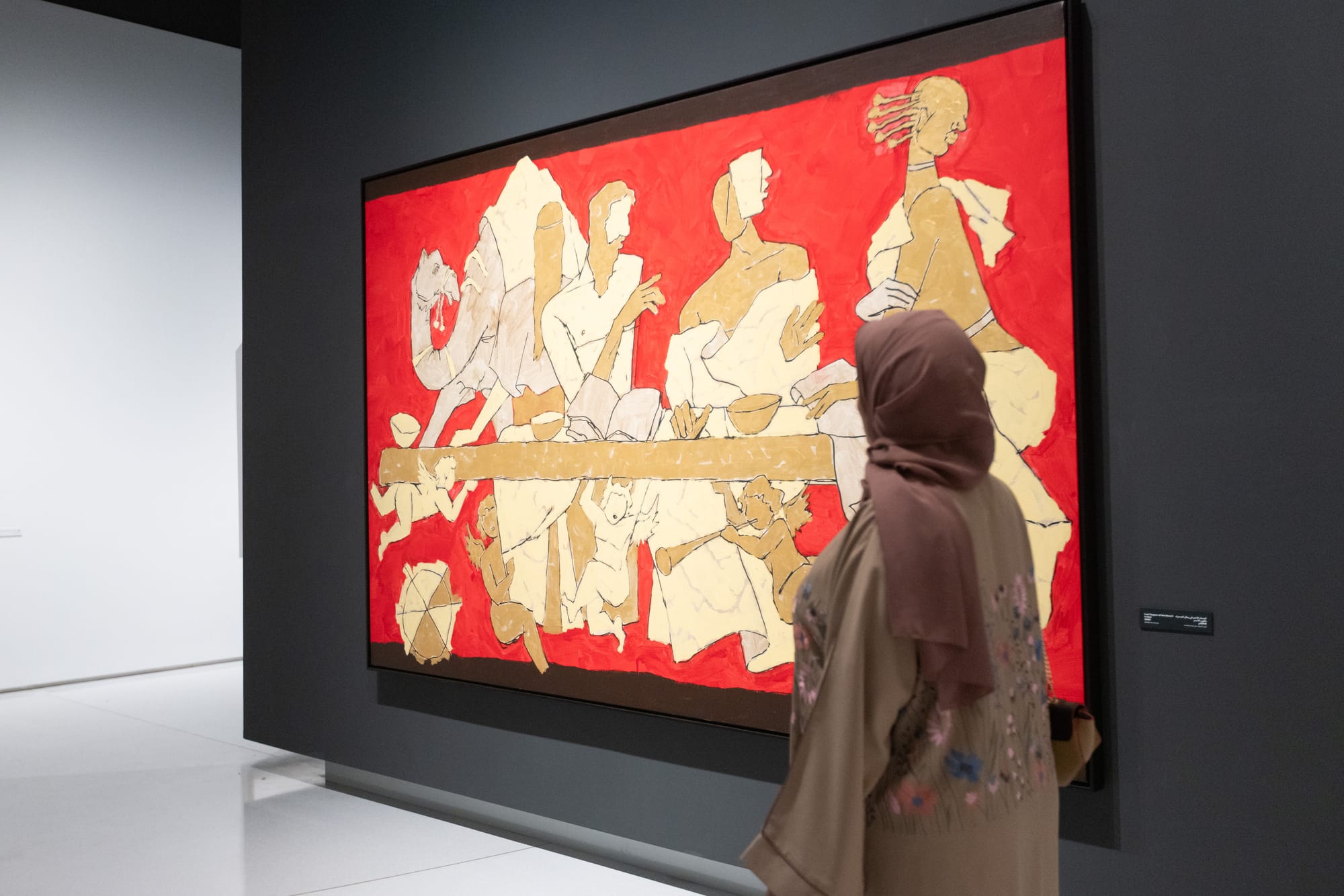
Of the reportedly 40,000 paintings Husain produced in his lifetime, the museum brings together just over 150 artworks and personal items now under the custodianship of the Qatar Foundation. These include sketches, films, and archival materials such as paints, brushes and even an embroidered jacket with his trademark motifs. Upon entering the blue block, visitors are immediately surrounded by projections of Husain’s life and artwork in an immersive space. The first floor is devoted to his life and work in India, though with no particular thematic focus. The earliest painting in the show is a small 1950s oil on canvas titled Doll’s Wedding, reflecting his interest in dolls and toys—an interest also evident in a section of wooden cut-out sculptures that recall Husain’s early experiments with toy design during his brief stint at a Bombay furniture factory in the 1940s. Large black-and-white photographs of the artist at various stages of his life dominate the exhibition space. Particularly striking is one by photographer Parthiv Shah showing the artist walking barefoot in Delhi’s Nizamuddin area, which also earned Husain the moniker “the barefoot artist.”
Facing Shah’s photograph is a section on India’s 100-year struggle for freedom, which includes a striking series of acrylic and canvas works commemorating India’s independence from British colonial rule. On display are three panels from 1985 that commemorate key moments in India’s freedom struggle and once formed part of a monumental 100-foot-long painting: Jallianwala Bagh, Gandhiji and Dandi March, and Quit India Movement. Independence marked an important moment in Husain’s life. He cofounded the Progressive Artists Group (PAG), a band of artists who wanted to challenge the Western academic style of painting and forge a visual vocabulary reflective of the newly independent nation. A large photograph depicts this group of idealistic young men.
Some of Husain’s other preoccupations can be spotted in the exhibition, including his depiction of Mother Teresa in an eponymously titled acrylic on canvas from 1998. She appears faceless, identified primarily by the blue-and-white sari she wore. Husain lost his own mother when very young, and the nun symbolized for him the epitome of motherhood, selflessly caring for the destitute. Paying tribute to Husain’s love for cinema is the film tower, where viewers can watch his experimental films Through the Eyes of a Painter (1967), Gaja Gamini (2000), and Meenaxi: A Tale of Three Cities (2004).
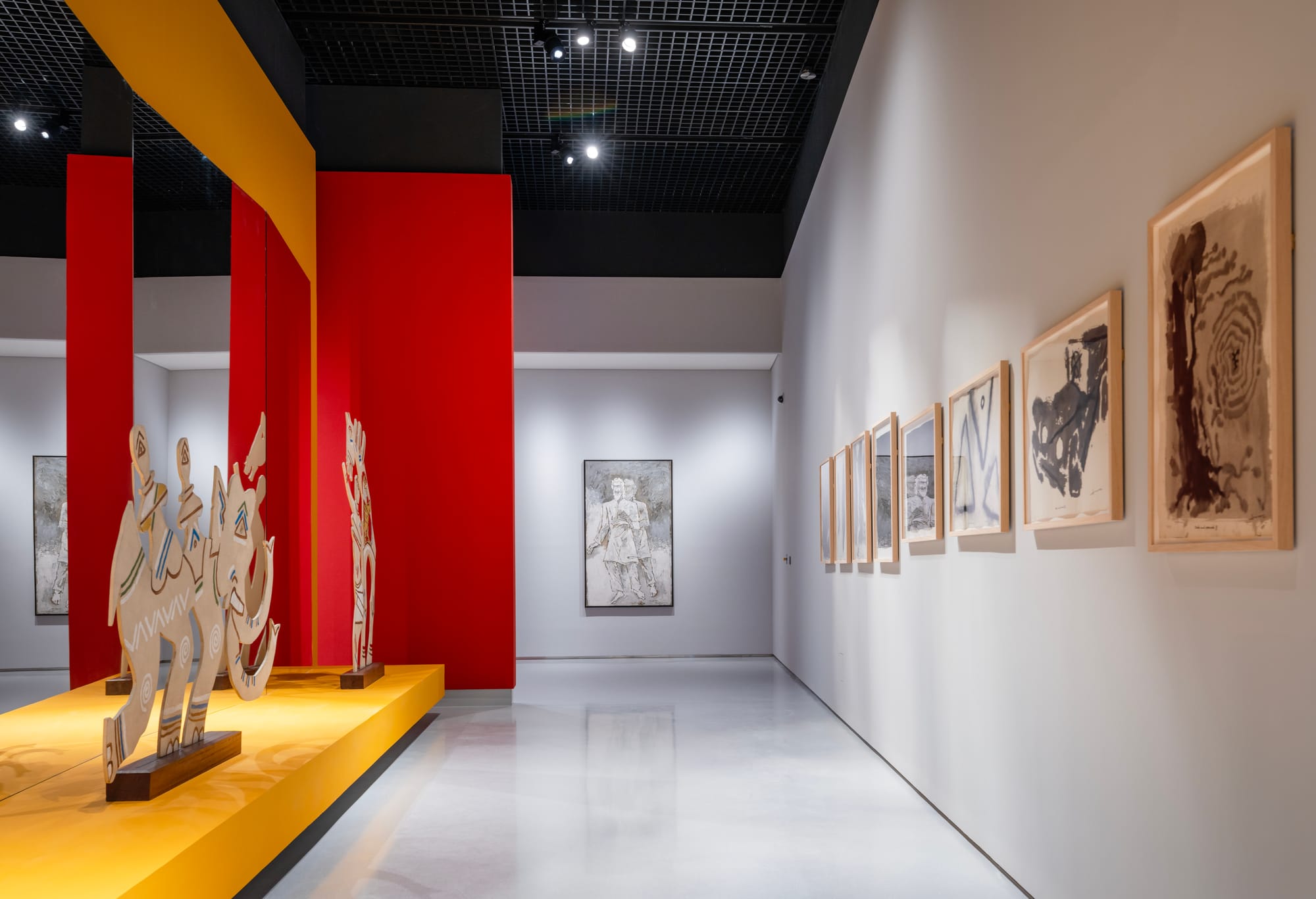
What comes as a surprise in the Indian period of his career is a number of rarely seen abstract works. One, titled Raman Effect (1987), is an homage to the scientist C.V. Raman on his 99th birthday in 1987. Rendered in geometric abstraction with block-colored triangles, squares, and circles, the work is a visual representation of a beam of monochromatic light splintering into a spectrum of colors. Nearby, a series of poetic monochromatic watercolor and ink works titled Dabs and Wounds (1998) are dedicated to the Mexican Nobel Literature laureate Octavio Paz, whom Husain knew personally.
Husain left India in 2006 and went into self-exile after incurring the wrath of right-wing forces for his depiction of Hindu goddesses nude. Numerous court cases were filed against him and the Amdavad ni Gufa, a cave-like gallery he designed with architect B.V. Doshi in Ahmedabad, was vandalized. After leaving his homeland, he spent his life flitting between Dubai, London, and Qatar. In 2010, at the age of 95, he was granted Qatari citizenship and a section of the museum is devoted to the works he produced there. He was commissioned by HH Sheikha Moza to create 99 paintings on Arab and Islamic civilization, of which he completed over 35 before his death. In these rarely seen artworks there is a nod to his Sulaymani heritage in the painting Yemen (2008), a tribute to Arab scholars in Arab Astronomy (2008), and the commemoration of an early Islamic victory in Battle of Badr (2008).
Husain was also a great believer in syncretism, secularism, and humanism. He explored themes of faith and shared spiritual heritage in paintings such as Cross Cultural Dialogue (2003) and Theorama (1994), a series of 10 pieces celebrating different religions and cultural traditions through symbolism.
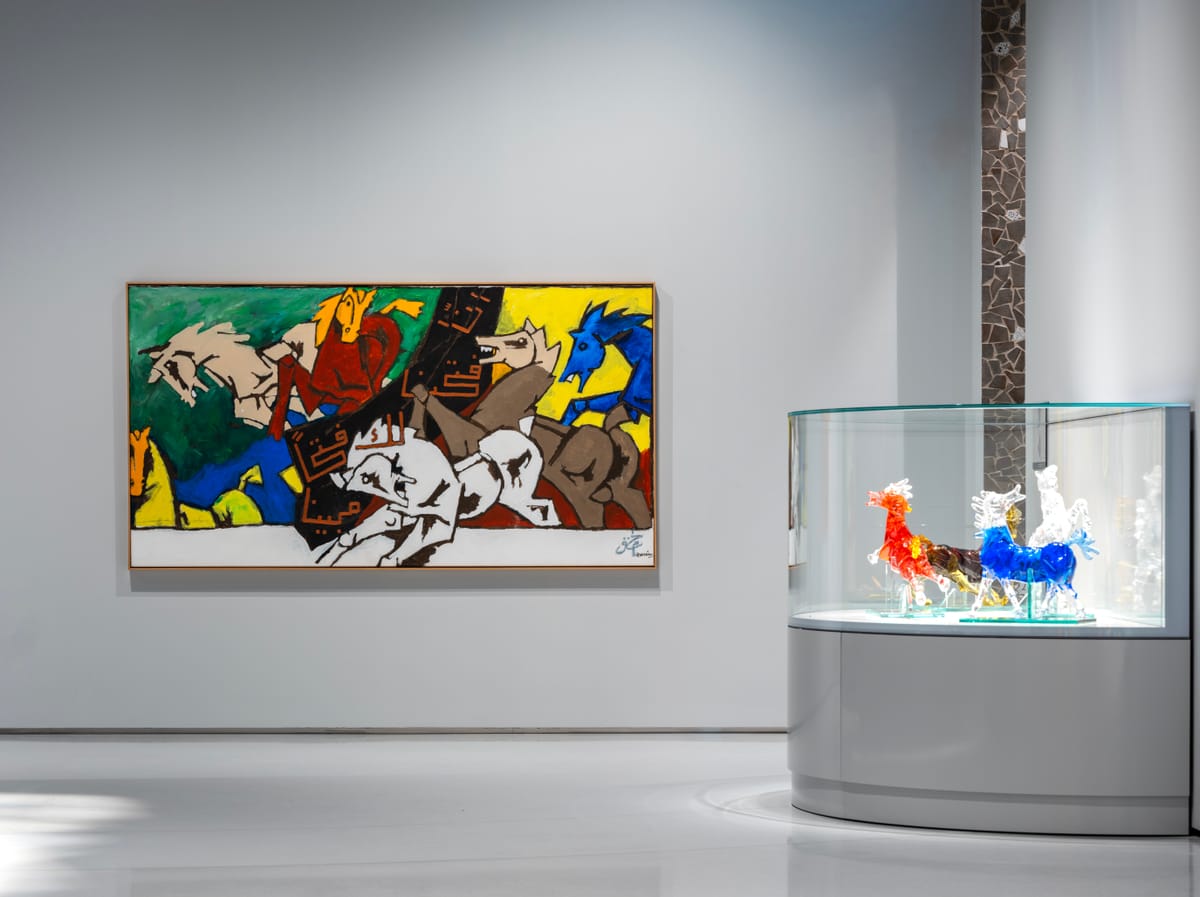
One of the recurring motifs that spans Husain’s practice both in India and Qatar is his energetic and fractured horses. Emblems of history, faith, and myth, they served as a muse, appearing in several canvases, among them the tapestry work The Artist and his Model (1984) and Zuljanah Horse (2007). But it is in his final kinetic installation, Seeroo fi al ardh (Travel through the Earth) (2009), that he truly celebrates them. Housed in a cylindrical glass pavilion adjacent to the museum, it commemorates human achievement and progress. Comprising the flying figure of the Andalusi polymath Abbas ibn Firnas, a model of Leonardo da Vinci’s Flying Machine, and a carousel of Murano glass horses and vintage cars, it clearly aims to bedazzle the viewer. It is apparent that Husain, despite his self-exile, was prolific and boundary-pushing in his final years. One of his sayings that flashed up in the museum reads, “Home is not where you are born but where you create.”
Meera Menezes is a Delhi-based art writer and independent curator.