Shows
Jacqueline Kiyomi Gork: Sounding the Wound
Jacqueline Kiyomi Gork
Gama
Empty Gallery, Hong Kong
Sep 27–Nov 15, 2025
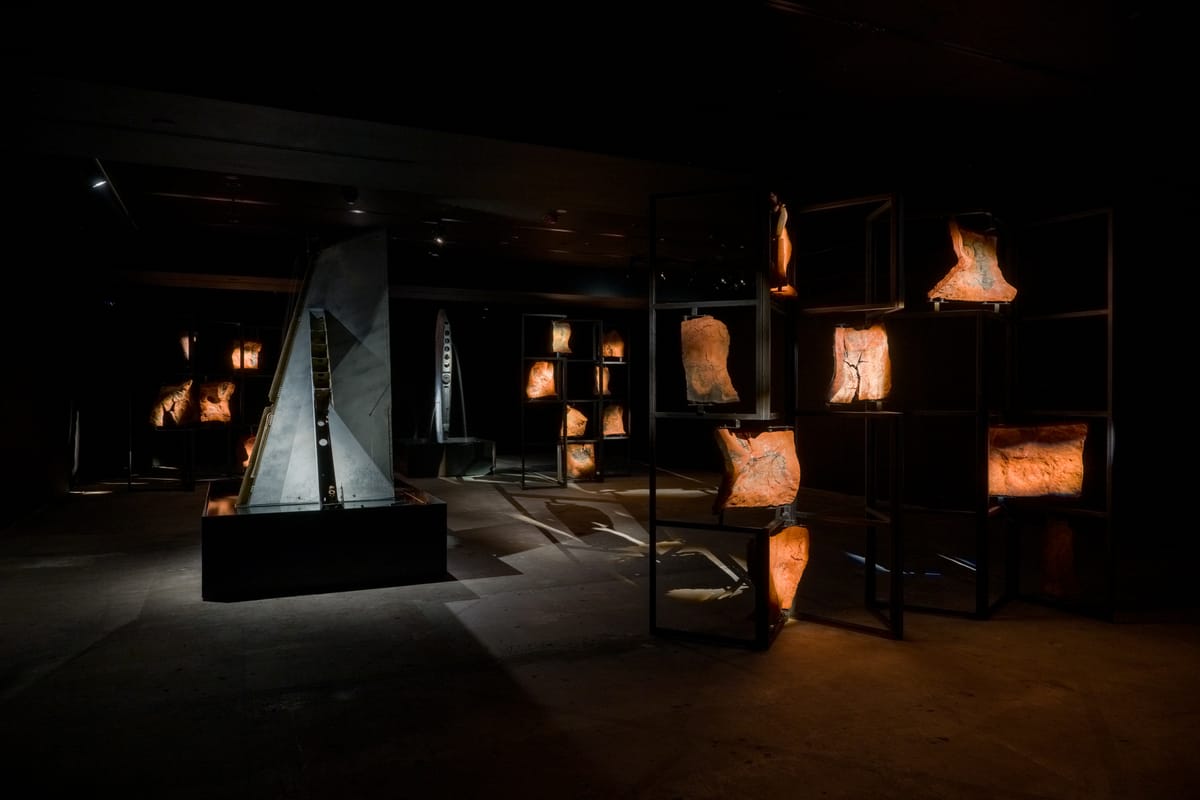
At Jacqueline Kiyomi Gork’s “Gama,” Empty Gallery’s pitch-black, two-floor void functioned less as backdrop than as active medium. For her third solo exhibition with the black-box space, Gork continued to nurture darkness as a collaborator, allowing the works to unfold as a single, cavernous installation.
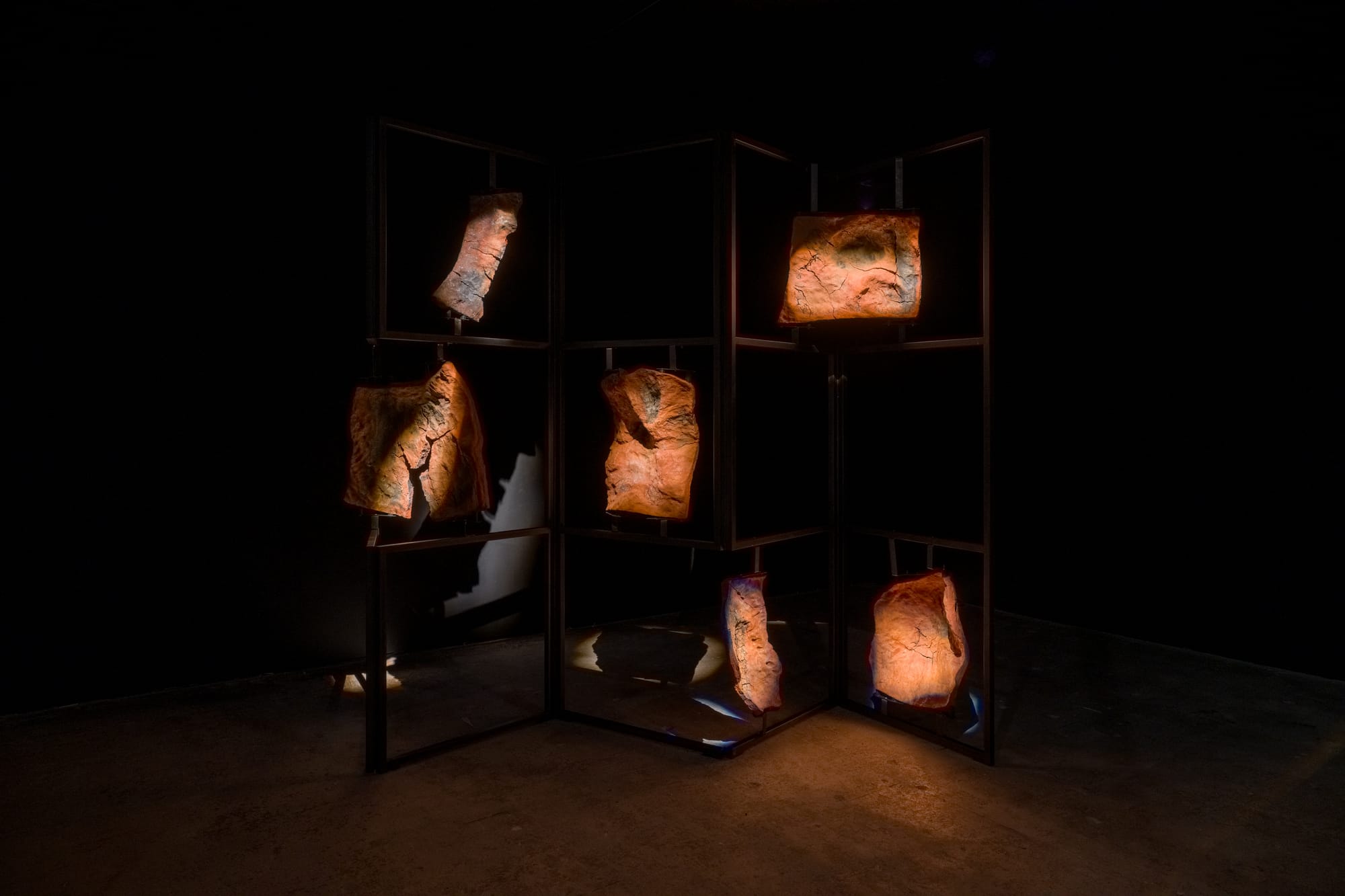
Cold air and darkness seized the senses upon entry. A short corridor and unguarded reception area led to Gork’s conceptual, deconstructed “cave,” where the titular sculptures, Gama 1, 2, and 3 (all 2025), emerged as sequences of chunky terracotta tiles suspended on steel frames. Named after the Okinawan word gama, meaning “cave,” the series uses the island’s red clay to trace the interior impressions of Shimuku Gama, where Gork first conceived these works. Conceived as “permeable membranes,” the blocks of terracotta hover ominously in liminal darkness, solid and weighty yet cracked and vulnerable.
This contradictory tension perhaps reflects a dissonance within Gork’s family heritage, which she felt compelled to confront after Hamas’s attacks on Israel on October 7, 2023. Half Japanese, with Okinawan ancestry on her mother’s side, and half Jewish on her father’s, Gork—personally pro-Palestine—grew up surrounded by ideas concerning technology and the military, as both her father and grandfather worked in aerospace. While her earlier works and shows undertook forensic dissections of sonic and technological systems, “Gama” pivots toward the trauma of the 1945 Battle of Okinawa and the enduring legacy of American and Japanese imperialism.
Amid fractured terracotta and cold steel, jarring digital sounds swelled and receded, emanating from two large sound sculptures, HNZF I and III (both 2025). Crafted from the pylon and wing, respectively, of an LTV A-7 Corsair II—a 1970s US fighter jet salvaged from an aerospace boneyard in Arizona—the works evoke Zen fountains in form while subverting their usual calming associations. Cold water splashed onto visitors’ skin as a looping, disembodied soundtrack shattered the quiet: microphones concealed within the sculptures captured the sound of falling water, and the audio was reprogrammed to render it abrasive.
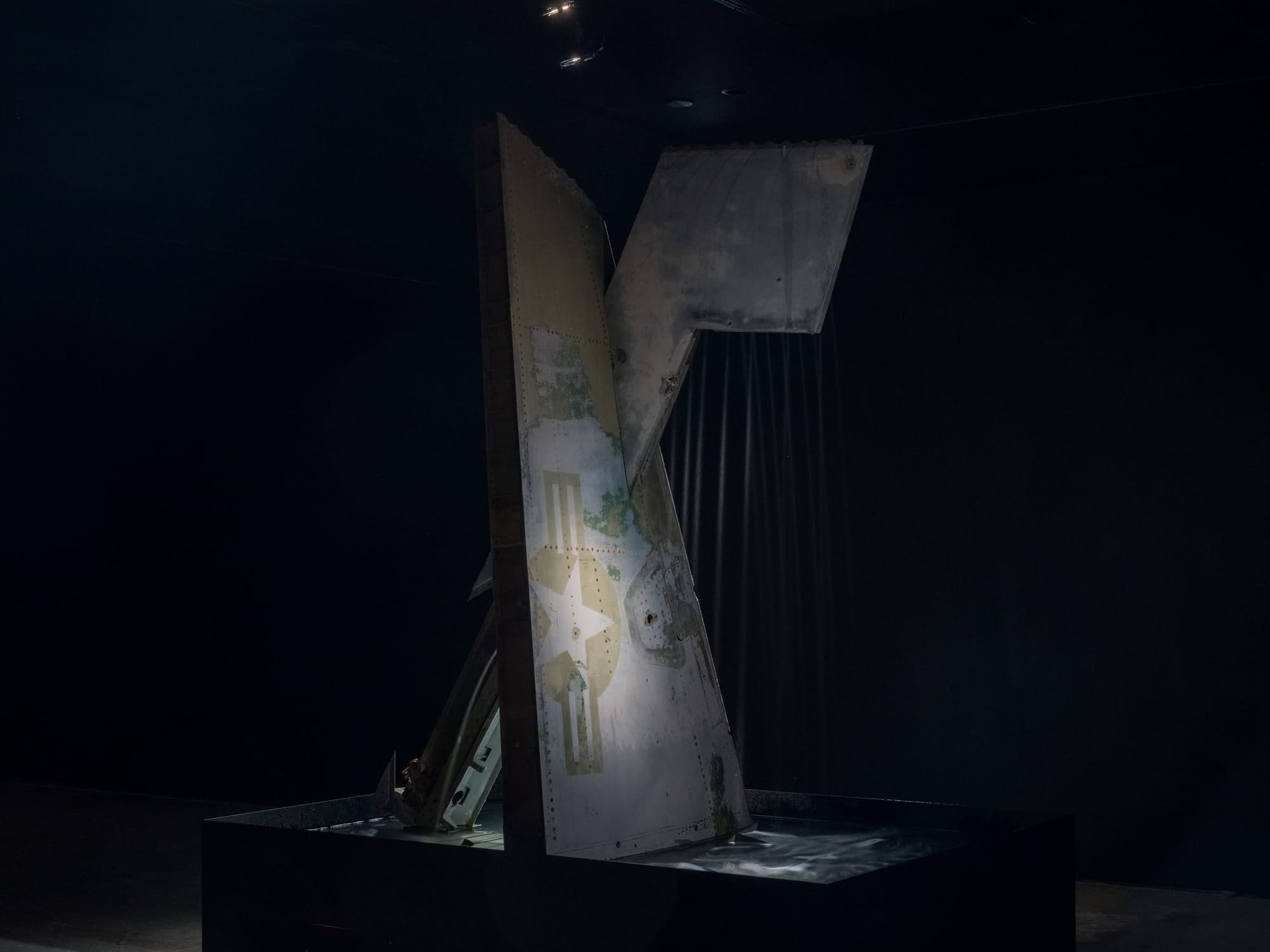
During her visit to Shimuku Gama, where a stream flows through the cave, Gork was struck by the menacing echo of running water—a sound at once serene and disquieting. The experience brought to mind the cave’s dark history, when local civilians sought refuge inside as US forces attempted to flush them out and Japanese soldiers threatened those who considered surrender. Just as military forces once invaded the cave, the fighter jet fountains now haunt Gork’s reimagined cavern. The works point to the Western commodification or mistranslation of Eastern spiritual practices—particularly Zen—into marketable atmospheres of calm, critiquing a manufactured tranquility built atop histories of violence.
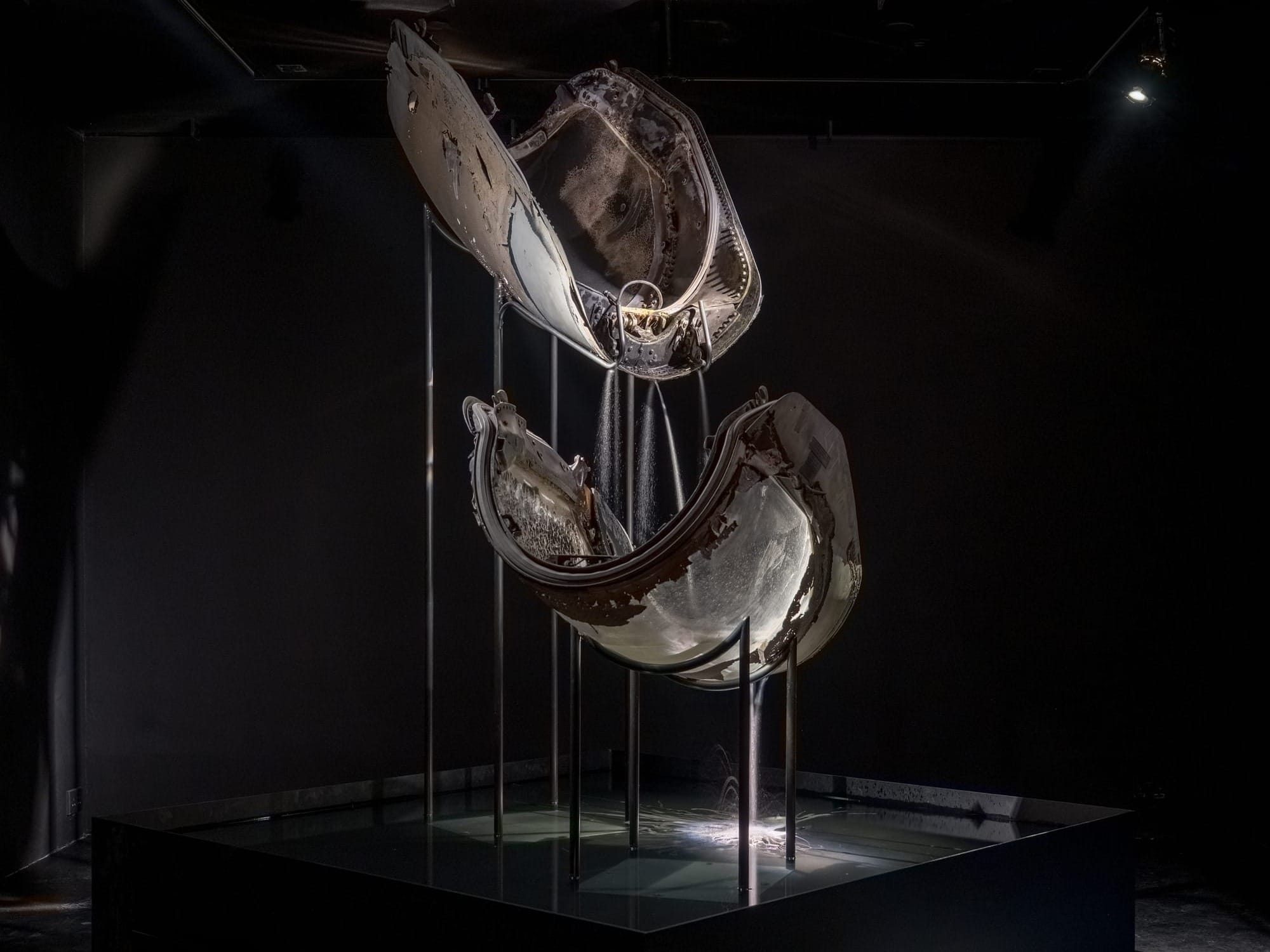
As visitors descended a narrow stairway, a sense of confrontation intensified. Opposite Gama 4 (2025)—a short sequence of terracotta tiles mounted on the wall—was the looming HNZF II (2025), fashioned from the canopy of a Douglas A-4 Skyhawk. Dramatically lit, the hulking installation lurked in the cramped chamber like a dormant monster, its glinting industrial edges ensnaring viewers in a threatening aura.
Compared with Gork’s two earlier exhibitions at Empty—“CATCHY” in 2017 and “Olistostrome” in 2021—“Gama” signaled a sharpening and expansion of her longstanding concerns. While “listening” had always been central to her practice, in “Gama” it was mobilized with heightened conceptual clarity, foregrounding tensions between protection and confinement, and between memory and erasure. Refusing catharsis, “Gama” offered neither closure nor healing for historical trauma; instead, it held us within its unresolved reverberations.
Yuqian Fan is an editorial assistant at ArtAsiaPacific.