Shows
Faith in Fragments: Bùi Thanh Tâm’s “Christ, Buddha, and the Jigsaw”
Bùi Thanh Tâm
Christ, Buddha, and the Jigsaw
Gate Gate Gallery at Chillala House of Art
Ho Chi Minh City
November 17–24, 2025
I was raised to believe that faith could not be plural. In the Buddhist temples of my childhood in China, devotion felt singular and disciplined. Years later, working in New York’s art world, I encountered the vast visual and theological vocabulary of Christian art. Between these worlds, I often wondered what it means to revere—and whether transcendence allows more than one path. Hanoi-based painter and sculptor Bùi Thanh Tâm confronted these questions directly in “Christ, Buddha, and the Jigsaw,” a dazzling yet disquieting meditation on how spirituality mutates amid political division and image saturation.
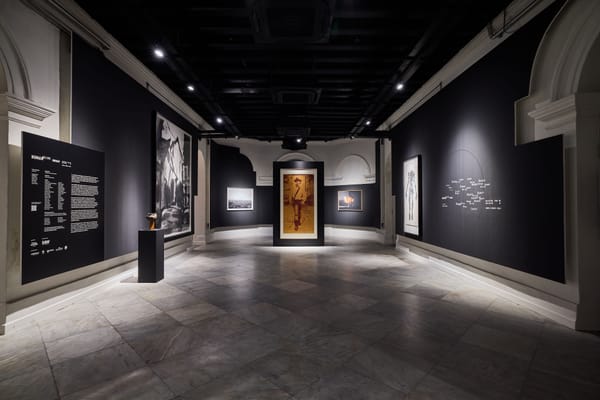
Presented by Gate Gate Gallery at Chillala House of Art and curated by Richard Vine, former managing editor at Art in America, and Phil Zheng Cai, partner of Eli Klein Gallery in New York, the exhibition gathered nearly 50 works made between 2020 and 2025. Paintings, digital multiples, and sculptures intermingled across two floors, charting Tâm’s transformation from social satirist to visual theologian. Known for his series Crazy People (2010–14) and Young Vietnamese Girl (2010–17), which lampoon consumerist aspiration in post-Đổi Mới Vietnam, Tâm now turns his critique toward belief itself—both religious and artistic.
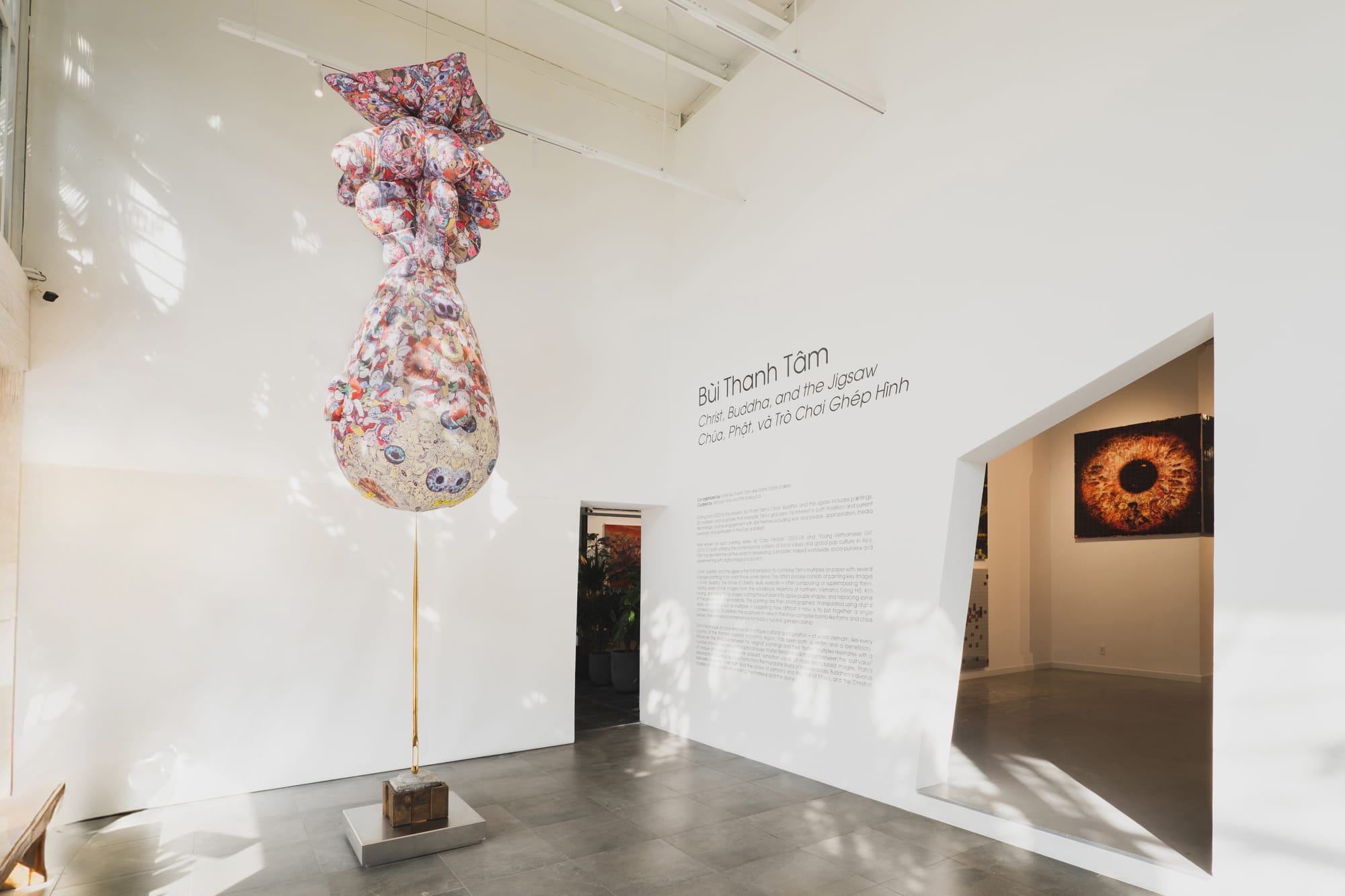
The show greeted viewers with The Ultimate Good—The Ultimate Evil (2020–25), a four-meter-tall installation at the entrance. An enormous balloon-shaped sculpture—its skin printed with jubilant Đông Hồ children—hovered precariously above a razor-sharp steel needle. Gilded in gold and silver acrylic and studded with faux gem-like “eyes,” the buoyant form radiated festivity even as it threatened to burst. The work crystallizes what Tâm calls “the fragile game of life,” shaped by Vietnam’s continual oscillation between conflict and recovery as well as a personal loss: during the pandemic, the artist lost close friends and lived in constant fear that death could arrive as suddenly as a balloon meeting steel.
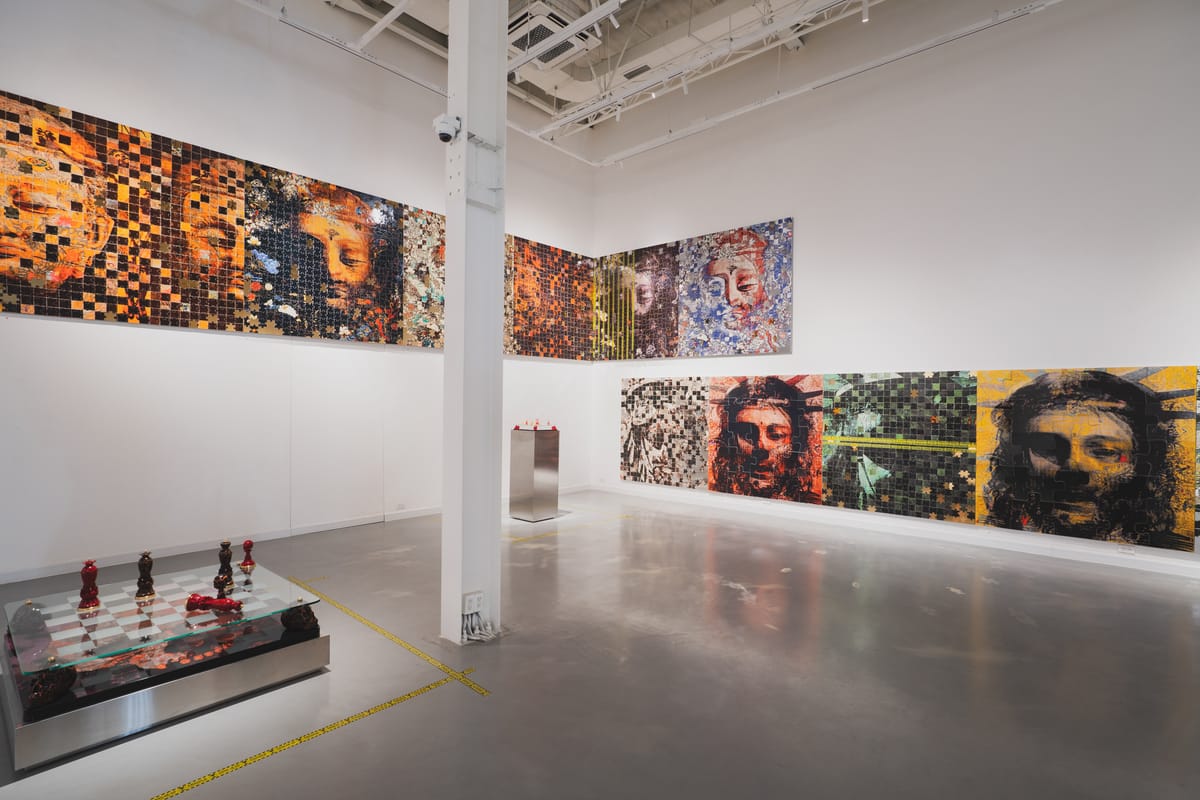
The lower floor featured two-dimensional digital multiples—reworked iterations of original paintings—where Christ, Buddha, skulls, eyeballs, and the Statue of Liberty mingle with motifs from Đông Hồ, Kim Hoàng, and Hàng Trống woodblock prints. Faces and haloes fractured into shimmering grids, as if spiritual conviction were pixelated. Tâm explained that each work began as a densely layered collage on canvas: folk fragments cut into thin slivers “like lines of a poem,” adhered, painted over, washed with chemicals, photographed, color-edited and reprinted via smartphone. This recursive cycle—creation, destruction, reproduction—folds the sacred into the logic of the screen. “Sometimes the digital experiment expresses my mind better than the original,” he told me, describing technology not as corruption but revelation.
The presentation’s deepest emotional current flowed from personal history. Tâm’s father, a former soldier who lost an eye and part of a lung during the war against the French, watched Tâm’s television interviews from his hospital bed until his death. “I only accepted those interviews so my father could see me and be proud,” Tâm recalled. After his father’s passing, Tâm retreated from public view; this exhibition marked one of the first times he spoke openly about the five years shaped by mourning and fear.
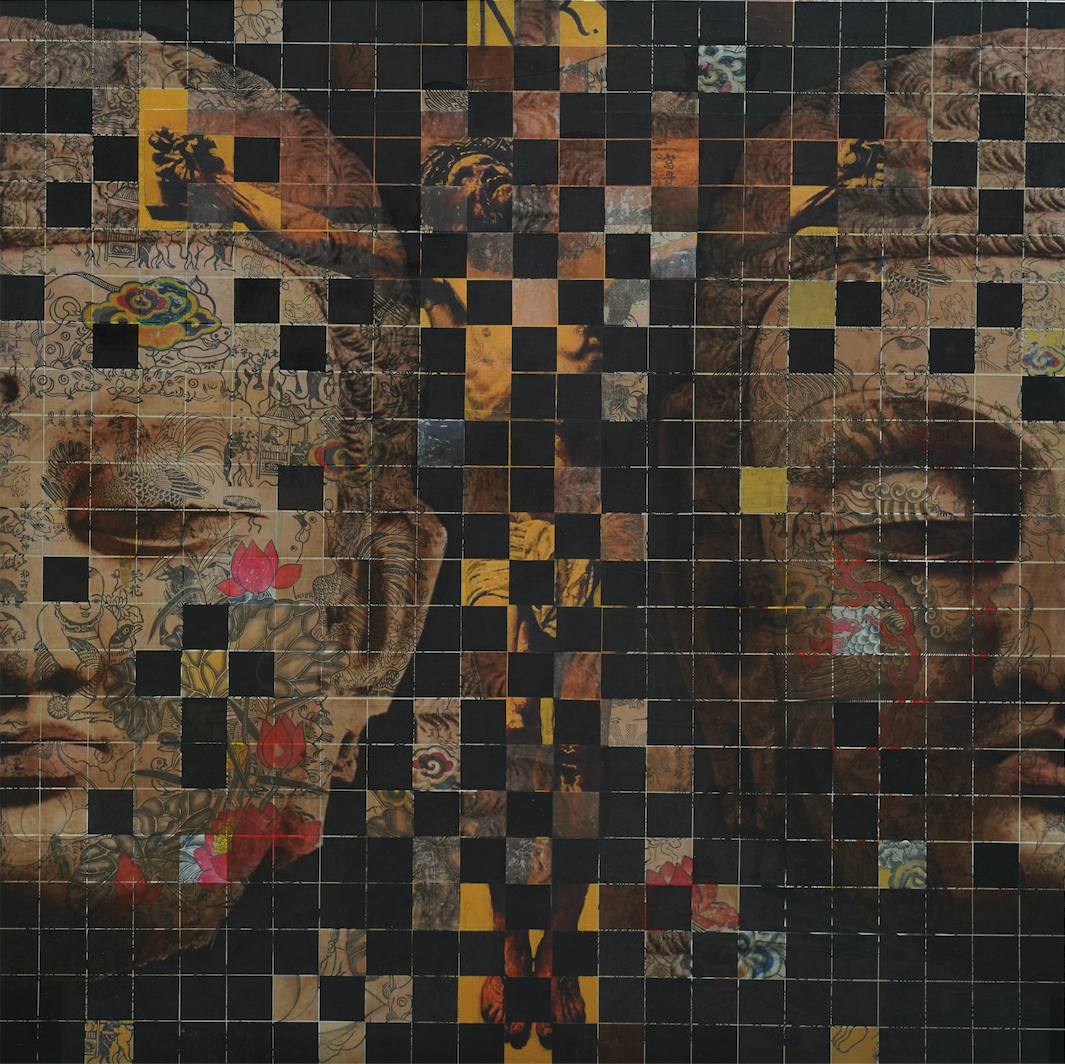
Upstairs, the focus shifted to the original paintings that inspired the multiples. In Life is present in the place of enlightenment and salvation No. 0 (2020), two monumental Buddha faces dissolve across a mosaic of black squares, lotus blooms, cranes, and tattoo-like linework. Between them flickers a crucifixion scene, leaking through the cracks like an uninvited ghost. The work condenses Tâm’s central concerns: the fragmentation of spiritual certainty, and enlightenment as an image assembled from loss.
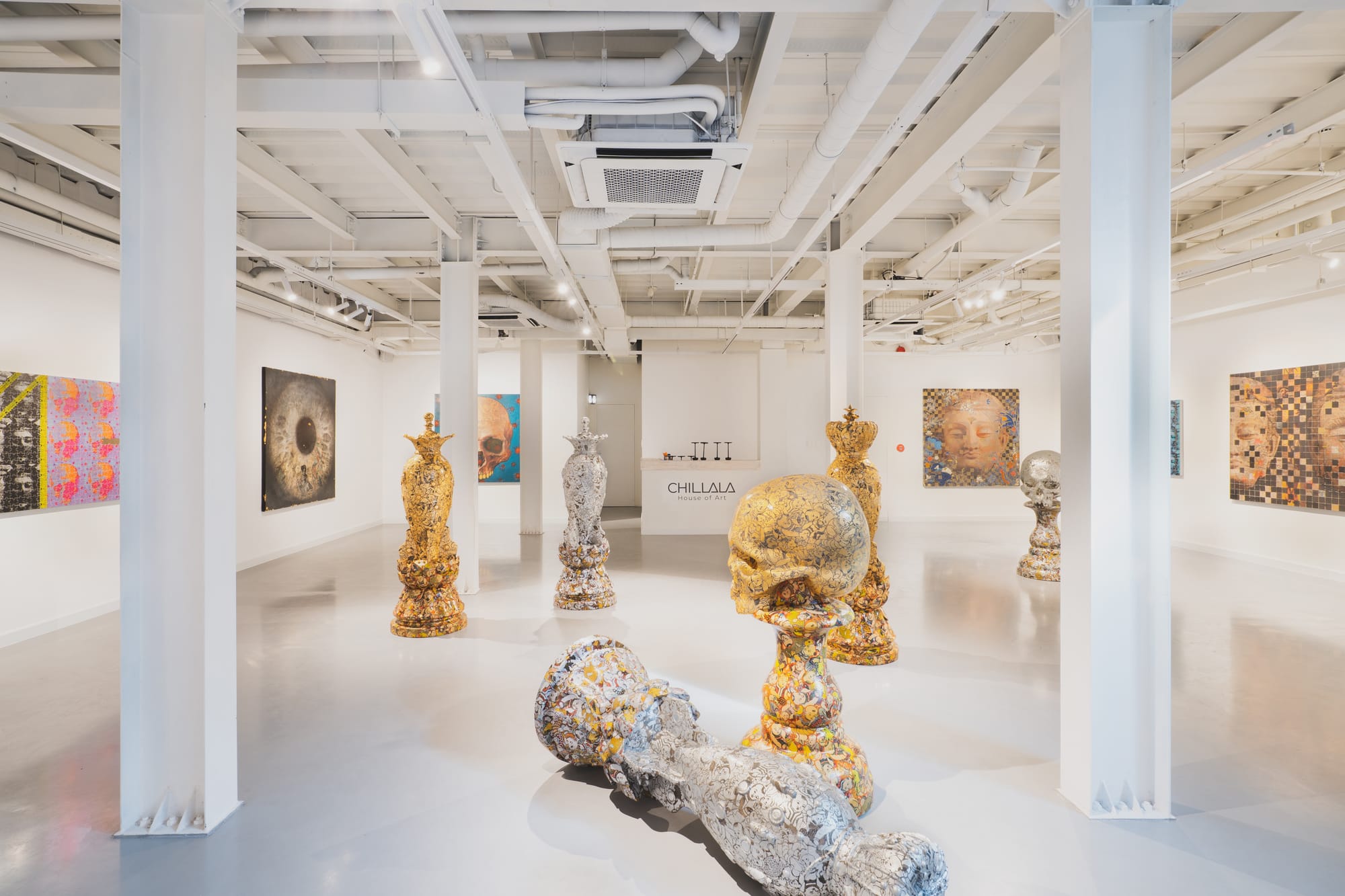
Nearby stood three monumental chess pieces from Tâm’s The Game of Intellect series (2020–25): a skull-topped pawn, a gem-studded queen, and a bishop rising from a lotus base. These sculptures continue the chess motif in a smaller chessboard installation directly below on the first floor, mirroring it vertically across the two levels of the building. The surfaces of the enlarged chess pieces teem with folk-art children, their playful bodies entwined around the forms historically associated with hierarchy, sacrifice, and strategy. The recurring chessboard theme sharpens Tâm’s metaphor: in a world governed by brinkmanship, life and death remain locked in a perpetual, perilous game.
Tâm’s cosmology—where Buddhist and Christian symbols collide with digital processes—reflects a Vietnam negotiating its own modern, global identity. Beneath the radiance of his visual iconography is a quiet confrontation with loss, mortality, and the unstable ground of belief. The works propose that life is not a singular vision but a puzzle of memories and contradictions. In a world fractured by violence and uncertainty, Tâm reminds us that worship begins with vulnerability—and that every search for faith is, ultimately, a search for ourselves.
Xintian Tina Wang is president of the New York chapter of the Asian American Journalist Association in Washington, DC. Her work appears regularly in news and culture publications such as Time, Elle, The Brooklyn Rail, ARTNews, and The Observer.