Shows
Chang Yuchen’s “For those who share mornings and evenings”
Chang Yuchen
For those who share mornings and evenings
Smack Mellon
New York
Sep 27–Dec 14, 2025
“Absence becomes an active practice, a business (which keeps me from doing anything else)…” This line, from Roland Barthes’s A Lover’s Discourse (1977), resonated throughout Chang Yuchen’s solo exhibition “For those who share mornings and evenings” at Smack Mellon in New York, where the act of love—once embodied in daily exchanges and gestures—became a practice of remembering, editing, and reassembling. The exhibition was both an elegy and an inquiry: what happens to intimacy when the beloved is gone, and what might be preserved—or newly generated—in the lover’s absence?
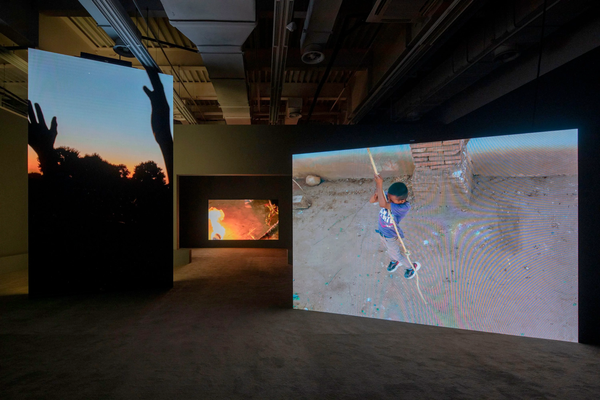
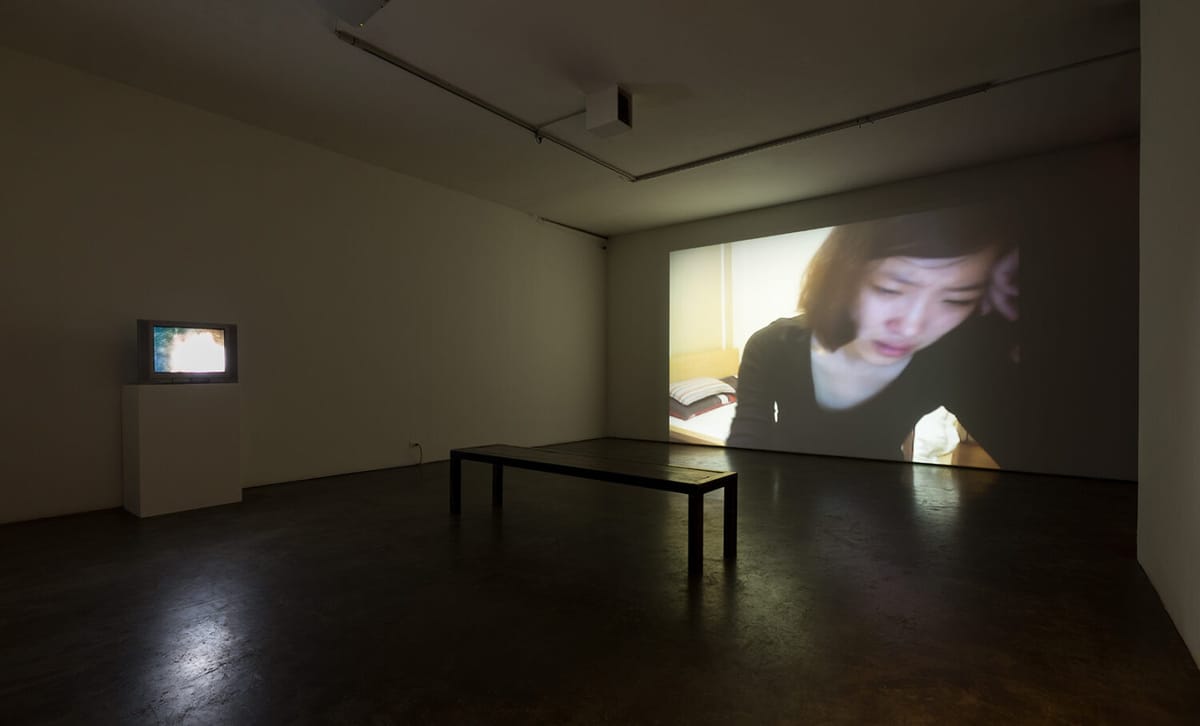
At the center of the show was a five-hour video installation projected across an entire wall, composed of thousands of screenshots taken by Yuan Yi, Chang’s late husband, during their long-distance video calls from 2011 to 2013. Above the projection, the faintly glowing “Exit” sign reads almost like a footnote—half solemn, half playful—pointing to the slippage between “exit” and “exist.” The artist’s recorded breathing forms the video’s ambient hum, echoing through the space. Low-resolution images—capturing Chang in her apartment, in bed, reading, playing music with her roommate, and sometimes sitting in a café or a corner of a shopping mall—accumulated into a durational portrait of presence. The artist arranged them as a slow slideshow, a quiet rhythm of everyday life filtered through a lover’s gaze. Every now and then, glimpses of Yuan Yi himself appear briefly, hinting at the devoted attention behind each frame. There is no audible dialogue or narrative, yet what emerges is the palpable residue of a relationship once sustained through screens.
Here, Barthes’s idea of the lover’s discourse becomes literalized: language is replaced by image, speech by the ongoing exchange of seeing and being seen. Each screenshot was once a gesture of attention, a lover’s note saved in pixels. Compiled together, they no longer address a single recipient but weave an archive of shared time—a love letter that, in retrospect, has become a eulogy. The work recalls Andy Warhol’s Sleep (1963), another durational experiment in depicting intimacy without narrative. Both pieces resist easy consumption; neither expects to be viewed in full. Instead, they stretch time to the point where the act of looking becomes a quiet endurance, mirroring the patience of love sustained across distance—and, later, across death. Chang’s video opens a portal into a space where affection lingers painfully, where time itself becomes the medium of mourning.
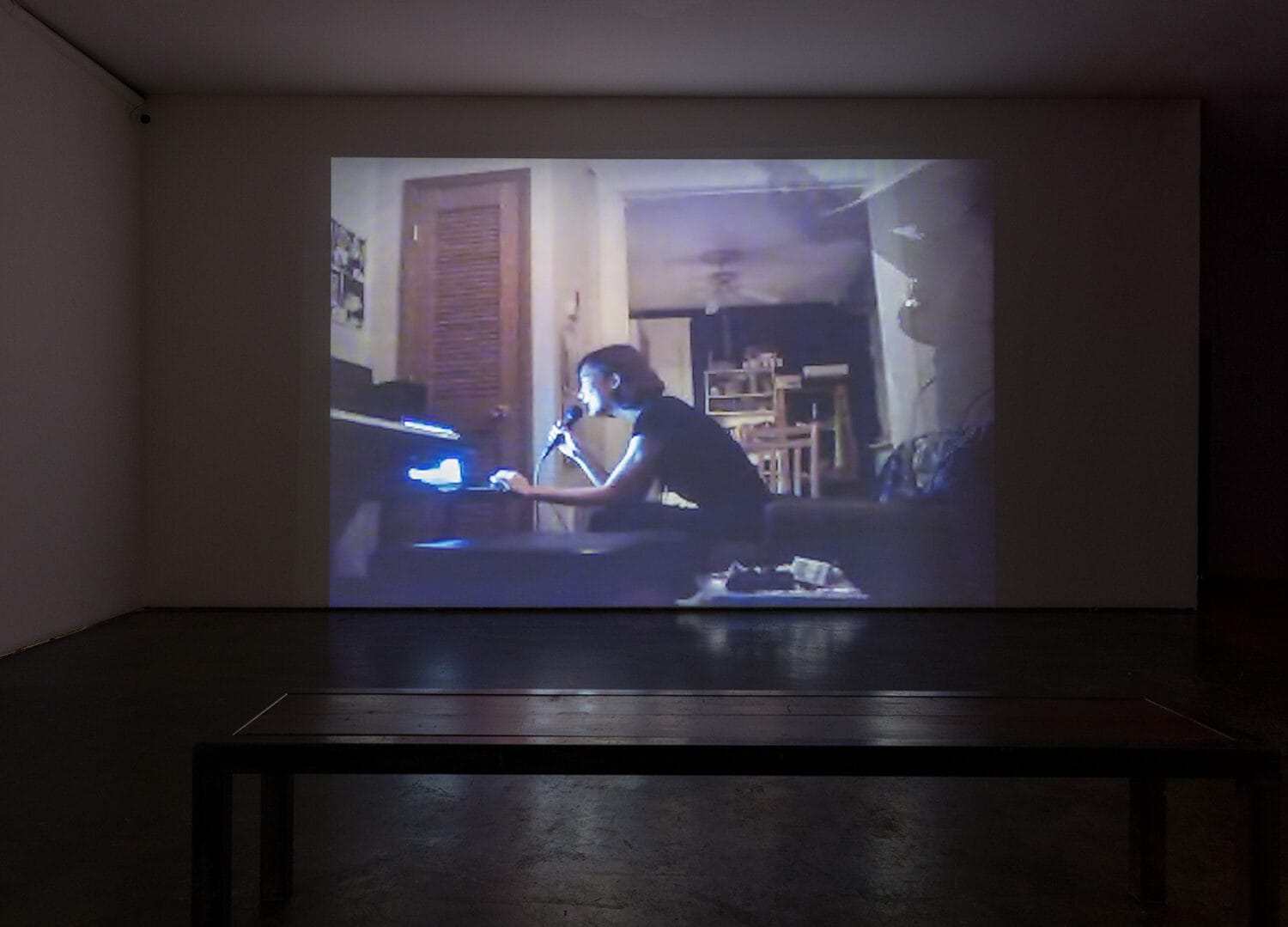
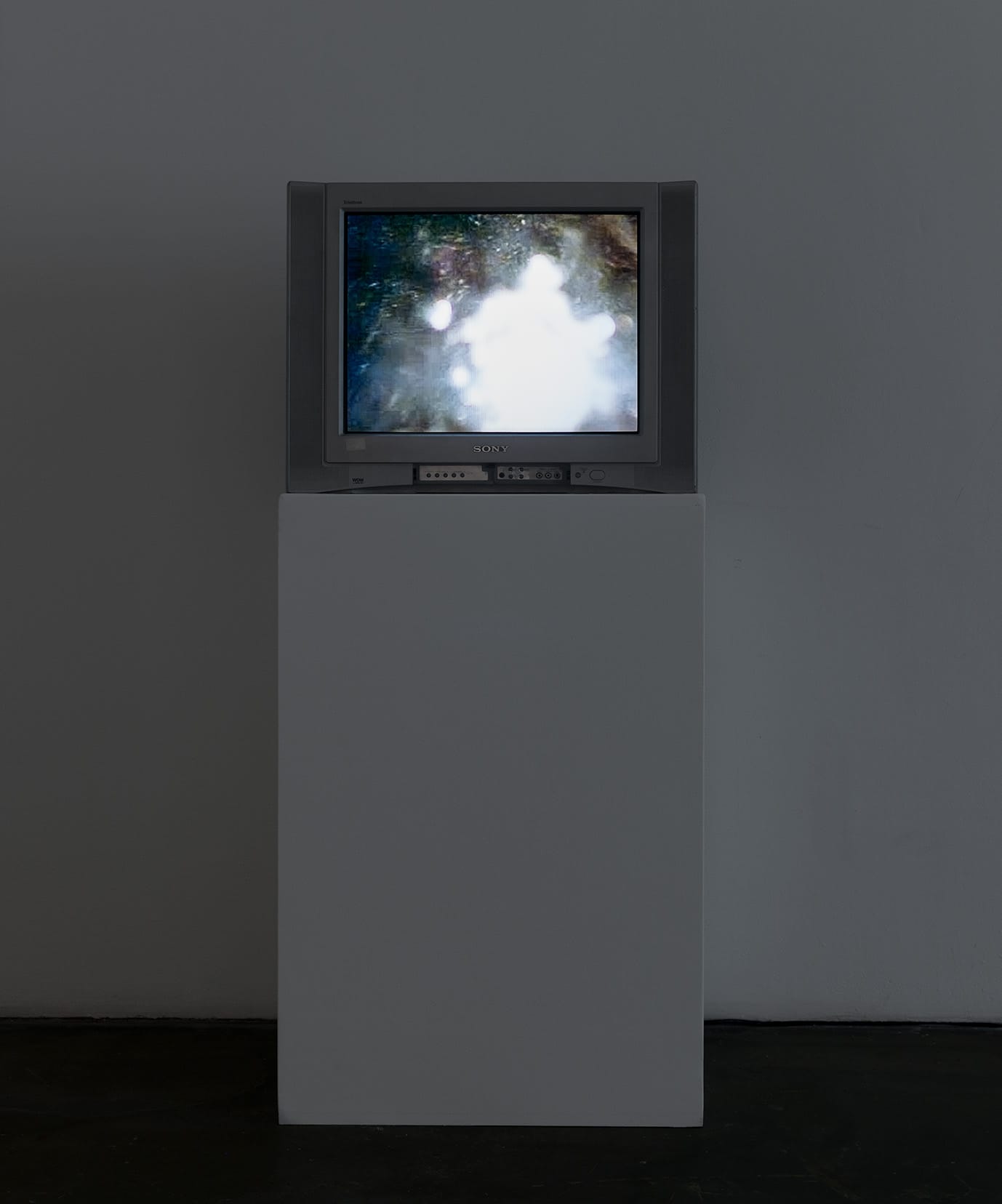
Installation view of CHANG YUCHEN’s “For those who share mornings and evenings” at Smack Mellon, New York, 2025. Photo by Etienne Frossard. Courtesy Smack Mellon.
Across the gallery, a small vintage television flickered with another looped video. Its intimate scale contrasted sharply with the immersive wall projection. Footage of snowflakes drifting beneath a streetlamp at night—shot by Yuan Yi in 2012—is overlaid with subtitles written by Chang, recounting 10 dreams she had after his death. In one dream, realizing that “no one had actually tried to rescue you. . .without even going in the water to reach for you, without even seeing your body,” Chang murmurs a profound sense of having been left behind, confronted by the realization that there was no final encounter, no physical closure. In this smaller work, Yuan Yi’s irretrievable body becomes the structural void around which both the dream and the video revolve.
The juxtaposition between the two installations—one filled with the artist’s recorded presence, the other marked by the negation of the beloved’s corporeal form—staged a subdued yet tense dialogue between intimacy and its disappearance. Physical touch, always central to love, becomes a site of inquiry: can love persist when the body is unreachable, or when the latter has vanished altogether? Chang’s work doesn’t attempt to answer this question; it suspends it, allowing what is missing to resonate as its own form of presence.
The exhibition’s emotional force also stemmed from the fact that Yuan Yi was himself an artist. His obsessive act of taking screenshots—a gesture at once banal and profound—was a way of making art from the mundane, preserving fleeting moments against time’s passage. As Chang writes in one of the dream texts, “in long-distance love, your way of sensing your lover is like poetry; in love that shares mornings and evenings, it is more like photography.” This distinction—between the lyric and the document, between fantasizing and recording—ran through the exhibition. In a sense, the two works form a collaboration across time: Yuan Yi’s original capture and Chang’s posthumous editing together produce an artwork that collapses the distance between them. Working with the traces left behind, Chang composed a photographic poem—or rather, a poetic moving image—that both mourns and preserves, blending perception with imagination, presence with memory.
This was an exhibition not about grief so much as it is about duration—the attentive, emotional labor of contemplating what love means—as Chang suggests that loss can also be a continuation, an ongoing act of looking. To stare at what is no longer there, as Barthes reminds us, is a serious matter; Chang turns that seriousness into a work of luminous and enduring resonance.
Qianfan Gu is a New York-based writer, translator, editor, and art worker. She is also the co-founding publisher of Gong Press.