Shows
Nocturnal Worlds: Keita Morimoto’s Uncanny Cities

Keita Morimoto
what we told ourselves
Kotaro Nukaga, Tokyo
Jan 17–Mar 7, 2026
Walking home alone at night, the city unfolds under the glow of street lights. Their soft radiance is quietly comforting. Suddenly, a lone figure appears in the distance, standing motionless beneath a streetlamp, bathed in a stark pool of light like a character stranded on a stage. In that moment, the scene slips from familiarity into estrangement, and the world takes on an uncanny edge. These contradictory sensations are condensed in Keita Morimoto’s Beneath a familiar light (2026). His dramatically illuminated spaces register as faintly eerie, as if supposedly inert flickers of painted light have acquired their own agency.


KEITA MORIMOTO, For the light that left us, 2025, acrylic and oil on linen, 333.3 x 248.5 cm (left); and Beneath a familiar light, 2026, acrylic and oil on linen, 162 x 130.3 cm (right). Courtesy Kotaro Nukaga, Tokyo.
Inspired by Baroque masters such as Rembrandt, Morimoto places the theatricality and drama of chiaroscuro at the center of his practice, fusing classical technique with contemporary urban imagery. Earlier bodies of work concentrated on human figures based on his friends, scrapbooked into hyperreal Tokyo cityscapes and interiors. Over time, his focus shifted toward the urban night itself; a deepened palette accentuates the glow of telephone booths, convenience-store signs, and digital billboards—ostensibly banal fixtures that have seeped into daily life now emerging as protagonists in their own right.
In the exhibition “what we told ourselves,” these light sources coalesced into a parallel, neon night-city. A series of nocturnal canvases, from hand-sized panels to works at human scale, was installed at eye level, each suffused with a measured, cinematic tension. Large-scale works such as Night Shift (2025) and Things we couldn’t remember (2026) appeared to beckon from a distance, drawing viewers into carefully constructed, affectively charged environments.
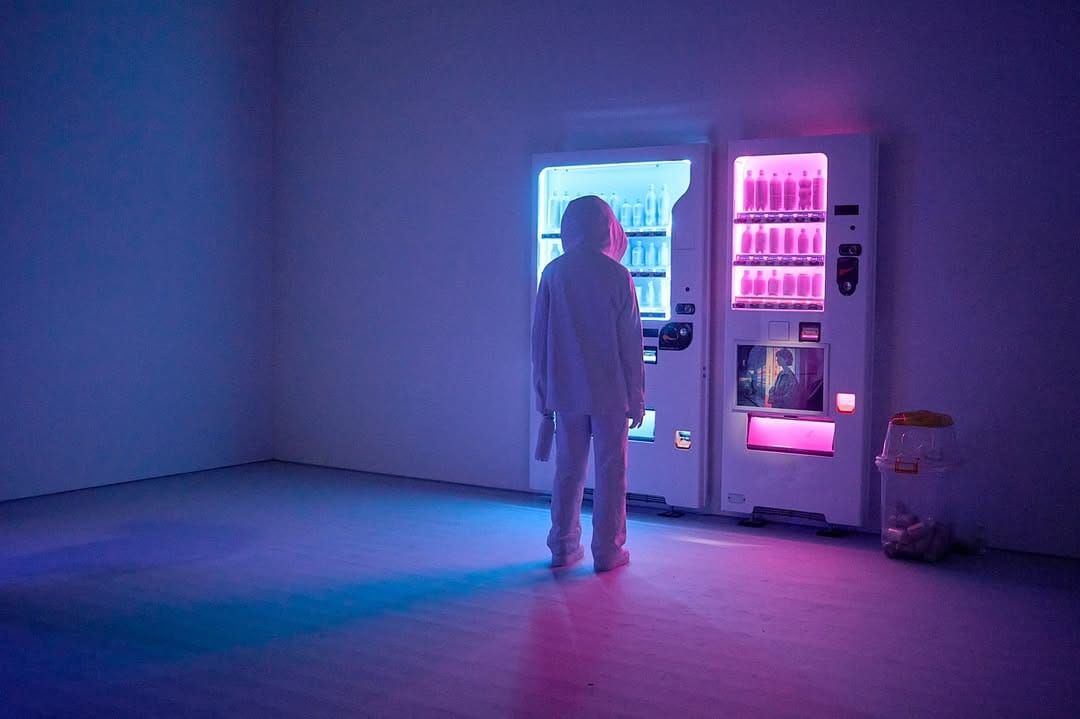

Installation views of KEITA MORIMOTO’s Encounter, 2026, mixed media, dimensions variable, at “what we told ourselves,” 2026, Kotaro Nukaga, Tokyo. Courtesy the artist.
Alongside oil paintings, Morimoto’s recent turn to sculpture extends this inquiry into illumination and artifice. “I wanted to find a way to show that this is ‘something created.’ Using motifs from my paintings, I created sculptures—translating reality into painting, and painting into three-dimensional form, to see how the image would change.” Three life-sized vending machine models were positioned against two intersecting walls, their interiors lined with neon tubes that cast saturated color across the gallery. Functional Mythologies (2026) occupied one wall, emitting a brilliant ocean blue, while Encounter (2026) and Collected Memories (2025) formed a pair on the other, gleaming fluorescent aquamarine and magenta.
In front of the twin machines, a white hooded figure stands with their head slightly bowed, unmoving. Initially legible as a visitor transfixed by the dispensed bottle in the vending machine’s open compartment, the figure revealed itself, upon closer inspection, as a sculptural element of Encounter. The configuration recalls Morimoto’s painting Drifting Blue (2024), in which a similar hooded figure faces the viewer with closed eyes. Here, by contrast, the body is turned away, its posture oriented toward the machines’ glow. Under harsh fluorescence, the figure hovers between object and organism like a cyborg, as if animated—or even sustained—by the ambient light.

“I’m naturally drawn to night scenes, especially artificial light and how it emits color,” Morimoto noted. “At night, I’m drawn to those moments when, in the darkness, you feel like you’re seeing something that isn’t really there. Although I’m depicting the real world, I want both myself and the viewer to sense fiction, story, and imagination within it.” Across the show, this interest in artificial illumination produced an illusionistic reality in which hyperrealistic paintings can be mistaken as photographs and sculptures for living bodies, suspending perception between document and apparition. The works ultimately posed a lingering question: Are they here with us, or have we stepped into their world?
Minnie Chan is an editorial intern at ArtAsiaPacific.