People
Sacred Thresholds: Interview with Gulnur Mukazhanova
From coruscating felt tableaux to evocative photographs and hovering textile installations, Gulnur Mukazhanova’s practice summons the rich cultural heritage of her native Kazakhstan to probe the tensions between ancient traditions and contemporary issues. Her solo show at Hong Kong’s Centre for Heritage, Arts and Textile, titled “Dowry of the Soul,” delves into the post-Soviet conditions of her homeland, confronting the sociopolitical systems and values that continue to shape our identity in an increasingly globalized world. On the occasion of her exhibition, which runs until March 1, ArtAsiaPacific spoke with the Berlin-based artist about ideas of inherited consciousness, ancestral veneration, and spiritual thresholds.
AAP: You initially studied textile design before changing paths and dedicating yourself to working with traditional Central Asian materials, such as felt and brocade. What made you shift your focus, and in what ways—creatively and technically speaking—does your current artistic methodology differ from working in textile design?
GM: After my first year at the Weißensee Kunsthochschule Berlin, I realized that traditional textile design was not my way of creation. I believe that conceptual thinking frees my artistic gestures from any constraints, while still allowing for a certain depth in formal exploration. Fortunately, we had professor T. Pranyko, who encouraged me to embrace a more conceptual approach, which gave me the freedom to adopt an independent mindset when it came to artmaking.
Living outside of my homeland also shaped my way of thinking and enabled me to see things differently—this is how I started the journey of discovering my inner self.
Felt is a very time-consuming medium to work with. Could you walk me through your creative process, beginning with how you conceive your ideas for your felt tableaux? Do you already have specific images and colors in mind when you create these works, or do you prefer a more instinctive approach?
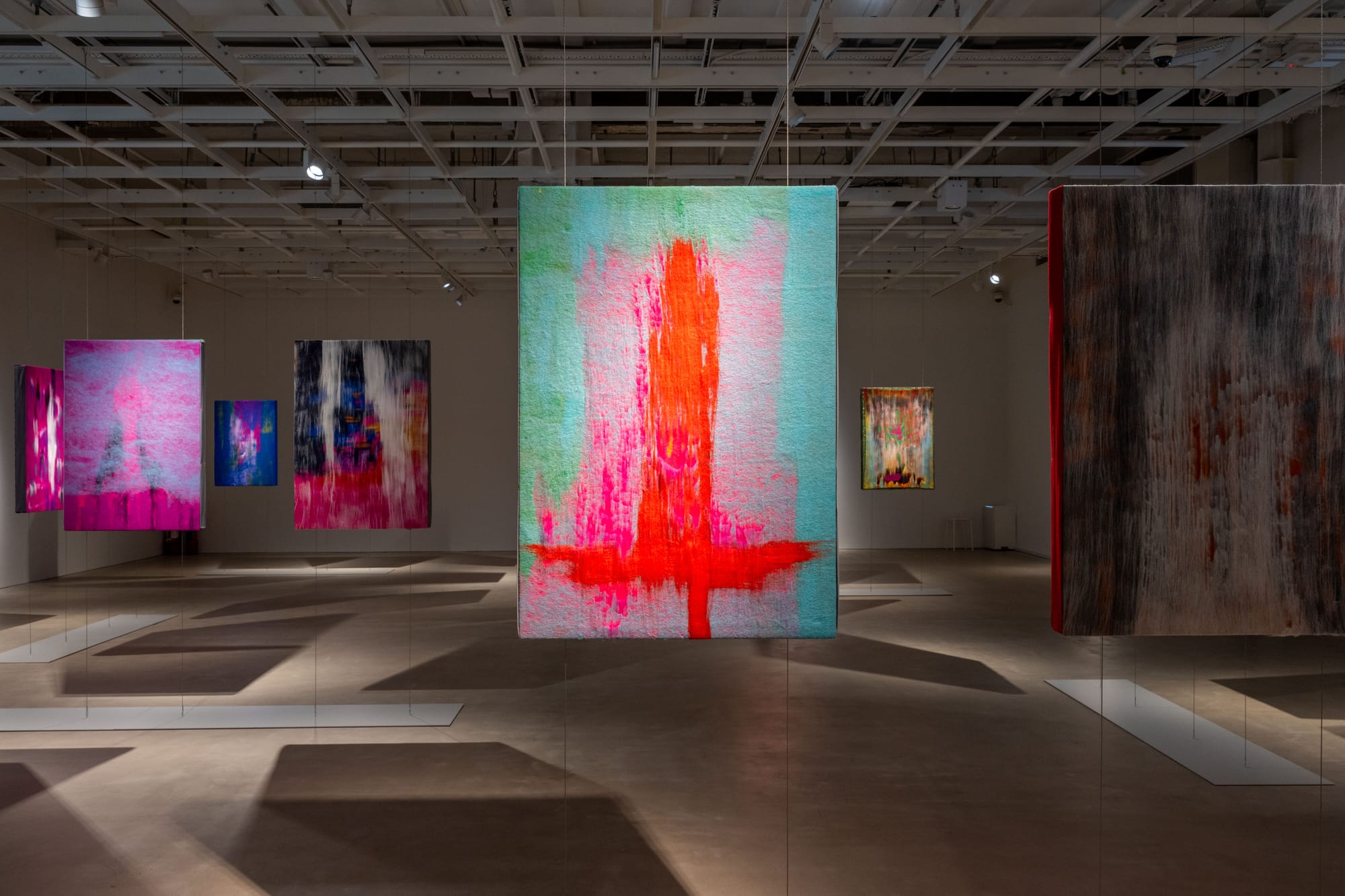
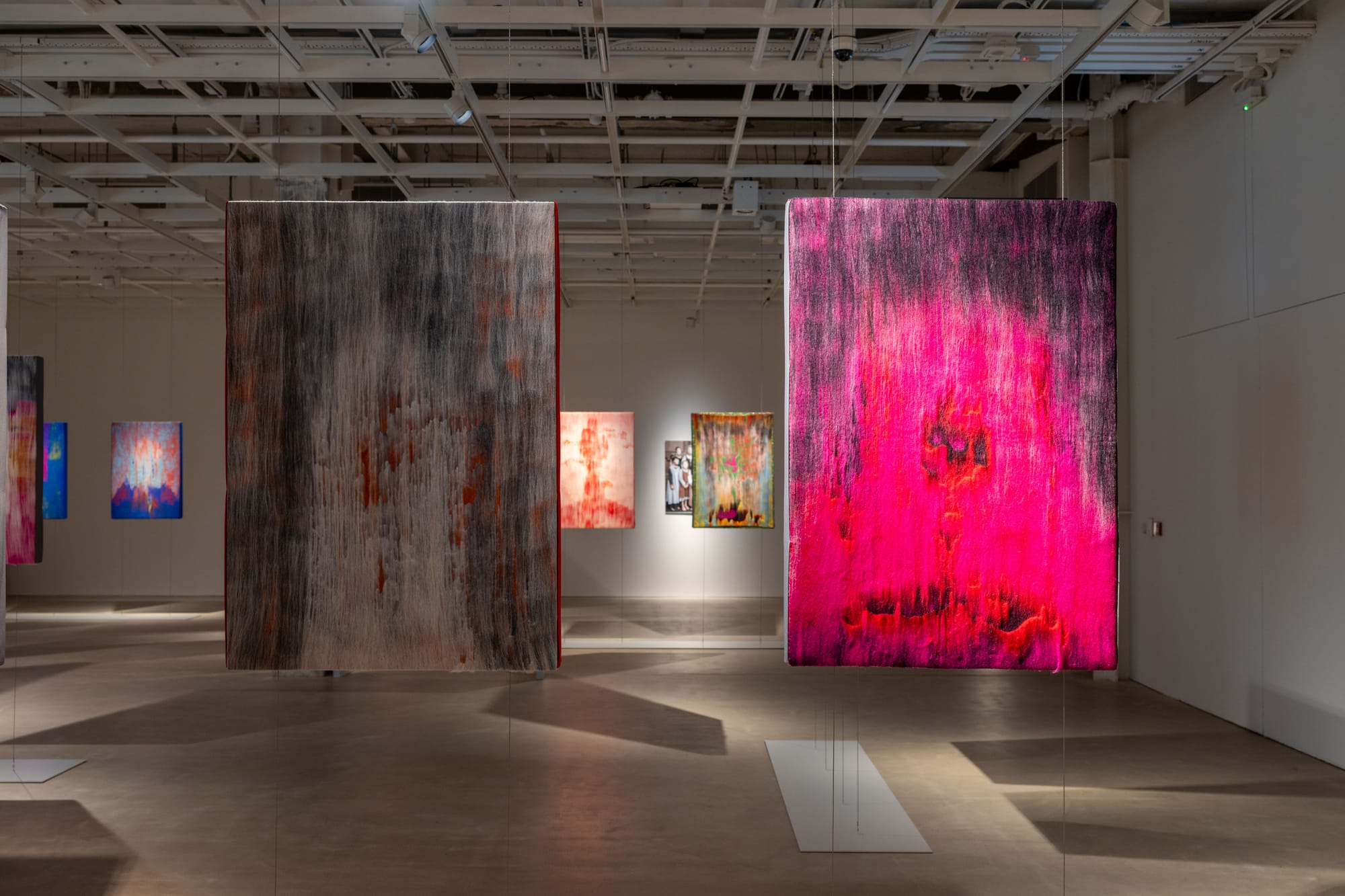
The idea of the tableaux is to transform a traditional technique into contemporary art, using felt as the main material. My process is highly intuitive—I tune into my emotions, which emerge through my body and hands. And my projects usually manifest in a serial style, with each series encapsulating its own form and energy.
The first step is to stretch a very soft felt over a frame. When I do this, I can feel the tensions in our society, shifting and floating around the world. With smaller-scale formats, I often work on two or three pieces at the same time. Some works involve a mix of felt and fabric collage and, therefore, require more time, as they develop slowly. Others come about naturally and effortlessly. For site-specific installations, I create sketches to understand the shape and volume, but the motifs and color combinations arise intuitively throughout the process.
After graduating from university in Almaty, you relocated to Berlin, where you have been living and working for the past 18 years. Could you tell me more about your decision to move to Germany? How has living in another country shaped the way you engage with your Kazakh heritage, particularly in your artistic practice?
My decision to come to Germany was driven by the desire to continue my studies, to learn more, and to discover the art world. I encountered a different way of life in this country. Being able to compare both cultures, I began to question my origins—who I am and what I am doing here.
I should also mention that during my studies at the Art Academy in Kazakhstan, my professor, Saule Bapanova, consistently emphasized the importance of producing high-quality work and preserving knowledge of traditional felting and weaving techniques. Over time, I came to understand that all this knowledge became the foundation of my artistic practice, and thanks to Professor T. Pranyko, I realized that I am following my own path now. It helped me understand that it was necessary to know who I am, to find my role in the global society.
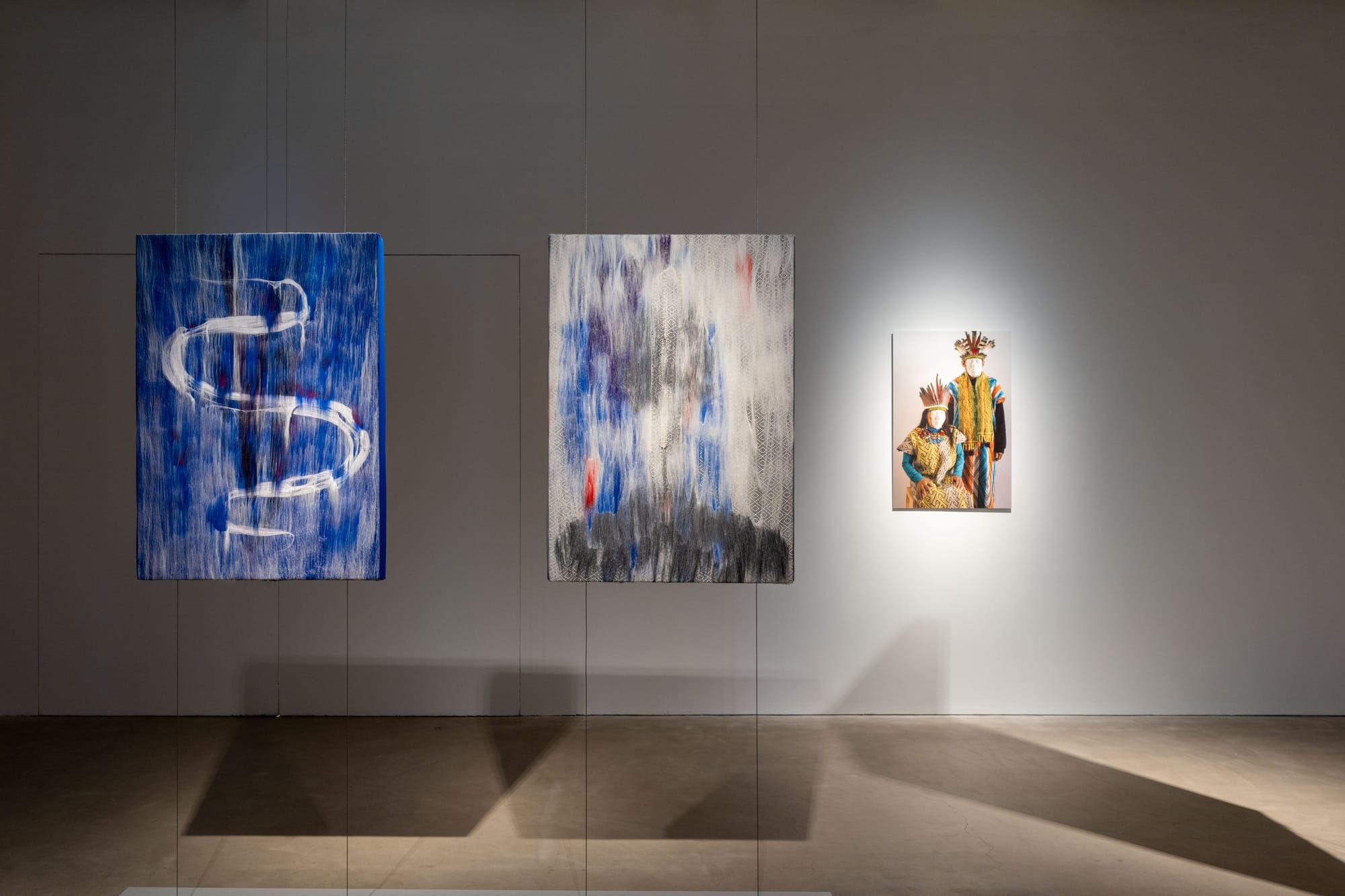
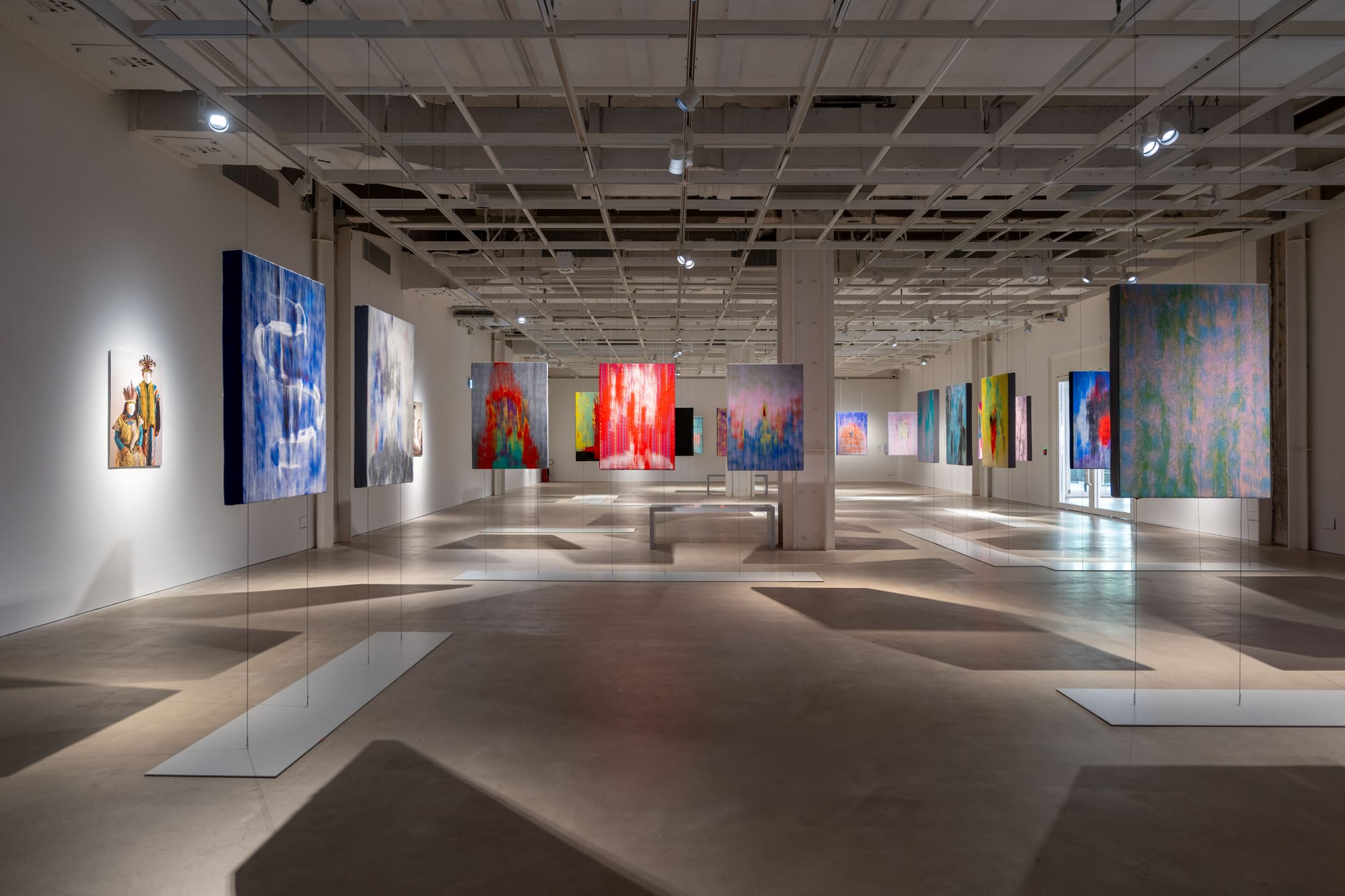
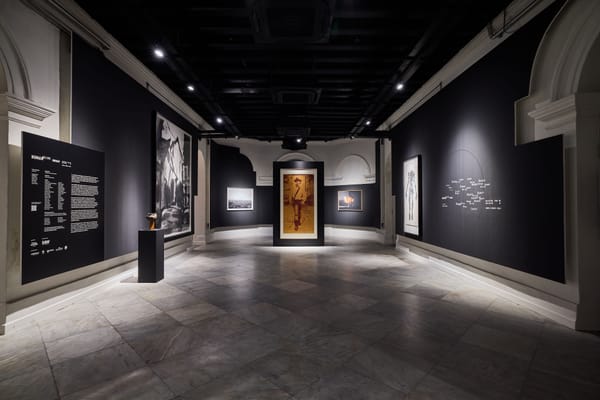
Installation view of GULNUR MUKAZHANOVA’s “Dowry of the Soul” at the Centre for Heritage, Arts and Textile (CHAT), Hong Kong, 2025–26. Courtesy CHAT.
The title of your show at CHAT is “Dowry of the Soul.” At first, it inevitably calls to mind the idea of a bride bringing money and property to her husband for their marriage, though there is also a spiritual connotation because of the “Soul.” What is the meaning behind this poetic title, which bears associations with femininity and devotion, but also refers to this age-old system of marriage settlement?
“Dowry of the Soul” refers to what is passed down from one generation to another beyond material possessions. While the idea of a dowry is historically linked to marriage arrangements, obligations, and social order, I use it as a metaphor for wider social structures.
Like a family, society is shaped by inherited patterns of behavior, norms, and values. These are embedded in our collective consciousness, and continue to influence us even when their original contexts have been lost. Such invisible systems shape expectations, roles, and the way people relate to one another, forming ideas of duty, belonging, and identity. In this sense, the “dowry” represents cultural heritage that we do not consciously choose, but still carry within us. It affects how we see the world and how contemporary society continues to reproduce itself in a globalized context marked by migration and constant change. The project looks at these inherited structures as living systems and invites a critical reflection on their influence on modern consciousness, asking which values we continue to pass on—and why.
In your Portrait-Reflections (on the history of my homeland, Qandy Qantar 2022) (2022– ), rather than depicting actual people, as the title suggests, each piece captures the fraught dynamic between the individual and state power in postcolonial Kazakhstan through vivid abstractions that evoke a multitude of feelings and themes—from ebullience to loss and melancholy, as well as violence. What emotions and memories do you tap into when creating these works? Moreover, what kind of response are you seeking from viewers, particularly when it comes to the perception of your homeland and its culture and history?
Each piece represents a singular emotional state. They are my deep condolences and reflections on these events. In this context, I believe the work is about human loss and the value of life. After all, we are all human beings living in different cultural contexts, yet we experience the same emotions. Therefore, this series is about empathy, sharing grief, and accepting pain without losing oneself in it.
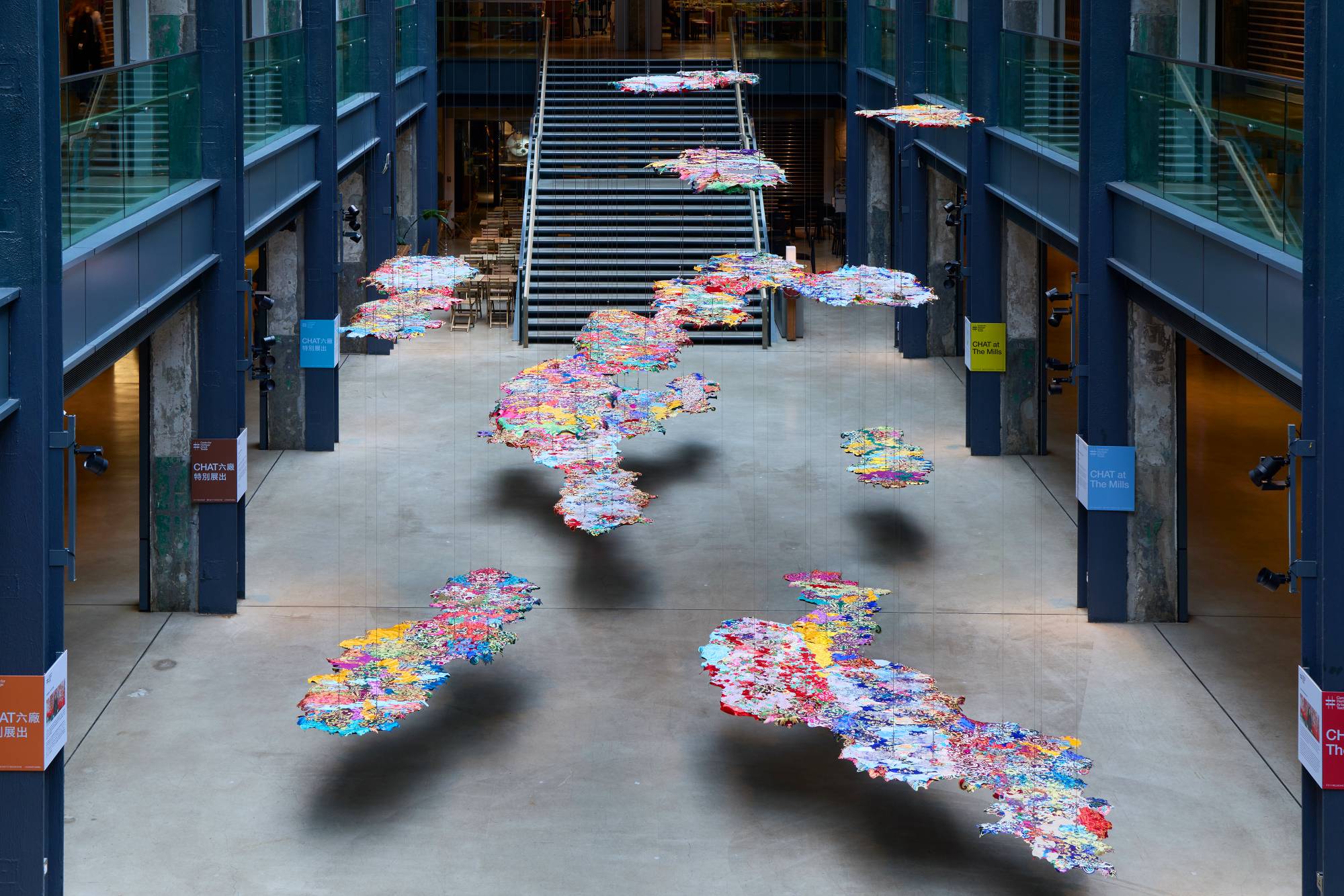
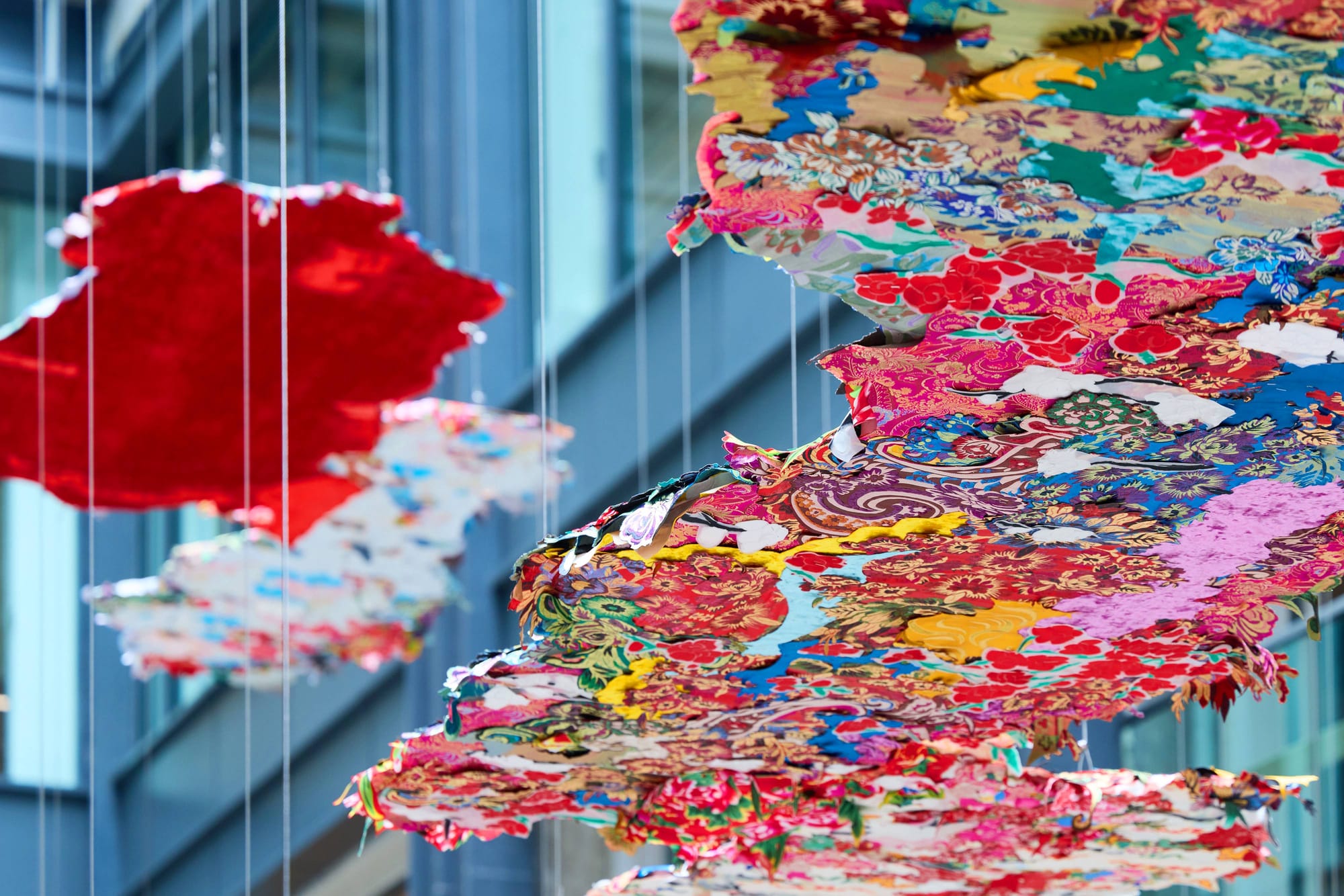
Installation view of GULNUR MUKAZHANOVA’s False Hope or Moment of the Present, 2018, mixed media, dimensions variable, at the Centre for Heritage, Arts and Textile (CHAT), Hong Kong, 2025. Courtesy CHAT.
You also showcased your large-scale collage installation, False Hope or Moment of the Present (2018), at CHAT—a large-scale textile collage installation that hangs mid-air, appearing like clouds or floating islands. While they conjure a dreamlike scene, there is also a sense of fragility as the delicate cloths hang in the air, teetering between buoyancy and collapse. Could you tell me more about these contrasting elements and how they embody the cultural significance of Kazakh textiles in the contemporary context?
Shiny fabrics symbolize our modern obsession with surface and appearance, the pursuit of glamor and luxury without recognizing the deep cultural traditions behind them. This highlights how superficial our perception and values can become.
The installation, suspended from the ceiling and seemingly floating in the air, creates a dreamlike illusion, yet it remains fragile and unstable. But there are also needles, which emphasize this vulnerability and hidden danger, as if these illusions could collapse at any moment. In this context, the textiles become a symbol of loss: the loss of cultural codes, values, and a genuine connection to our heritage.
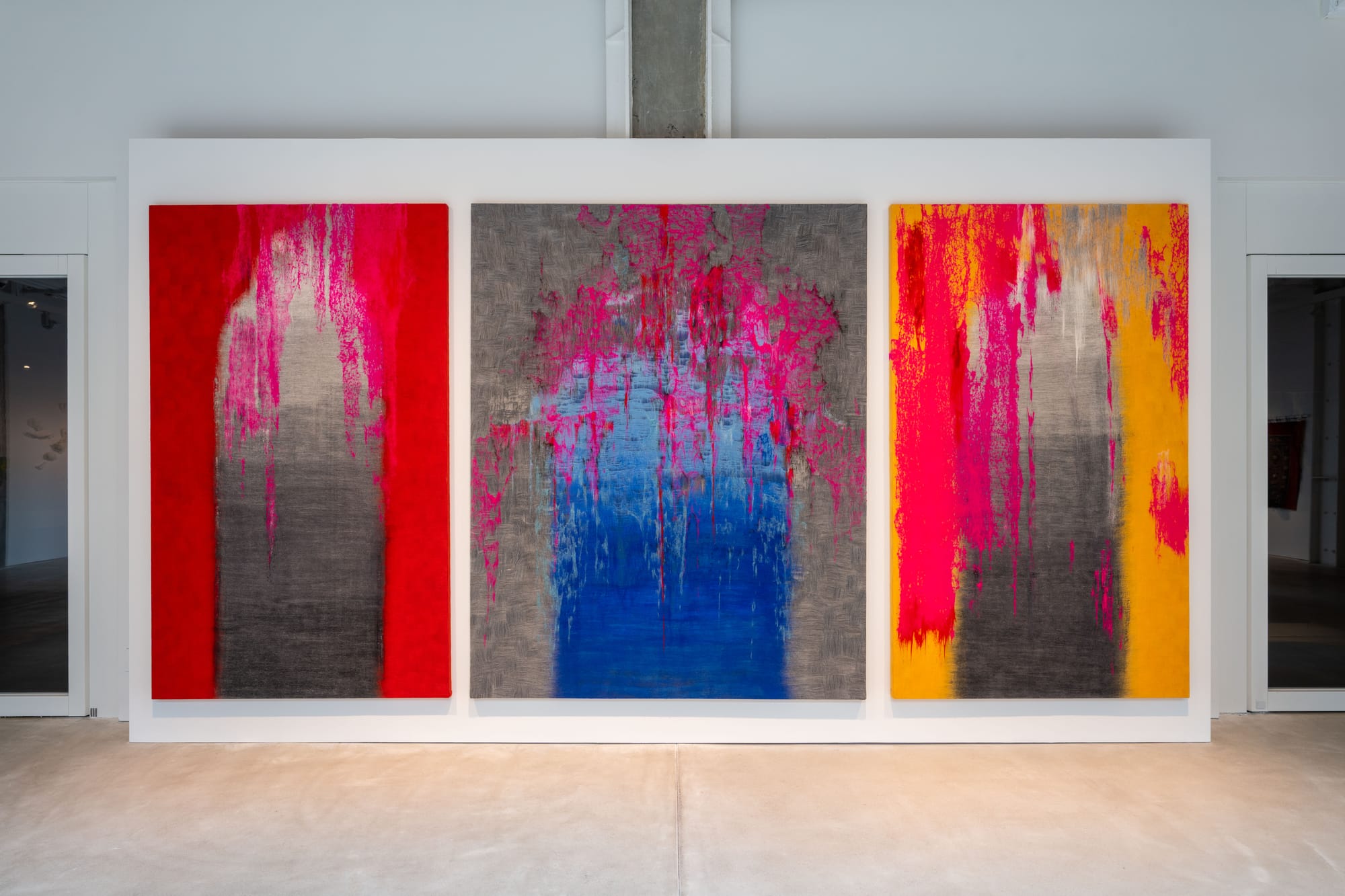
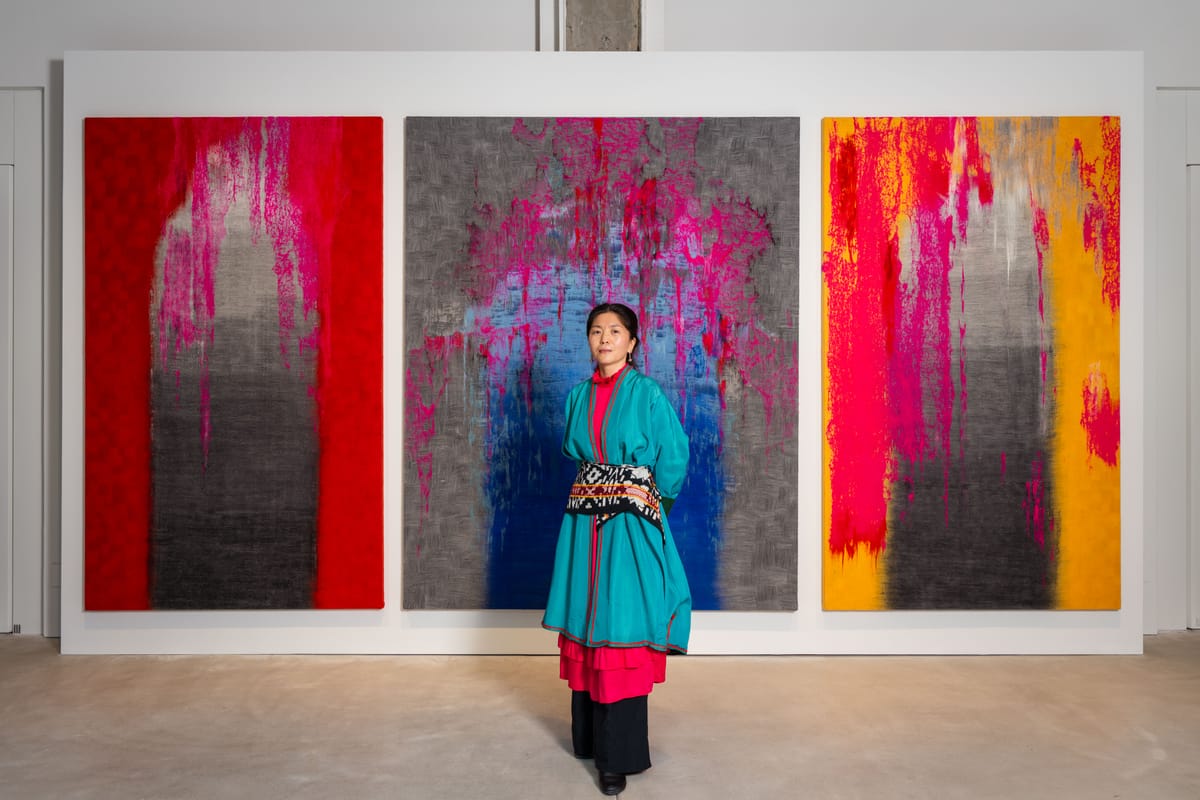
Your three large-scale felt works, Post-Nomadic Reality – Untitled (2025), displayed at CHAT, also feature bold streaks of color. Looking at each piece, it’s as if we’re standing in front of a threshold, peering through curtains into the far-off horizon. Could you tell me more about this series?
Yes, there is a horizon, but it is very far away because we are standing on a threshold. The works capture a transitional state: we want to move forward, but we are blocked. In Kazakh culture, the threshold is a sacred place. People believe that the spirits of their forebears live there. That is why it is forbidden to lean on the doorframe or step on the threshold: one must bow out of respect for the souls of the ancestors before crossing it.
My ancestors were shamans, and we still honor their spirits. I believe there is meaning in this—it reflects our transitional state and the struggle to move forward.
Your practice also spans photography and video. Conceptually speaking, how does your approach to these latter media differ from your work with textiles?
Photography complements my textile works. It lets me unfold the conceptual idea from a different perspective, and allows me to engage in a more direct dialogue with society.
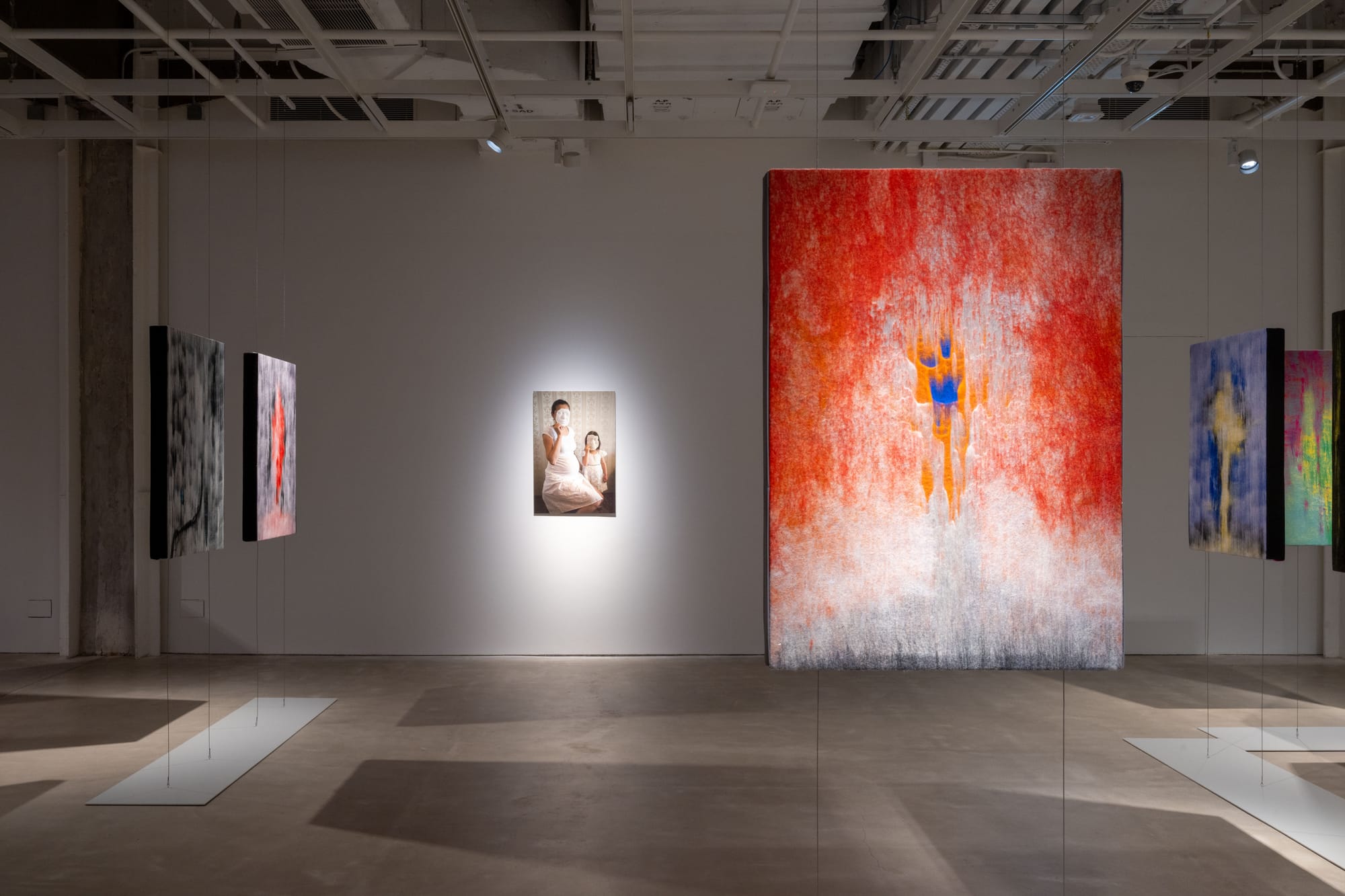
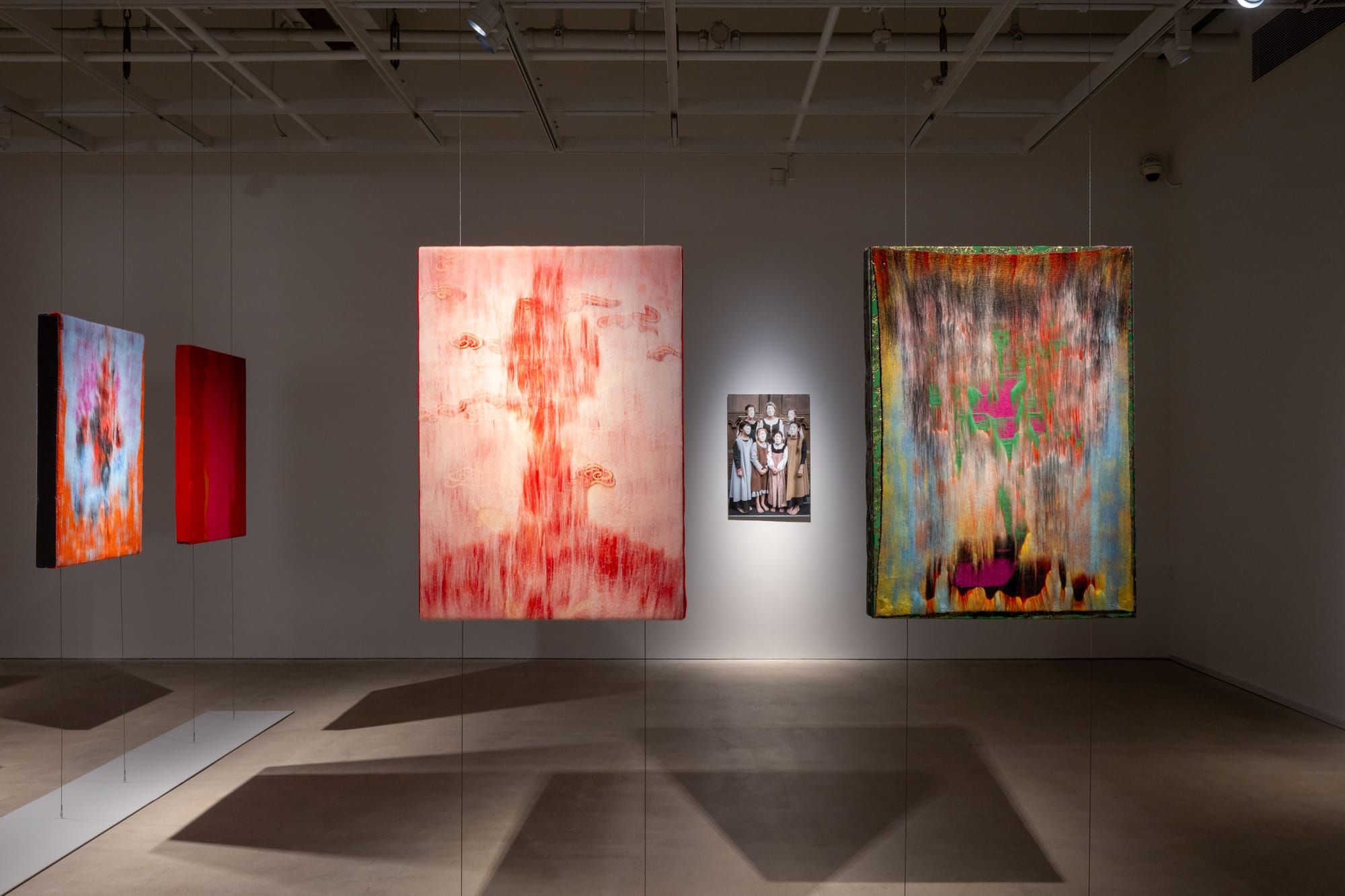
At CHAT, your photographic series Global Society (2013) offered a stark visual contrast to your Portrait-Reflections, delving into the impact of globalization on Kazakh society. Each image depicts various individuals—most of whom are women—and they’re holding up white felt masks to cover their faces. Could you share your process of taking these photographs, as well as your experiences of engaging with the subjects you captured? Who are they?
The idea of combining felt and photography came from the curator Wang Weiwei, and I believe it was a very successful decision. The photographs and felt portraits complement each other, and the contrast augments the essence of the works. It just so happened that most of the subjects are women, although this was not intentional.
They are different people I encountered along the way during various residencies—not only in Central Asia, but also in Europe. The idea of working with photography emerged after my sculptural works with masks, Transformation of traditional values during Globalisation (2012). Fortunately, the people I met were open to experimentation.
The white masks are a notably recurring motif in Global Society, made in the likeness of each respective subject. There’s a tension between visibility and anonymity here—what do the masks symbolize to you, and what are you seeking to express through these images?
I wanted to present the world as a single face, to allow for a direct encounter with it. In fact, at that time, this idea felt frightening to me because I was in a rather strange state of mind. The project began in 2013, and today, many years later, I understand more clearly that we are deeply connected to our roots, even when they seem to have disappeared. On an unconscious level, we continue to draw energy from them.
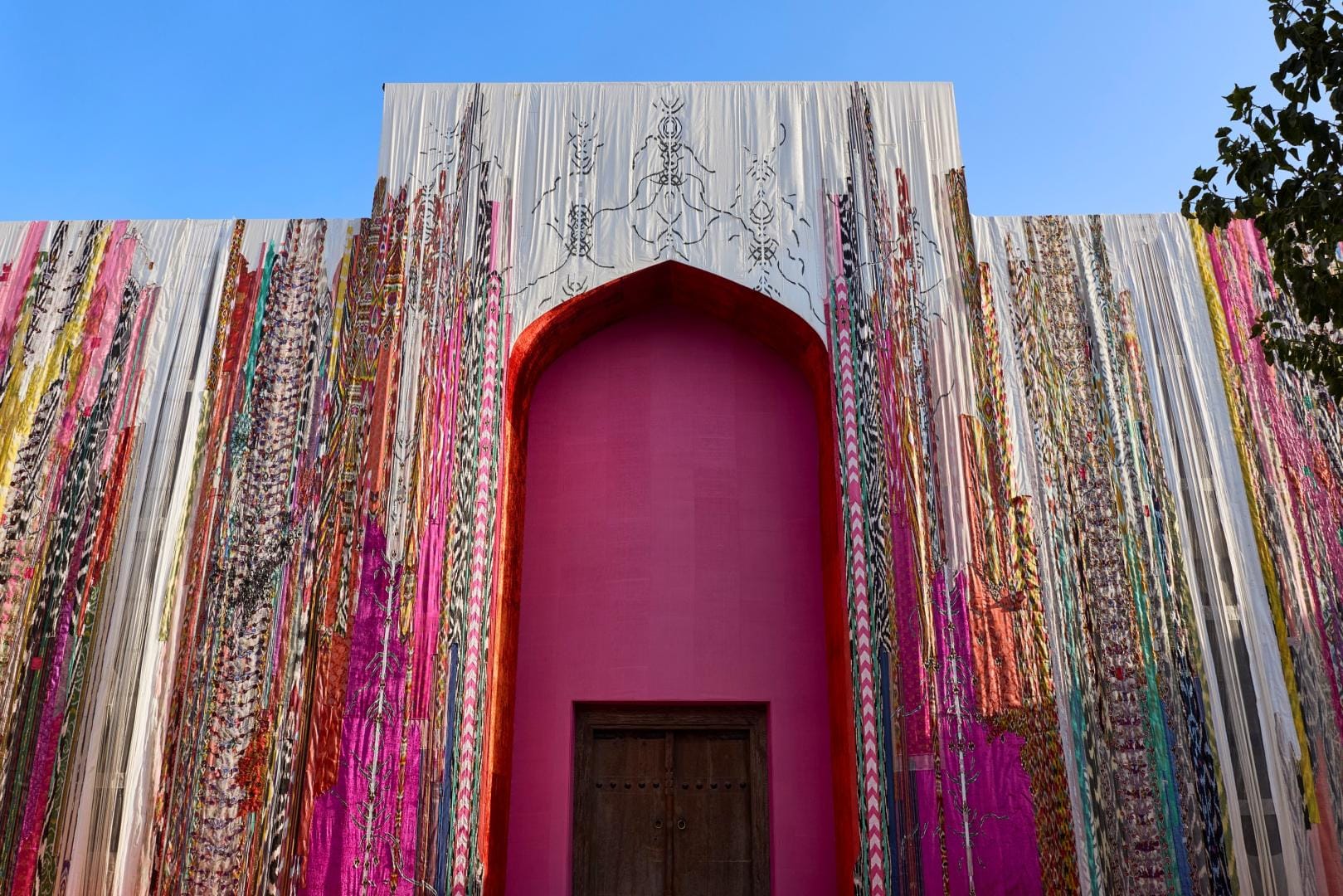
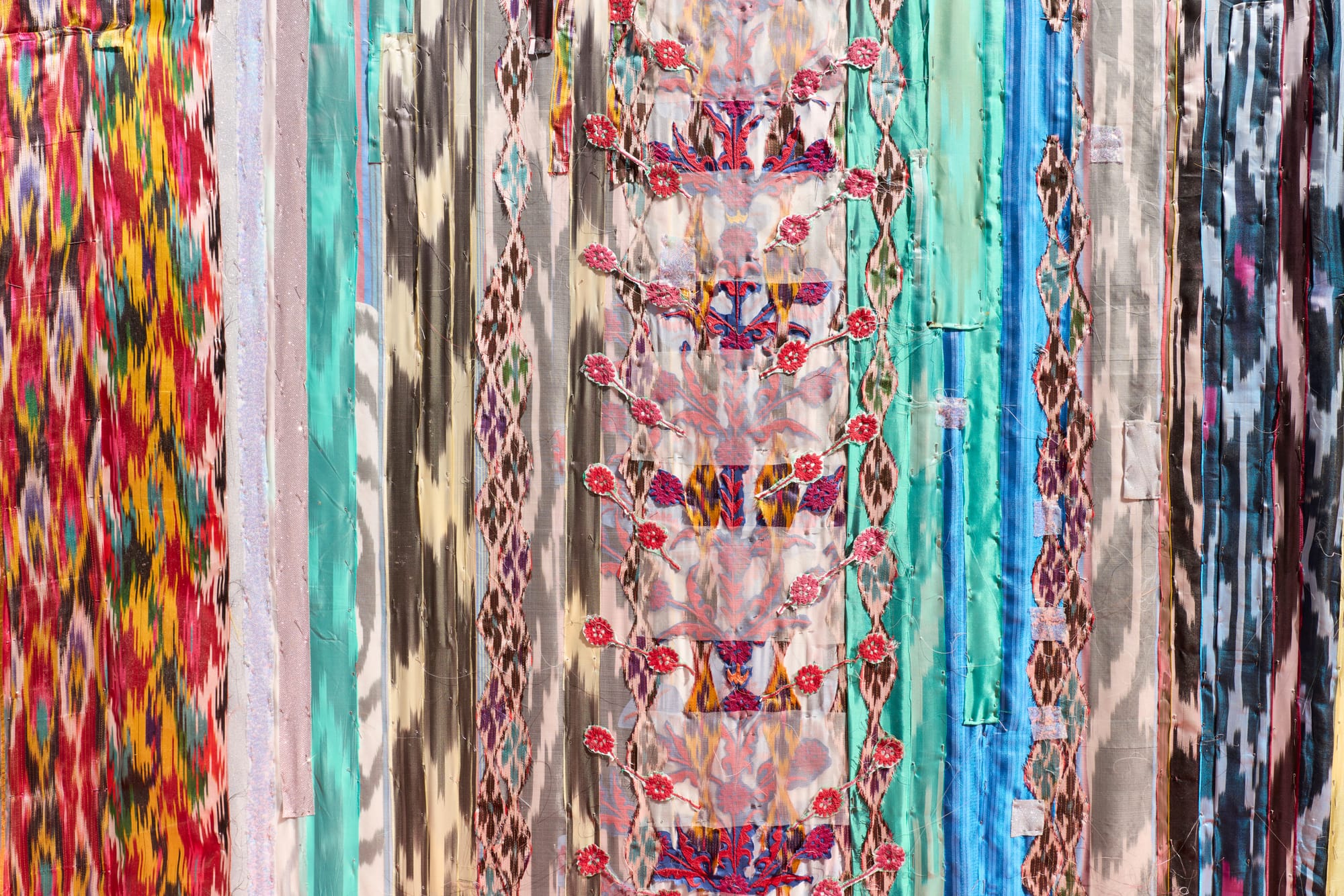
For the inaugural Bukhara Biennial, you collaborated with Uzbek artisans to produce The Healing of Present (2024–25), a monumental textile installation comprising vibrant vintage fabrics held up by needles, which explores fragility, remembrance, and collective healing. Could you tell me more about the story behind this piece; did it take one year to make? You worked with local craftspeople to realize the project. Uzbek artisans also have a rich textile tradition distinct from Kazakh traditions—what synergy emerged from your collaboration?
I began working on the concept of the project in 2024. After that, the form, colors, and textures that would convey the concept came naturally. The actual production of the entire installation took about one month of very intensive work with 18 assistants. These were wonderful women from Bukhara—seamstresses and students. We spoke in our own languages: I spoke Kazakh, and they spoke Uzbek, and we understood each other perfectly. It was a beautiful time of working together, sharing our experiences, and discussing our cultures and contemporary society. In Central Asia—whether in Uzbekistan or Kyrgyzstan—I feel at home. We share one history.
What upcoming projects are you looking forward to this year?
This year is going to be very exciting for me. I am working on new large-scale, site-specific installations for two exhibitions in Berlin: a solo show at Kunsthaus Dahlem and the Kyiv Biennial at the KW Institute for Contemporary Art in the summer. Then, in November, I will be holding a show at Whitworth Gallery in Manchester, with the support of the Bagri Foundation. These projects will continue my exploration of cultural memory, identity, and the relationship between the body and space.
Annette Meier is an assistant editor at ArtAsiaPacific.