People
Fragile Monuments: Interview with Pio Abad
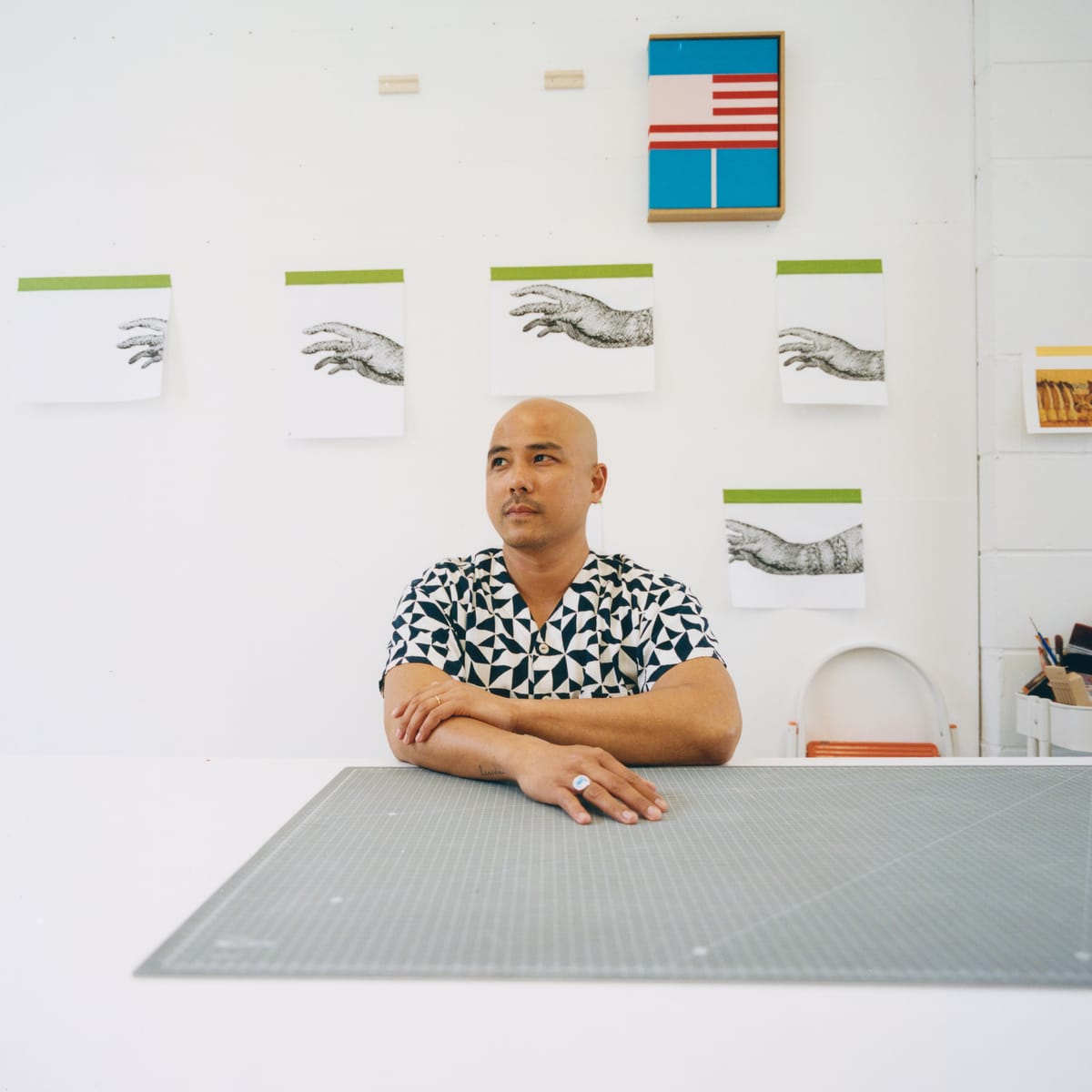
This conversation with Pio Abad traces the interwoven histories of migration, loss, and belonging through two of his works, Giolo’s Lament (2023) and Vanwa (2023/26), presented at this year’s Diriyah Contemporary Art Biennale. Spanning the Philippines, Oxford, Taipei, and Saudi Arabia, the interview connects a tattooed hand in a 17th-century print to fragile earthen text in the endangered Ivatan language, mapping the emotional and conceptual terrain they share.
Reflecting on Giolo—a young tattooed boy from the Mindanao region taken to England in the 1690s and exhibited in London as a colonial curiosity—and on Ivatan love poems sung at rites of passages, Abad considers art’s capacity to monumentalize the ephemeral: song, grief, and memory. The discussion delves into the quiet politics of beauty and the entangled histories of Saudi Arabia and the Philippines. What emerges is an intimate meditation on tenderness, loss, and unstable territories—emotional and geopolitical—within which Abad’s work persistently seeks out a voice.
The theme for this edition of the Diriyah Biennial, “In Interludes and Transitions,” suggests a space of pause, of being in-between. How do you think your works exist within this framework? What does “Interludes and Transitions” mean to you in the context of Giolo’s hand reaching out across time, or Vanwa’s fragile monument to an Indigenous community and its customs?
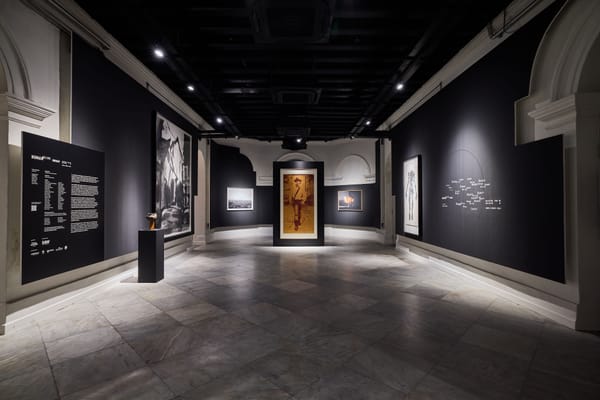
I am really happy to be showing these works together for the first time in Diriyah. To be able to bring them in the same space and in conversation with such an amazing community of artists is special. I love that it’s in a room the curators have titled “A Hall of Chants.”
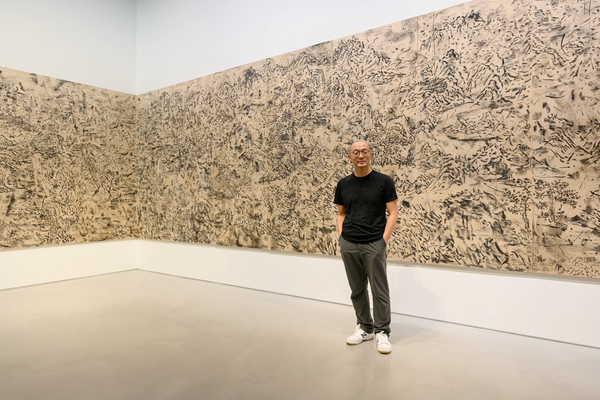
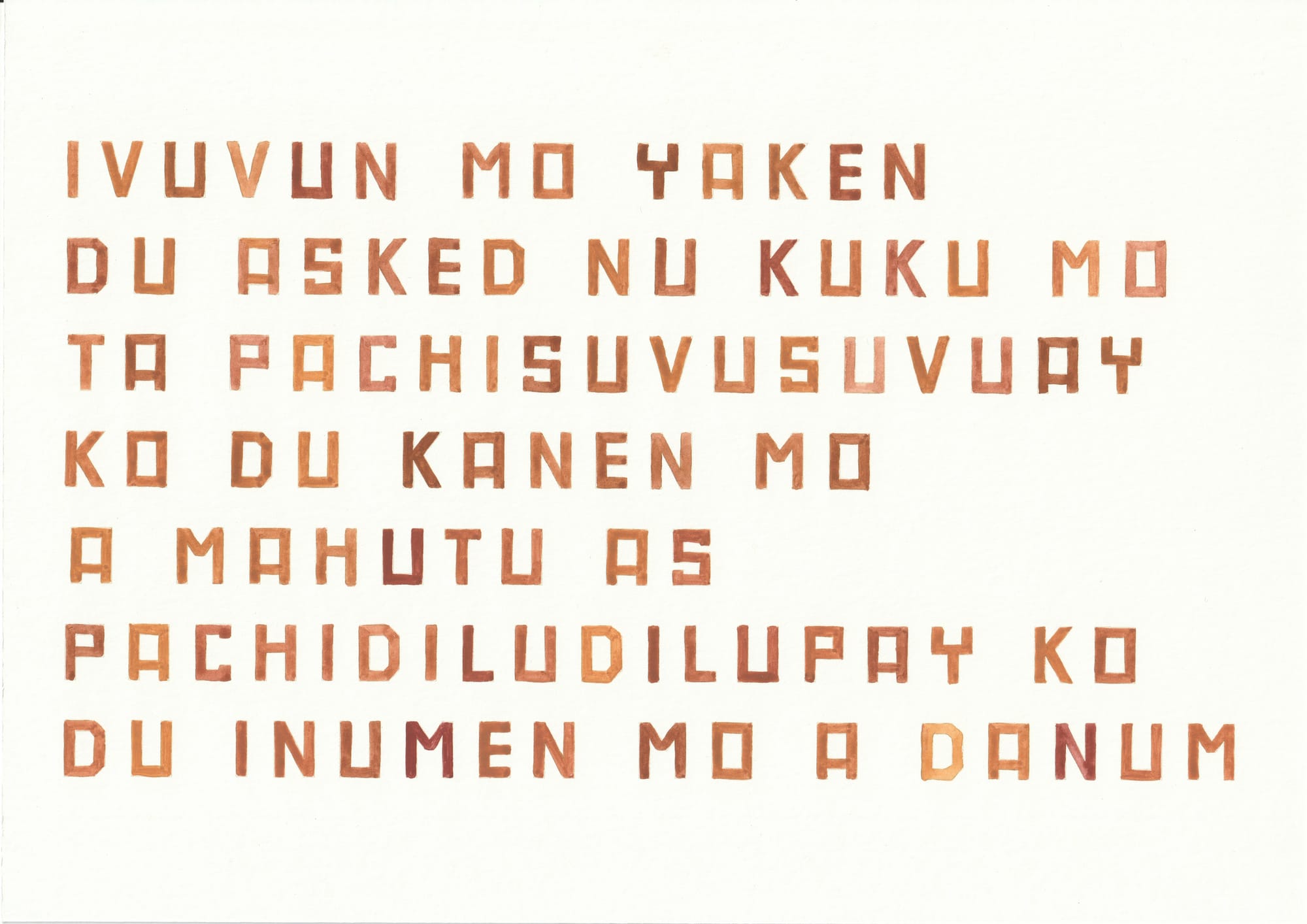
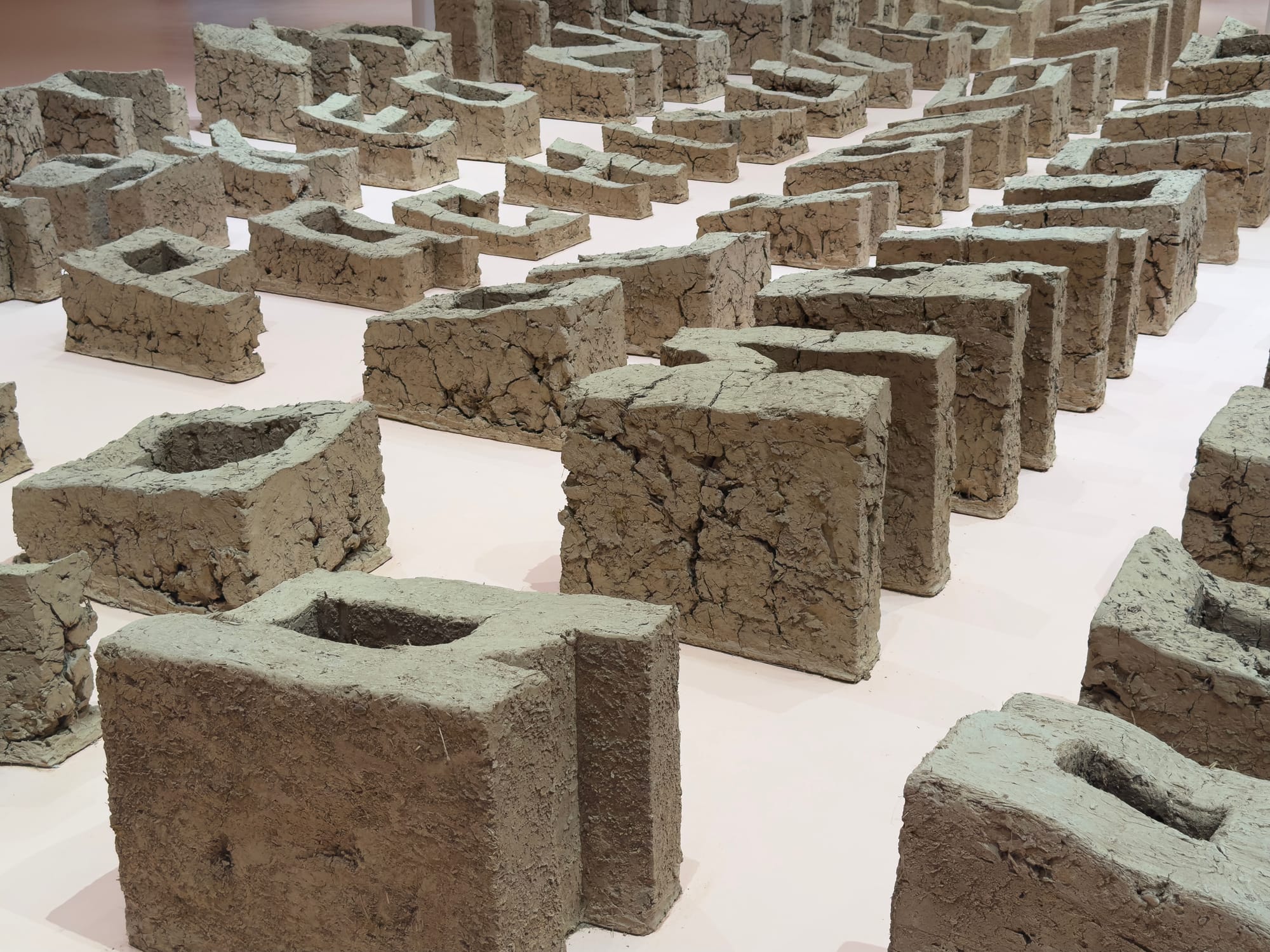
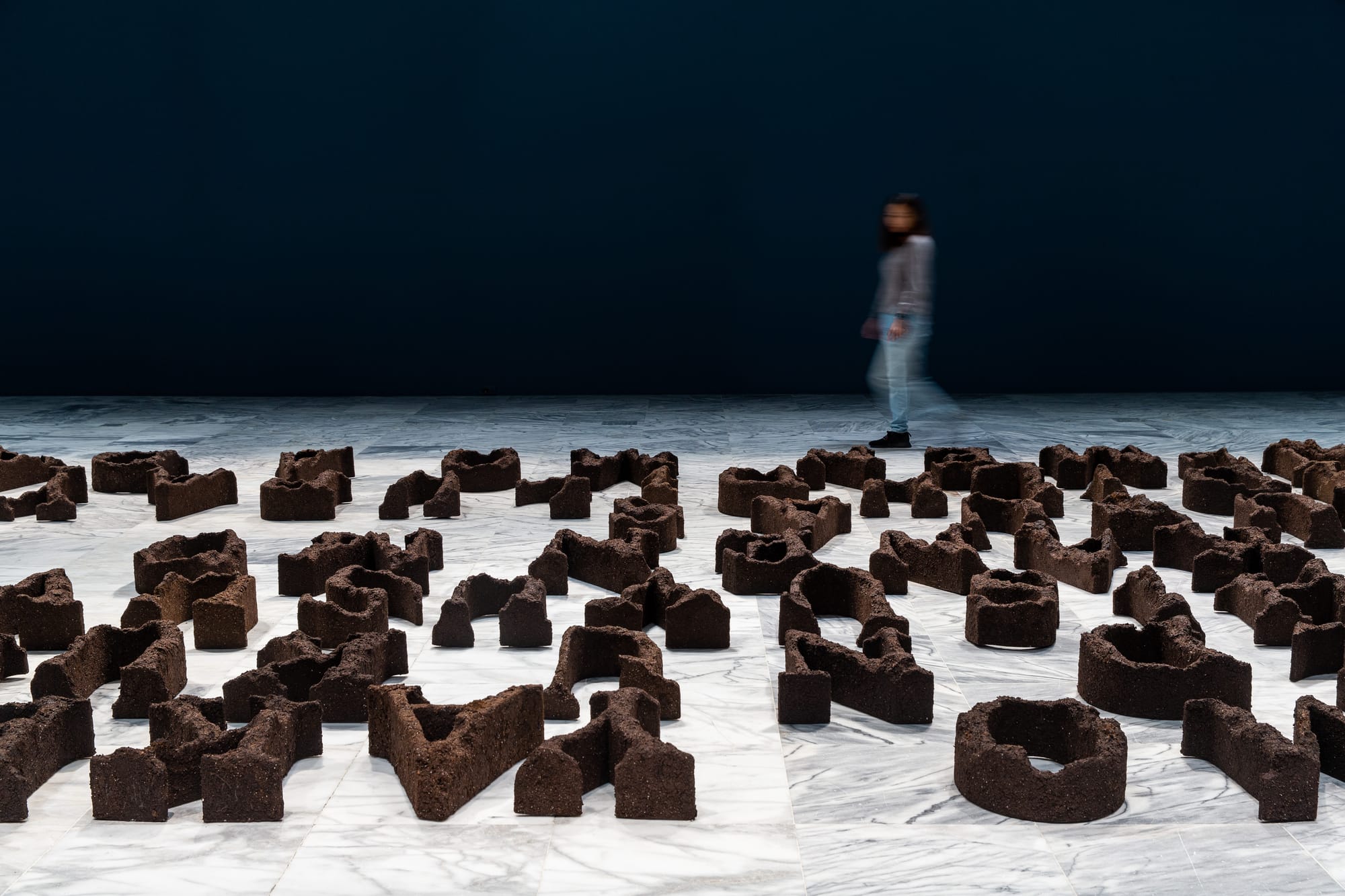
With Vanwa, the work is initially encountered as a landscape but as you walk around it, you realize it’s composed of letters—it’s a text piece masquerading as an archaeological site. As you look closer, you realize you might not necessarily understand what it says. It’s a poem in Ivatan, my father’s language from the northernmost islands of the Philippines—a language that not many people speak. Despite that layer of opacity, the public’s response to the work has been really beautiful. I think the way it shifts between language and landscape is evocative in so many ways. It is a sense of in-betweenness that invites interpretation and is constantly generative.
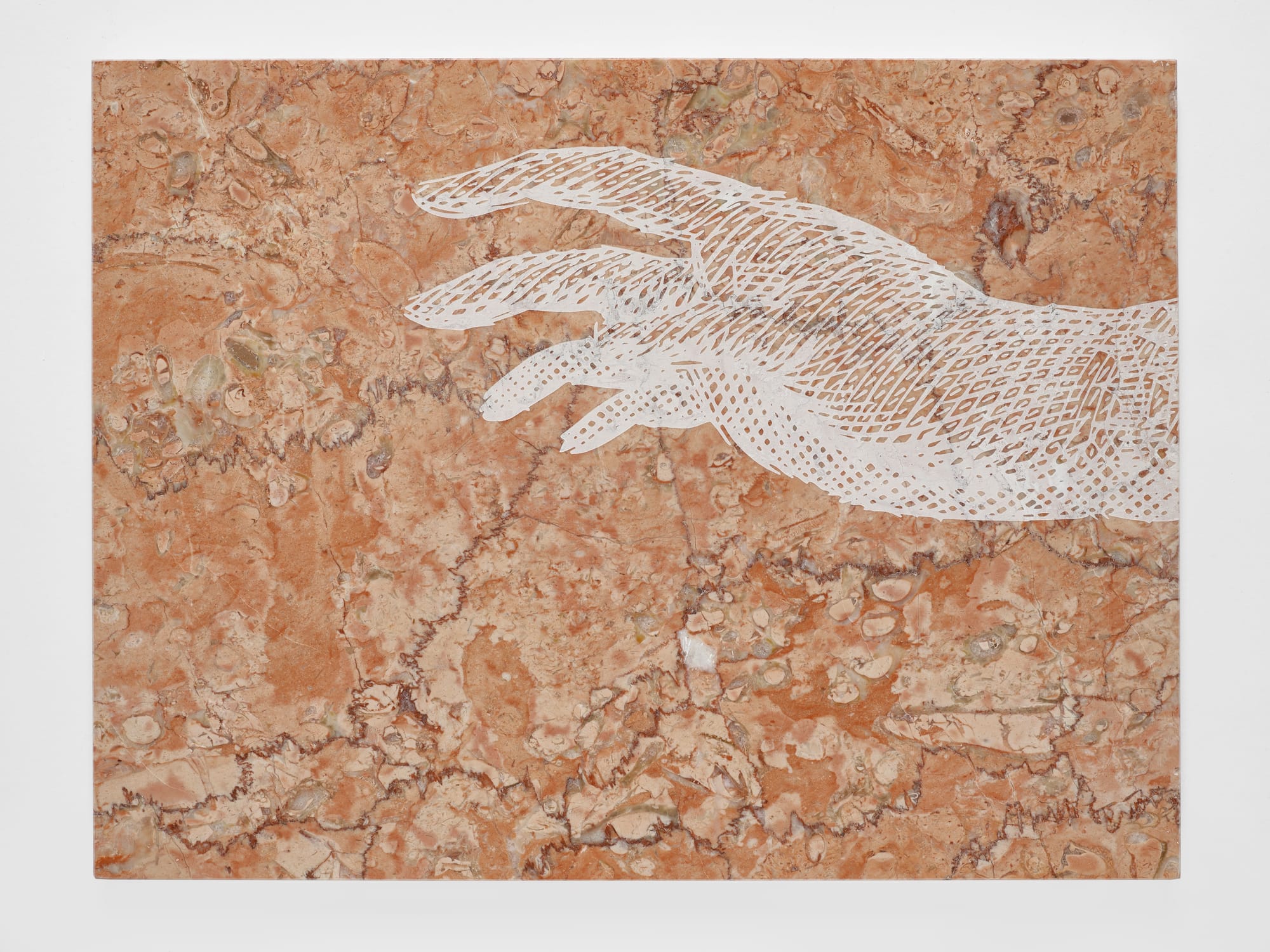
With Giolo’s Lament, the 11 marble slabs of his tattooed hand are like a musical score. You can read the work in two ways: the hand as grasping for something, or the hand as it is pulling away, struggling, or fading. This idea of transition, of a body in transit, or of land becoming language becoming land, speaks to an instability—of entities constantly shifting across time and across oceans.
If Giolo’s Lament is a song of mourning, what melody or rhythm did you hear while making Vanwa?
The words given form in Vanwa are actually fragments of an oral tradition in Batanes called laji. The Ivatans refer to them as love poems and they are performed during rites of passage. As a child in Batanes, I remember hearing these songs being performed during weddings, town fiestas, and wakes, usually by the elderly ladies of the community who know these songs by heart, passed on to them by their elders. The whole cycle of life is contained within these laji. For the longest time, these poems were only passed on orally, and I believe it was only in the 1960s or ’70s, that an Ivatan anthropologist recorded the performances, and then transcribed and documented them. I showed an iteration of this work at the Taipei Biennial in 2023. At the time, it was titled Laji No. 97 based on this book of transcriptions.
When Nora and Sabih and I began talking about the Diriyah Biennale, the idea of songs as primary agents of transmission and procession became central to how they conceived of the exhibition. It became clear to me during our initial conversations that I wanted to reimagine the laji installation for Diriyah.
The reimagined installation has been retitled Vanwa, the Ivatan word for “harbor,” the site of many community rituals in Batanes. It is also a word that recurs across the Pacific and the Austronesian diaspora. In my mother’s language, Kapampangan, it means “age” or “celestial space.” In Cebuano, it means “homeland.” The name of the nation island Vanuatu derives from this word. Again going back to an instability—a word constantly changing form and migrating in meaning while retaining a kind of spirit.
Why did you choose that particular poem?
I simply fell in love with that fragment of a poem. It translates as: “Bury me under your fingernails, so that I may become part of every morsel of food you eat, and that I may become part of every cup of water you drink.” When you think about burying, often it is about leaving something behind. But this idea of being buried under someone’s fingernails conjures a beautiful image of loss.
Yes, because then it’s always with you.
Yes, it’s itinerant, rather than fixed, which is what burying usually is, right? It also speaks about loss as something that could be nourishing.
And the fact that the work is about hands, and Giolo’s Lament is also a hand engraved across pieces of marble. As I say this, I’m only realizing this now—they’re both portraits of hands.
I was just thinking to myself, why didn’t I get that?
But I also just realized this now! I think that’s the beauty of bringing together works that have never shared a physical space before. You discover these really essential things that you can forget about amid the complexity of making.
Or maybe it’s just happening subconsciously.
Yes, or that I just make work about hands!
How does does Giolo’s Lament harmonize with ideas of migrations and transformations?
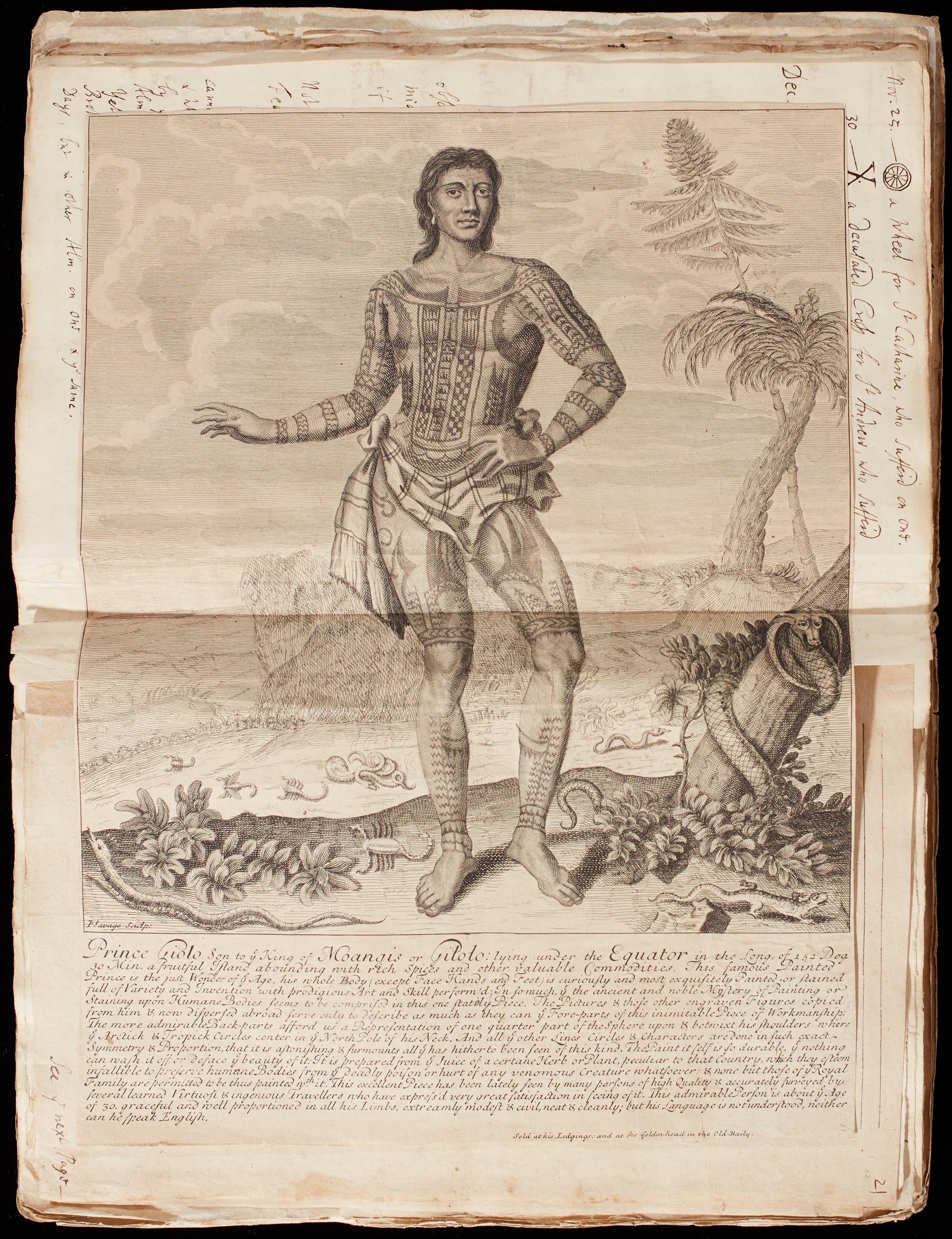
The idea of the migrant, and the migrant body, is present in both works. Giolo’s Lament is based on this etching I found at St John’s College in Oxford while I was doing a project at the Ashmolean Museum two years ago. It depicts a young man, tattooed from neck to toe, and originally functioned as an advertisement to see “Prince Giolo” in pubs all around London. He was taken by the British pirate William Dampie, from Miangas—an island near Mindanao—and brought to the UK to be sold as a slave. He ended up being exhibited around Fleet Street as an exotic curiosity. Later, he got smallpox and was moved to Oxford, and that’s where he died. After his death, sections of his tattooed skin were removed and preserved as specimens at the Bodleian Library—layers of indignity that extend beyond his lifetime.
And it was institutionalized indignity.
Yes. It was not even Pitt Rivers, known for its anthropological collection.
Yes, the Bodleian—the Library.
Yes, the library of knowledge that all ethnographers view as the source of all the taxonomy of everything we know. I wanted to bring his story to life, but not through that painful history. I wanted to monumentalize him. There’s a biblical quality to it that I kept going back to—the hand in the etching is like Adam’s hand in the Sistine Chapel. I also wanted to insist on his humanity. I used marble that was the color of flesh—of blood coursing through veins.
But as I was researching—and this is when it gets interesting—I realized that William Dampier was also among the first Europeans to set foot on Batanes, my family’s ancestral land. He had traveled to Southeast Asia in search of spices and gold, journeying to Mindanao, where he encountered Giolo, and to Batanes shortly beforehand.
It’s almost like you’re coming full circle! So he was a pirate?
They were all pirates! He was a buccaneer, but also chronicled his time in Batanes, producing one of the earliest written accounts of life in a Pacific village in the Iron Age. But I didn’t know that when I first found Giolo’s story. It’s interesting how these facts end up finding you.
My own theory is that Giolo was probably a young boy, as the accounts describe him being taken with his mother. Yet in the etching he is rendered in idealized contrapposto, with the classical proportions of an adult European male.
What were the accounts saying?
That he was a prince who was taken from his home with his mother, who ended up dying during the journey back to England. There were also questions about whether he was from the Philippines or from Indonesia. But during that time, there was no distinction between nations, of course.
But he was from Batanes?
He was from Miangas, so this pirate Dampier had managed to traverse the whole of the Philippines, from North to South, and return to the UK—not with gold or spices but with the grieving Giolo.
And to you!
Yes, to me in Oxford. On a personal level, I think loss is a monumental experience for everyone. Knowing Giolo’s story—his mother dying in Dampier’s captivity—made me realize how much of my own work comes from that same source of grief. I empathized with that little fragment of text saying that he was taken on a ship with his mother, but only he survived. Vanwa then became a way of ventriloquizing what that loss might sound like: perhaps as a voice for Giolo, or perhaps his mother telling him she will always be there.
That’s so beautiful.
Really beautiful. And then these two works start having this conversation.
Haven’t you in the past talked about how objects have an existence, a meaning, or a way of connecting to the world and to histories beyond?
Yes, these networks are larger than us, but also deeply embedded within us.
And here, you have your two artworks, unknowingly talking to each other.
I think the more we have this conversation, the more I realize how many more links there are—you start embroidering the connections even more.
I find Giolo’s story so heartbreaking.
Yes, every time I tell his story I get goosebumps. This story resonates beyond an understanding of Philippine history.
They might not relate, but they imagine together.
There’s something about that gesture, or that hand, that people really connect with. Perhaps it’s because it is roughly human-sized, or because of the way the marble undulates—it almost echoes a song, but it’s also the movement of the ocean.
I know we have had multiple conversations about my work over the past few years and how I have invested quite a lot of time talking about the specificities of Philippine political history. With these works, there is another layer of tenderness and poetry that I am trying to get to that was less present in earlier work, which was a lot more forensic.
Can you talk about this sense of loss that exists in both pieces, especially within the setting of Diriyah, where they are rooted in Philippine history? What are you trying to reveal though the works?
When I showed the first iteration of Vanwa in the Taipei Biennial, one of the curators was Reem Shadid, who is Palestinian. The show opened in November, so a month or so after October 7. What I found in the conversations I had during that week with Reem and the other artists was that people had this almost visceral connection to the work. Even if the language is not accessible, it communicated feelings of love and loss, of land and belonging.
Earlier at breakfast, we talked about beauty in history, and I still really want to make beautiful things. I’m still seduced by surface, or in the case of Vanwa, how the mud crumbles in specific ways. I’m still staging a ruin in an exquisite sense because I hope that the audience can initially be seduced by the work, and then, as they spend more time with it, they read about the historical context it was produced in.
Speaking of beauty, your work often has this quiet beauty, but underneath, they speak to violence or loss. How do you approach this balance—creating something visually seductive without softening the emotional, ethical, or political edges of what that object is supposed to represent?
I am very clear: I am an artist. I want to make things that people want to look at. I’m not a politician or an activist, so fundamentally, the first contract of exchange between the thing I make and the viewer is the encounter with form. There is a way to talk about pain or loss without replaying the violence of that pain or loss. Literature always plays a role in how I think about work. If words can hold and transform experiences, then the stroke of a pen drawing a hand, or a hand molding earth into sculpture, can do so as well.
As a way to talk about uncomfortable things?
I like the idea of a lament or an elegy—that there can be a beauty in how you talk about lives lost, or a delicacy in how you talk about territories that can never be regained. The beauty is important because that’s why I make art. I still want to make beautiful things, even if they talk about painful things.
That’s the power of your work. Some artists don’t want to make beautiful things because they think beauty is banal. But I think it’s one of the reasons why people who are not naturally willing suddenly find themselves engaged in the stories or histories explored in your work. You take them there.
You take them on a journey, with surface, with line.
When you mentioned Diriyah earlier—the way Saudis talk about the development of Diriyah—the past is always in the same sentence as the future. I was thinking about that when choosing to make Vanwa out of this mud brick, which is literally the material language of Diriyah and its history.
I never know how to talk about it, but the history of Saudi Arabia and the history of the Philippines are so interlinked because there’s a huge population of Filipinos who helped build Saudi Arabia, past and future.
Yes, the enormous overseas worker community.
Yes, and it’s not really present or overt in my work, but I think about that every time I’ve been here, going back and forth for the last five months. When I was growing up, the phrase “to Saudi” was a verb, because it meant to work overseas. I have had this in mind while I’ve been here making the work, and it would be remiss of me not to mention it.
When I first looked at your work, I wondered if the Philippine community working and living here in Riyadh will have a chance to encounter your work.
I hope so. That’s one of the initial things I was thinking about—whether I should translate the text into Tagalog.
Because it’s in Ivatan?
Yes—a language spoken only by about 30,000 people. In the end, I felt that the intimacy of that language is very important to the work. But I also hope that the work can resonate beyond language.