News
Yayoi Kusama, 1929–2026
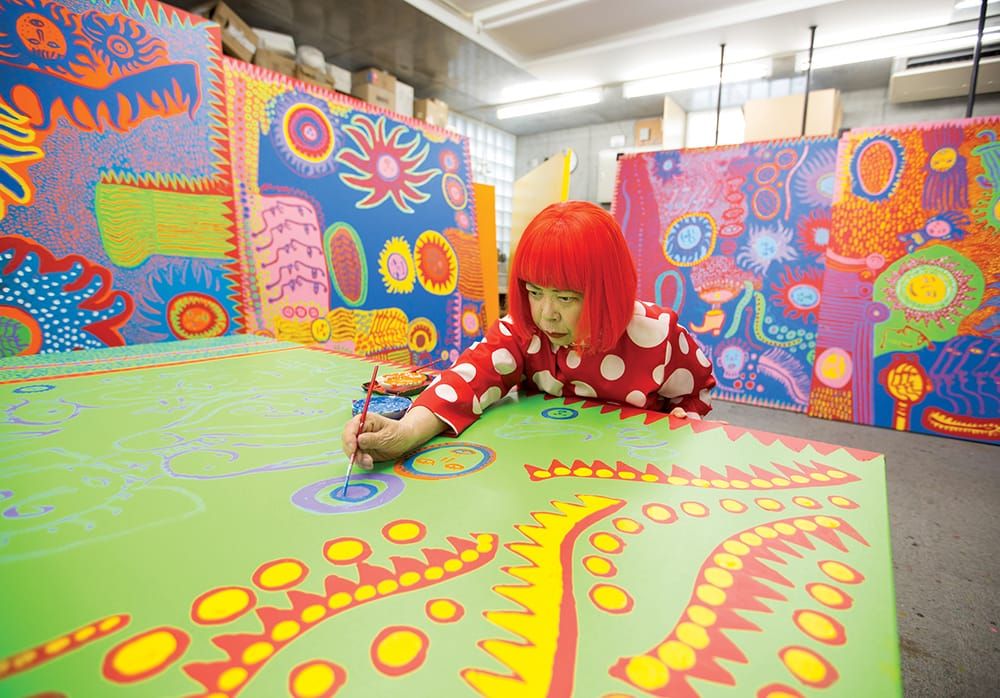
Yayoi Kusama, whose practice mobilized seriality and proliferation into a singular visual language at once euphoric and annihilating, died in a hospital in Tokyo on August 14. She was 97. Announcing her death on August 27, her studio said she had continued to paint until her final days.
The late Kusama was received as an artist of joy and abundance. Through fields of dots, monumental pumpkins, and vast mirrored chambers, she drew mass audiences into her repetitions and reflections. But her work’s iridescent, instantly consumable image—as fame compounded, less an oeuvre than a brand—could eclipse the severity of her project. Her imprint runs through several of the century’s major turns: minimalism, pop art, performance art, and experiential art. Across seven decades, Kusama returned again and again to the precarious relation between self and world, holding the rapturous delirium of boundlessness against the threat of assimilation.
Death was there from the outset, inseparable from life. Born in 1929 into a Matsumoto plant-nursery family, she grew up amid growth and decay; flowers, fruits, and seeds supplied a mutable grammar with forms that swell, split, multiply, and rot. During World War II she was conscripted into a parachute factory where she learned to sew—a skill later carried into her hand-stitched Accumulation assemblages. In 1950 she painted Accumulation of the Corpses (Prisoner Surrounded by the Curtain of Depersonalization), shown two years later at her first solo exhibition in Matsumoto. Its title startles less for its morbidity than for its sequence of terms—death, confinement, then the evaporation of personhood. It anticipates what Kusama would later call “self-obliteration”—a serial gesture riven by a constitutive contradiction that binds psychosomatic relief to erasure, each repetition solacing the self even as it dissolves it.
This contradiction found its fullest expression in New York. Kusama arrived in 1958, having written three years prior to Georgia O’Keeffe, who encouraged her to bring her work to the US. Within a year she began her Infinity Net paintings. Against the bravado of male-dominated Abstract Expressionism, Kusama’s monotone strokes—light, tenuous, yet machine-like—fused intuition with logic, the delicate made heroic. Austere yet capricious, each loop asserted her place in a world that did not yet include her.
Nothing looked like it at the time. “If you compare it to almost anybody at that point, it’s newer and more original,” Donald Judd recalled in 1988, in an unpublished conversation with art historian Reiko Tomii and curator Alexandra Munroe. “You could strike out with Pollock, Newman, Rothko, etc., Reinhardt. The only person you could kind of find that might be a little bit close was, for a brief time, Frank Stella. But, actually, I think she’s somewhat more original than Frank. And clearly she has more durability than Frank.”
But commercial recognition came unevenly, and late. Beatrice Perry, co-owner of the Gres Gallery in Washington, DC, bought her work, gave her a debut US solo show in 1960, and secured her immigration visa—patronage found nowhere else, at a time when American dealers dismissed a Japanese woman working outside every faction they recognized. “I knew her work was something that had not been seen before,” Perry said, cited in a 2006 profile published by ArtAsiaPacific.
History would concur but took its time; Kusama kept arriving first. Her soft sculptures preceded Claes Oldenburg’s by months; Kusama recounted that his wife approached her at an Oldenburg opening in 1962 to apologize. In 1963, Kusama’s “Aggregation: One Thousand Boats Show” at the Gertrude Stein Gallery encased a single rowboat, bristling with phallic forms, inside a room papered floor to ceiling in 999 photographs of itself. Three years later, Andy Warhol wallpapered Leo Castelli’s gallery with a repeating cow. In 1965, Kusama unveiled Infinity Mirror Room—Phalli’s Field at Castellane Gallery, the first of her immersive mirror rooms that would eventually become blockbuster phenomena decades later, drawing record-breaking crowds around the world.
By the late ’60s, her work had left the gallery for the streets and the naked body. She staged nude Happenings and anti-war protests across the US and Europe, directed the film Kusama’s Self-Obliteration (1967), and in 1968 founded Kusama Fashion Company Ltd to sell her own avant-garde designs. In 1966, she crashed the 33rd Venice Biennale uninvited, littering the lawn before the Italian pavilion with 1,500 mirrored spheres, hawked at two dollars apiece until officials shut her down.
Joseph Cornell, fellow artist and decade-long close companion, died in 1972. Kusama returned to Tokyo the following year; her father, Kamon, passed away in 1974. Grief was funneled into collage, sculpture, fiction, and verse—a fascinating decade of work that confronted mortality, psychic rupture, and the uneasy interval between survival and self-destruction. “I cannot give up my existence,” she wrote around 1977. “Also I cannot escape from death. This languid weight of life!” By 1977, after hospitalizations for panic and hallucination, she moved permanently into a psychiatric hospital, keeping a studio nearby. Her novel Manhattan Suicide Addict followed in 1978, the first of several books.
Recognition returned first by degrees, then with force. Retrospectives in Japan and New York through the 1980s preceded her 1993 presentation at Japan’s Venice Biennale pavilion; from the late ’90s on, a cascade of major international surveys followed. The eventual scale and reach of her fame had few precedents among Asian artists of her generation. Her work moved with uncommon velocity between museum, market, luxury retail, and social media, making her not simply a celebrated Japanese artist but a global cultural icon. Speaking to ArtAsiaPacific, Kim Camacho, who with her husband Lito has amassed one of the world’s largest private collections of Kusama’s work and regularly loans pieces to museums internationally, described witnessing firsthand the artist’s hold on viewers “of all ages, all socio-economic classes, all faiths, and all races”—an attraction she calls immediate and a joy to watch unfold.
In 2008, aged 79, Kusama began My Eternal Soul, an expansive suite of brightly colored acrylic paintings teeming with flowers, faces, nets, dots, eyes, phallic forms, and amoeboid cells. She had initially intended to make 100; having surpassed that figure, she spoke in 2012 of making “a thousand paintings, maybe two thousand paintings, as many as I can draw.” In 2013, the artist said to ArtAsiaPacific during a studio visit: “I don’t know how much time I have left.” Neither a late stylistic departure nor a quiet summation, the series was an accelerated continuation of the compulsions that drove her oeuvre from the very beginning. Its titles did not evade death; one 2008 work is titled Fear of Death; a 2014 painting is named Message from Hades.
Hidenori Ota, who represented Kusama for over three decades through his gallery Ota Fine Arts, first worked with her in 1988 while at Fuji TV Gallery and became her representative in 1991. Announcing her death, he called the partnership “an irreplaceable part of [his] life,” and said a private funeral had been held for close relatives, with a memorial gathering to be announced later.
For seven decades Kusama had multiplied herself against disappearance. Psychic distress, war, and bereavement marked her life; death remained the fact neither sentimentality nor spectacle could contain. But Kusama had seeded the world with proxies—paintings, pumpkins, chambers of boundless reflection—built to proliferate after the hand that set them moving had gone still. That was the wager of her art. It now unfolds in every room still alive with her dots, in every viewer who enters a mirror chamber and, for a moment, loses count of themselves.
Michele Chan is managing editor at ArtAsiaPacific.