News
Painting at Kochi-Muziris Biennale Sparks Backlash Among Christian Groups
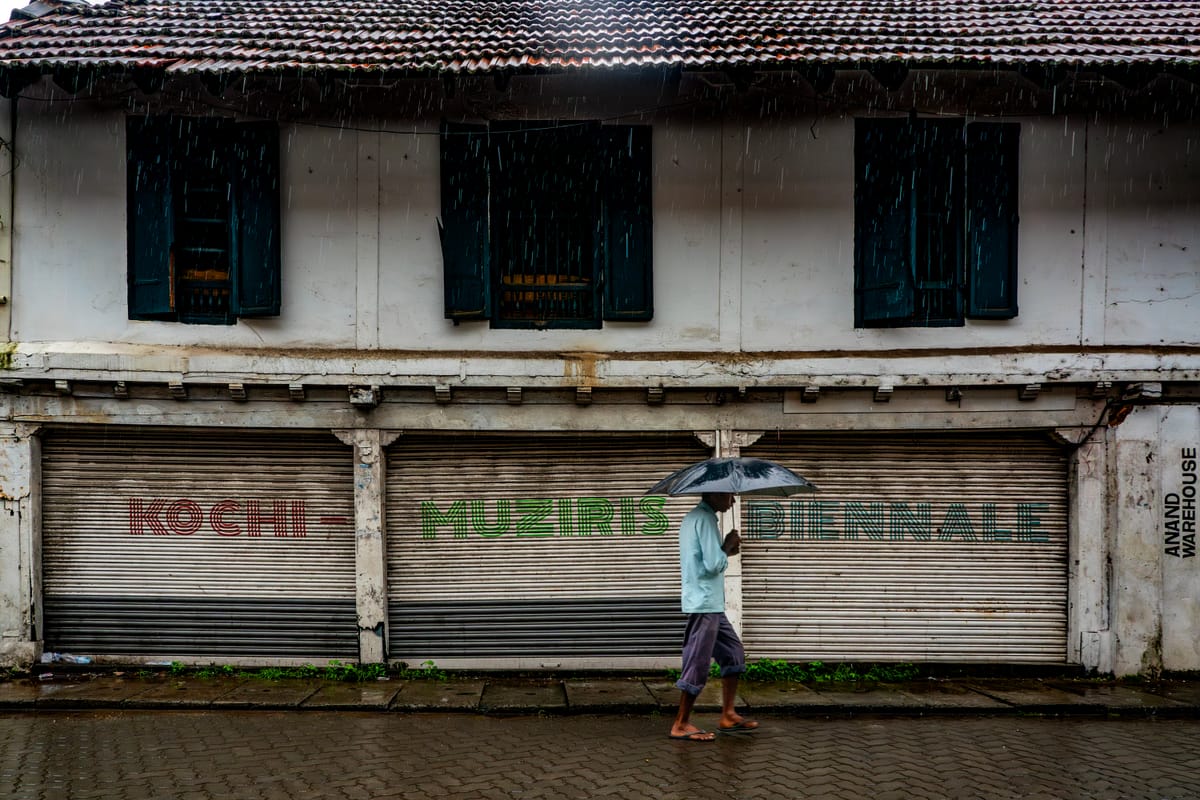
Nearly a month after launching its sixth edition in southwestern India, the Kochi-Muziris Biennale was forced to temporarily shut down one of its venues following backlash from Christian groups, who decried an allegedly blasphemous painting by Tom Vattakuzhy.
The work in question, titled Supper at a Nunnery, references Leonardo da Vinci’s The Last Supper (c. 1495–98) and depicts a topless woman sitting at a table, surrounded by nuns. According to the artist, the female protagonist represents Dutch dancer Mata Hari, who was convicted of being a spy for Germany during World War I and later executed by the French. While not officially part of the biennale, the canvas was featured in a recurring side exhibition organized by the Kochi Biennale Foundation, titled “Edam,” which is dedicated to spotlighting artists and collectives based in the southern Indian state of Kerala.
Kerala is home to the largest Christian population in the country, and it is said that Thomas—one of the 12 disciples of Jesus—was proselytized there. In a statement issued on December 30, 2025, the Syro-Malabar Church (one of the two Eastern Catholic churches in India) expressed “deep anguish” and “shock” over the tableau, describing it as a “distorted and inappropriate replica of The Last Supper.” It added that the public display of this work “crosses the boundaries of creative freedom and enters the realm of deliberate insensitivity to religious beliefs,” urging organizers to take it down immediately.
The curators of “Edam,” KM Madhusudhanan and Aishwarya Suresh, initially defended the painting in a joint statement alongside biennale president Bose Krishnamachari, remarking that it is inspired by C. Gopan’s theatrical adaptation of a poem about Mata Hari, Mridvangi’s Tragic Death. Nonetheless, the work was eventually removed from the exhibition to “respec[t] public sentiments.” The Garden Convention Centre, which hosted “Edam” and served as one of the biennale’s venues, was subsequently closed before reopening in early January.
Vattakuzhy told The Hindu that he never intended to offend anyone with his painting. Born and raised in Kerala, the artist himself grew up in a Christian household and frequently draws on “the humanism seen in Christian values.” He further emphasized that his painting “is an extension of that thought process and not a distortion of The Last Supper,” as he wanted to portray Mata Hari, a historically misunderstood figure who was wrongly accused of espionage after falling in love with a German man. Speaking with The News Minute, he said: “Every time I learn the story of an abused person like Mata Hari, I see Christ in them.”
Ashley Cheung is an editorial intern at ArtAsiaPacific.