News
More UNESCO-Listed Sites Damaged by Airstrikes in Iran
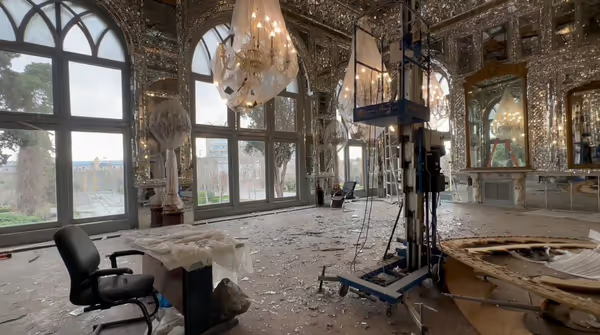
Multiple UNESCO World Heritage sites in Iran have been damaged by US-Israeli strikes that began on February 28. Following the recent damage to the Golestan Palace in Tehran on March 2, missile attacks targeting Isfahan’s provincial governorate building on March 9 have battered the city’s historic center.
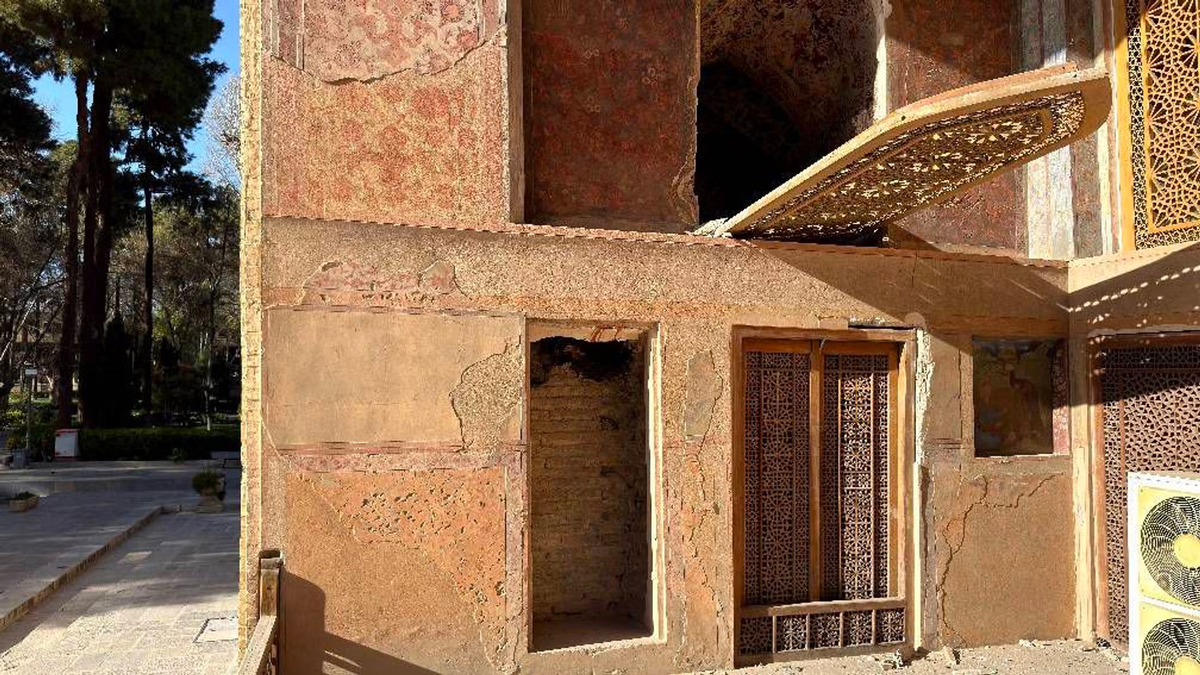
Isfahan, which served as the capital of the Safavid Dynasty during the 16th to 18th century, is home to some of the most significant monuments of Iranian art and architecture, including those in the Dawlatkhaneh complex. Among the wrecked sites is the Chehel Sotoun, a 17th-century palace and garden which have been inscribed as part of the UNESCO World Heritage’s list of Persian Gardens since 2011. Photographs and videos circulating on local media show scattered debris, broken windows and wooden doors, as well as a large fissure in one of the frescoes. While the palace’s renowned ayeneh-kari (mirror-work) decorations were ruined, most interior murals were unscathed.
Blast waves also reverberated across the nearby 17th-century Naqsh-e Jahan Square, shattering the doors and windows of the Ali Qapu Palace and blowing off the iconic turquoise and calligraphic tiles of the Shah Mosque, also known as the Jame Abbasi Mosque.
Other damaged sites in Isfahan include the Rakeb-Khaneh pavilion, the royal stable built during Shah Abbas I’s reign; Ashraf Hall, a 17th-century residential complex for the court; and Teymouri Hall, a Timurid-era building repurposed as the Natural History Museum.
In a social media post, Mehdi Jamalinejad, the city’s governor, condemned the military assaults as “barbaric,” saying they “hit the heart of humanity’s collective memory.”
Prior to the attacks on Isfahan, on March 8, the third-century Falak-ol-Aflak Citadel in Khorramabad also sustained damage despite authorities’ efforts to install Blue Shield emblems, which are international symbols of protection for important cultural sites during armed conflict. The citadel’s barracks, officers’ club, regimental building, and its archaeology and anthropology museums were hit, though the main fortress structure remains intact.
In a statement released on March 9, Iran’s ministry of cultural heritage, tourism, and handicrafts urged UNESCO to activate legal and monitoring mechanisms for the protection of cultural landmarks, citing the 1954 Hague Convention and the 1972 World Heritage Convention.
Although UNESCO has not yet responded to this appeal, the organization issued a statement last week condemning both the US-Israeli strikes on Iran and Iran’s retaliatory attacks.
Yuqian Fan is an editorial assistant at ArtAsiaPacific.