News
Liang Shaoji, 1945–2026
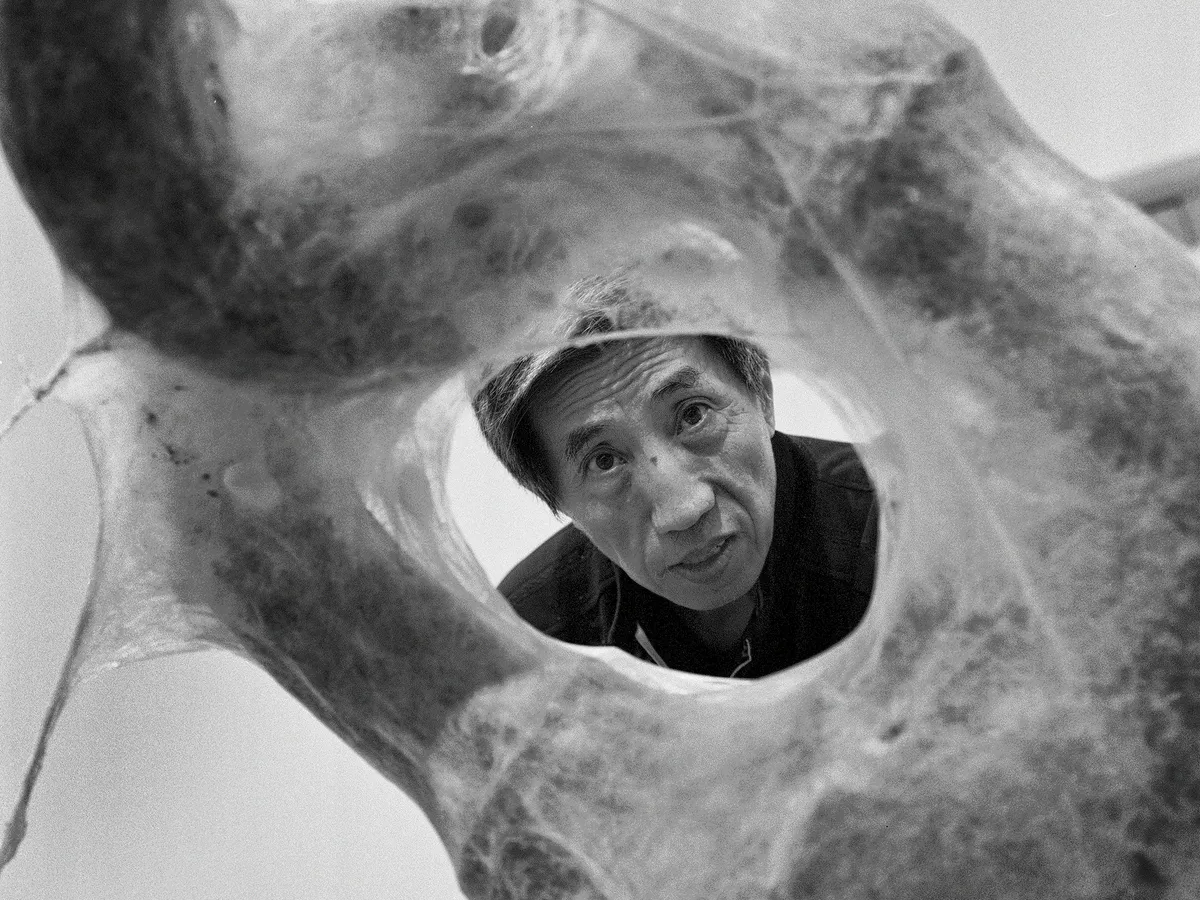
Multidisciplinary artist Liang Shaoji, known for his installations and mixed-media works incorporating live silkworms, died on September 14 in Shanghai following an illness, his longtime dealer ShanghART announced. He was 81 years old.
Born in 1945 in Shanghai, Liang was as a young adult unable to join his local arts school due to enrollments being barred throughout the Cultural Revolution, and was instead sent to work in a textile factory. Following the upheaval, he was admitted in 1986 to the China Academy of Art in Hangzhou (formerly the Zhejiang Academy of Fine Arts) where he trained under the Bulgarian artist Marin Varbanov and took up “soft sculpture,” the fiber-based movement Varbanov co-established. The technique, which would come to define Liang’s practice, encompasses three-dimensional art constructed from fabrics, fibers, and organic materials.
In 1989, Liang began his Nature series, which incorporated real silkworms into his installations, video art, and performances. Inspired by his own time as a fabric worker, Liang took advantage of silkworms’ ceaseless production of silk by allowing them to take over environments, gently directing the course of their silkspinning. Beginning on a smaller scale with shoes and coffee cups and eventually expanding to large-scale installations, Liang’s unique silk-coated conceptual works explore concepts of time, transformation, purpose, and existence, reflecting Liang’s own interests in Eastern philosophies and aesthetics.
His art has been exhibited globally, from the National Art Museum of China, Beijing (1989) and ShanghART Space, Shanghai (2007), to Hayward Gallery in London (2012), Al Riwaq in Doha (2016), and the Oscar Niemeyer Museum, Curitiba (2017). In 1999, his works simultaneously appeared in the 48th Venice Biennale, the sixth Istanbul Biennale, and the fifth Lyon Biennale. In 2002 he won the Chinese Contemporary Art Award, and received the Prince Claus Award in 2009. His most recent solo exhibitions, “Sea of the Cloud” at Shenzhen’s Sea World Culture and Arts Center (2024) and “Silk Radiance” at the Liangzhu Museum (2025), featured his largest silkworm installations to date.
Despite some critics’ concerns over using live animals in artworks, Liang always viewed the silkworms as his artistic “collaborators” and dedicated much of his life to rearing them with care, even seeing an equality between himself and the insects. He once mused, “Consumed by the pursuits of life, am I not a silkworm myself?”
Harison Butler is an editorial intern at ArtAsiaPacific.