News
Frank Gehry, 1929–2025
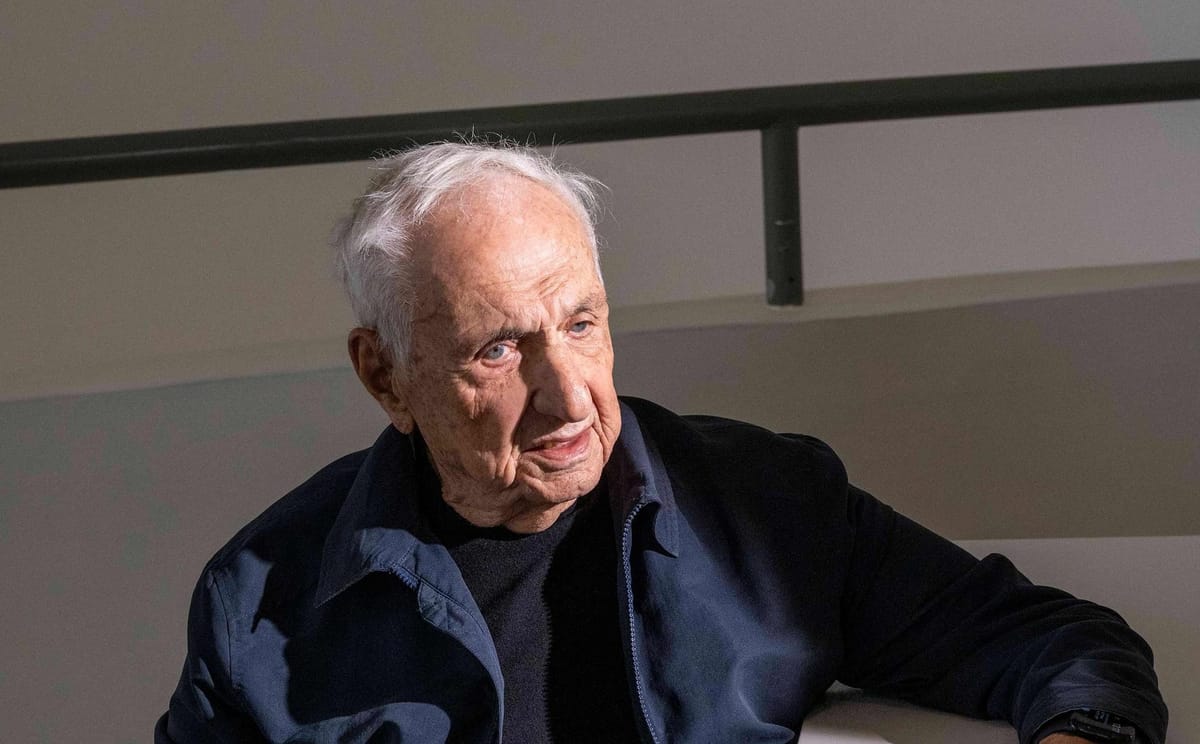
On December 5, Frank Gehry, the Canadian American architect and 1989 Pritzker Architecture Prize laureate, passed away at the age of 96 from respiratory illnesses.
Born in Canada in 1929, Gehry immigrated with his family to Los Angeles in 1947. He initially studied ceramics at the University of Southern California before switching to architecture after encountering the work of Raphael Soriano, eventually graduating with a Bachelor of Architecture in 1954. After a brief period of service in the US Army, he enrolled at Harvard’s Graduate School of Design to study urban planning but left before completing the program. Returning to Los Angeles, he founded his own firm in 1962, launching a career that would span more than six decades.
Gehry first gained critical attention in 1978 with the radical redesign of his own Santa Monica residence, in which he wrapped a modest Cape Cod bungalow in raw materials such as plywood, corrugated sheet metal, and chain-link fencing. This jarring collision has been interpreted as a reflection of the generational tensions in Cold War-era American society.
Gehry became best known for his postmodern architecture, characterized by irregular, sculptural forms clad in metal, most famously exemplified by the Guggenheim Museum Bilbao (1997). The building’s undulating titanium surfaces were designed to respond to the surrounding environment and capture shifting light, a recurring preoccupation in Gehry’s work. The striking appearance of the museum successfully transformed Bilbao’s former industrial waterfront into a major cultural destination. Other iconic projects include the Walt Disney Concert Hall (2003) in Los Angeles, the Fondation Louis Vuitton (2014) in Paris, and El Peix d’Or (The Golden Fish, 1992) in Barcelona, commissioned for the Olympic Games.
While most of Gehry’s work was concentrated in the US and Europe, he leaves behind two major projects in Asia. The Guggenheim Abu Dhabi—his second commission for the Solomon R. Guggenheim Foundation—is scheduled to open in 2026 as the foundation’s largest museum. The building extends Gehry’s formal vocabulary through an ensemble of clustered cones and prisms that appear to reach toward the surrounding desert landscape. In development for nearly two decades, the project has faced multiple delays. Meanwhile, construction began in May on the CMU Museum of Fine Arts in Taichung, which is expected to open in 2028. Considered one of the most technically demanding projects in Taiwan’s architectural history, the museum is envisioned by local officials as Taiwan’s next “international landmark.”
Gehry is survived by his second wife Berta Aguilera, their sons Sam and Alejandro, and his daughter Brina from his first marriage. He was preceded in death by his other daughter Leslie, who passed away in 2008.
Arphy Li is an editorial assistant at ArtAsiaPacific.