Market
Kiaf SEOUL at 25: A Market Split

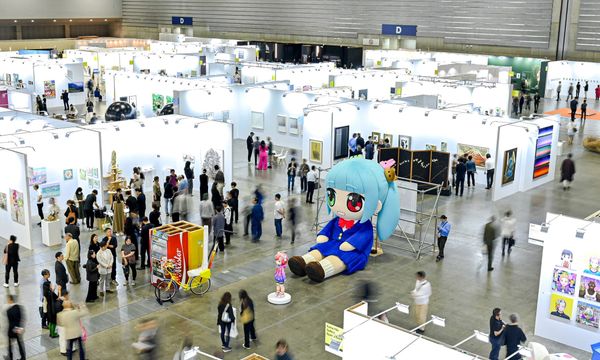
Kiaf Seoul returned this year for its 25th edition, the largest to date at 175 galleries. This iteration marks the conclusion of the fair’s first five-year partnership with Frieze. Next year, Frieze Seoul will move to the Dongdaemun Design Plaza while COEX undergoes renovation. The milestone arrived, however, against a softening market: Korea’s art sales peaked near KRW 1 trillion in 2022 and have since fallen roughly 25 percent to around KRW 615 billion. Some would call this more of a correction than a contraction—the pandemic-era practice of acquiring emerging names off a PDF, only to watch their prices fall as quickly as they had risen, appears to have largely run its course.
At Kiaf, Korean modernist masters, treated as domestic blue chips, sat at the upper end. Galleries nearest the Hall A entrance, including Gallery Hyundai, PYO, and Gana Art, presented familiar names such as Park Seo-Bo, Lee Ufan, Kim Tschang-yeul, Yoo Youngkuk, and Kim Whanki. Dansaekhwa and a broader postwar abstraction that fuses conceptual practice with East Asian calligraphic and ink traditions still dominated the market. PYO offered Park Seo-Bo’s Ecriture No. 33-23 (2021) at roughly USD 190,000. Gallery Hyundai showed Lee Ufan’s Dialogue (2019), a Kim Whanki Untitled (1970) from his New York period, and several 1990s Nam June Paik installations, among them My Faust: Arts (1989–91), reportedly priced between USD 221,000 and 369,000. The gallery’s total sales were said to exceed KRW 1.2 billion. Another stalwart, Kukje Gallery, anchored the top of the market with Park Seo-bo’s Ecriture No. 170606 (2022) and a rare Yoo Youngkuk oil canvas, Work (1979), which changed hands in the KRW 600–720 million (USD 450,000 to USD 540,000) range. Gana devoted its entire booth to Park Eunsun’s marble sculptures, includng Colonna Infinita – Continua (2026), priced at EUR 280,000.

At the lower end were bright, figurative, pop-derived, and cute-adjacent works, positioned in deliberate counterpoint to the more philosophically inclined abstraction nearby. Hakgojae presented Kim Jae Yong’s Donut Fear sculptures (USD 50,000–80,000), a series of vividly colored doughnuts that draw on the eye-catching visual language of mass-media food imagery. Arario showed Kiaf Highlights shortlistee Lim Nosik’s hazy, violet-grey canvases. His new work, Wildflower – Landscape 58 (2026), was priced at roughly USD 8,760. Whitestone placed a series of paintings by artist Aruta Soup, whose canvases depict a recurring, often bandaged rabbit rendered in a bright, cartoon-style idiom shaped by graffiti and club culture. In a cautious climate, buyers gravitate toward the poles, where value is either liquid and bluechip or inexpensive and low-risk; the ambitious mid-career and cross-media work in between is the first to thin out.
The master trade, it’s worth noting, rests on more than market momentum—it is also underwritten by institutions. In 2025, MMCA staged a major posthumous retrospective of Kim Tschang-yeul; the roughly 2,000-square-meter Park Seo-Bo Museum opened in Yeonhui-dong shortly before this year’s art week; and the Samsung-founded Ho-Am art museum is reportedly building a Lee Ufan museum. During art week, MMCA’s Do Ho Suh survey, Leeum’s Koo Jeong A presentation, and Seoul Museum of Art’s Yoo Youngkuk retrospective all served to amplify established Korean artists. The local blue-chip narrative seems to reflect a coordinated consensus between market and institution.

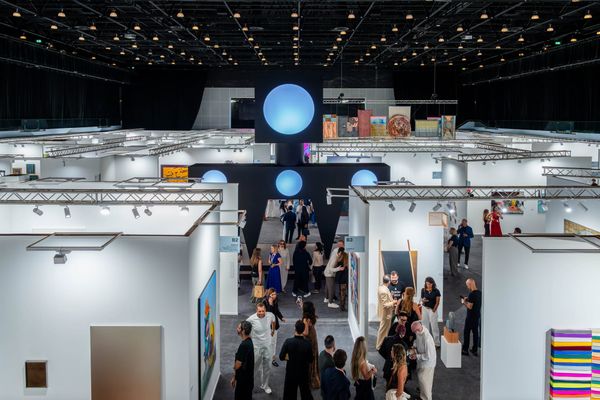
People tend to compare Seoul with Hong Kong. Art Basel’s Asian flagship remains the more international event, drawing a cross-border collector base Seoul has yet to match. This was evident at Kiaf: the collector base remained largely domestic. But what Seoul offers is a different kind of density, and this year its clearest expression lay not on the fair floor but in the city around it. The art week’s “Neighborhood Nights” drew a broad public into galleries, museums, openings, and after-hours events. The contrast with Hong Kong is telling: there, satellite programming remains largely the preserve of professionals and VIPs, whereas Seoul’s energy is diffuse, popular, and bound up with the wider apparatus of Korean cultural export. As some have observed, the country’s local art ecology has always been part of K-Culture, an extension of the same consumer engine that carries K-pop, K-drama, and K-fashion abroad. The open question is how far that momentum travels onto the fair floor.
Kiaf this year seems to have welcomed a younger cohort of collectors—internationally informed but budget-limited—pulling demand toward smaller, more accessible works. Whether this signals a healthy corrective remains uncertain. Perhaps the more measured reading falls somewhere in between: a broadening of the collector base, but not, on its own, the market’s rescue.
Louis Lu is an associate editor at ArtAsiaPacific.