Issue
One to Watch: Han Mengyun
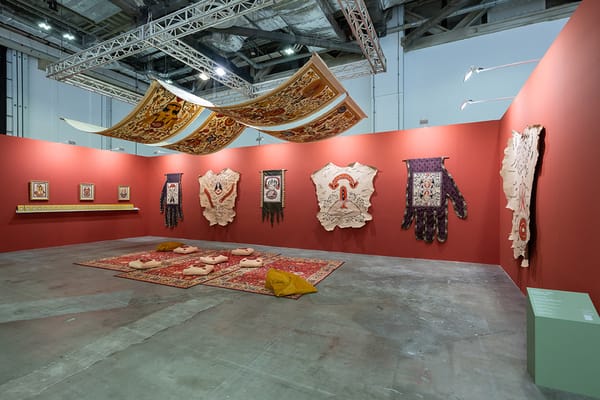
In Dhikr (2025), part of Han Mengyun’s film installation Suffering Hands, Broken Thread commissioned for the inaugural Bukhara Biennial, Uzbek women in a textile factory sit close to the ground, bodies folded in focused intensity. Their fingers move like rapid breath—swift, insistent, almost involuntary—as they maneuver their looms, each pluck and pull forming muted percussion. The soundscape expands into a quiet polyphony: the hum of machinery, a whirring fan, distant traffic, a baby’s soft wail. Every shot is composed with the precision of a painter’s eye, yet the work’s potency lies less in image than tempo. Layered rhythms—of labor, learning, and persistent, patient making—emerge as Han’s operative grammar, threading gesture and thought across bodies and borders.
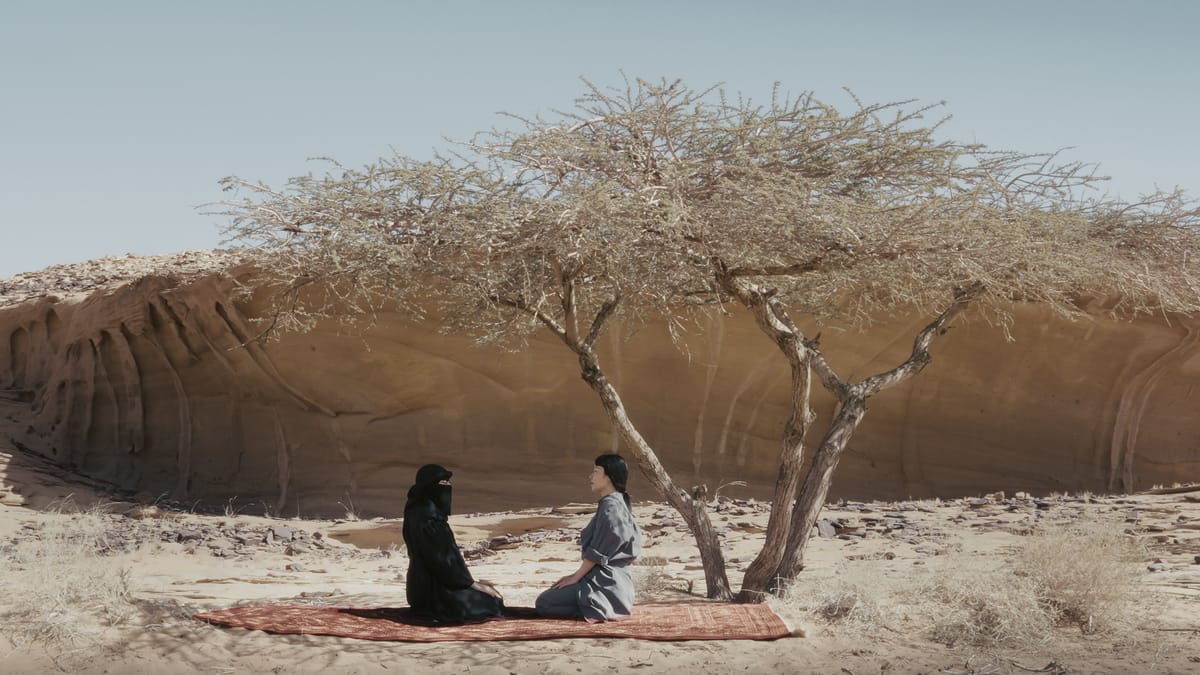
This rhythm is inseparable from Han’s long apprenticeship in languages—including Chinese, English, and Sanskrit—and the crafts she studies with equal rigor: woodblock printing, textile weaving, palm-fiber braiding. Gift (2025), filmed in palm groves during her AlUla Visual Art Residency in Saudi Arabia, proposes a feminine ecology where verse, vegetal life, and cycles of nurture unfold as interdependent forms of speech. Han’s peripatetic, research- and fieldwork-driven projects are not simply cultural crossings but translations in an ethical, Spivakian sense: exercises in deep listening, untelling and retelling, and the careful suturing of epistemes that avoids hierarchy and the violence of representation, binding self and Other.