Issue
Geumhyung Jeong: Under Construction
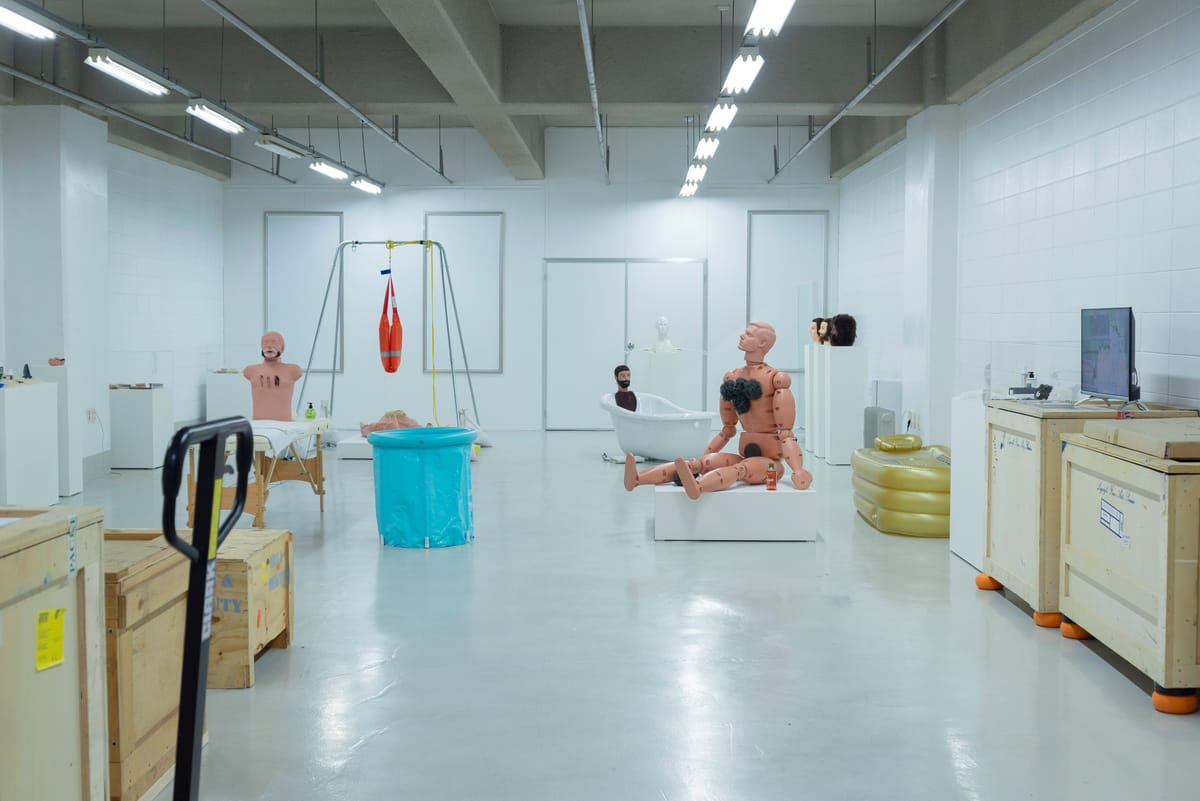
From stage to gallery, Korean choreographer-artist Geumhyung Jeong has forged one of the most idiosyncratic paths in contemporary art. Professionally trained in acting, dance, and film animation, she moves fluidly across registers: intimate performances with medical dummies and mannequin limbs, precarious encounters with excavators and heavy machinery, sculptural displays of disassembled prosthetics, and, most recently, DIY robots that sputter and stall, as moody and mercurial as living companions. This range is not mere eclecticism but reflects an utterly unique discipline that merges stage architectonics with a visual artist’s compositional precision, yielding work that is both choreographic and sculptural.
Internationally, Jeong is best known for uncanny “duets” with inanimate corporeal apparatuses that have been read through lenses of desire, control, and the more-than-human—interpretations that, while common, only partially capture her practice. These readings risk overlooking another axis of her work developed in Korea: the performativity of infrastructure itself. From assembling pre-performance moments to casting herself as a delivery messenger to undertaking practical industry roles conventionally assumed by staff at institutions, Jeong’s oeuvre proposes gestures that appear closer to logistics, administration, or display. In these works, the choreography lies not only in the body’s relation to objects, but also in the conditions that surround them. Emerging as operator, registrar, and host, Jeong choreographs not only bodies and machines, but also the very structures that frame them as art.
Machines, not Muses
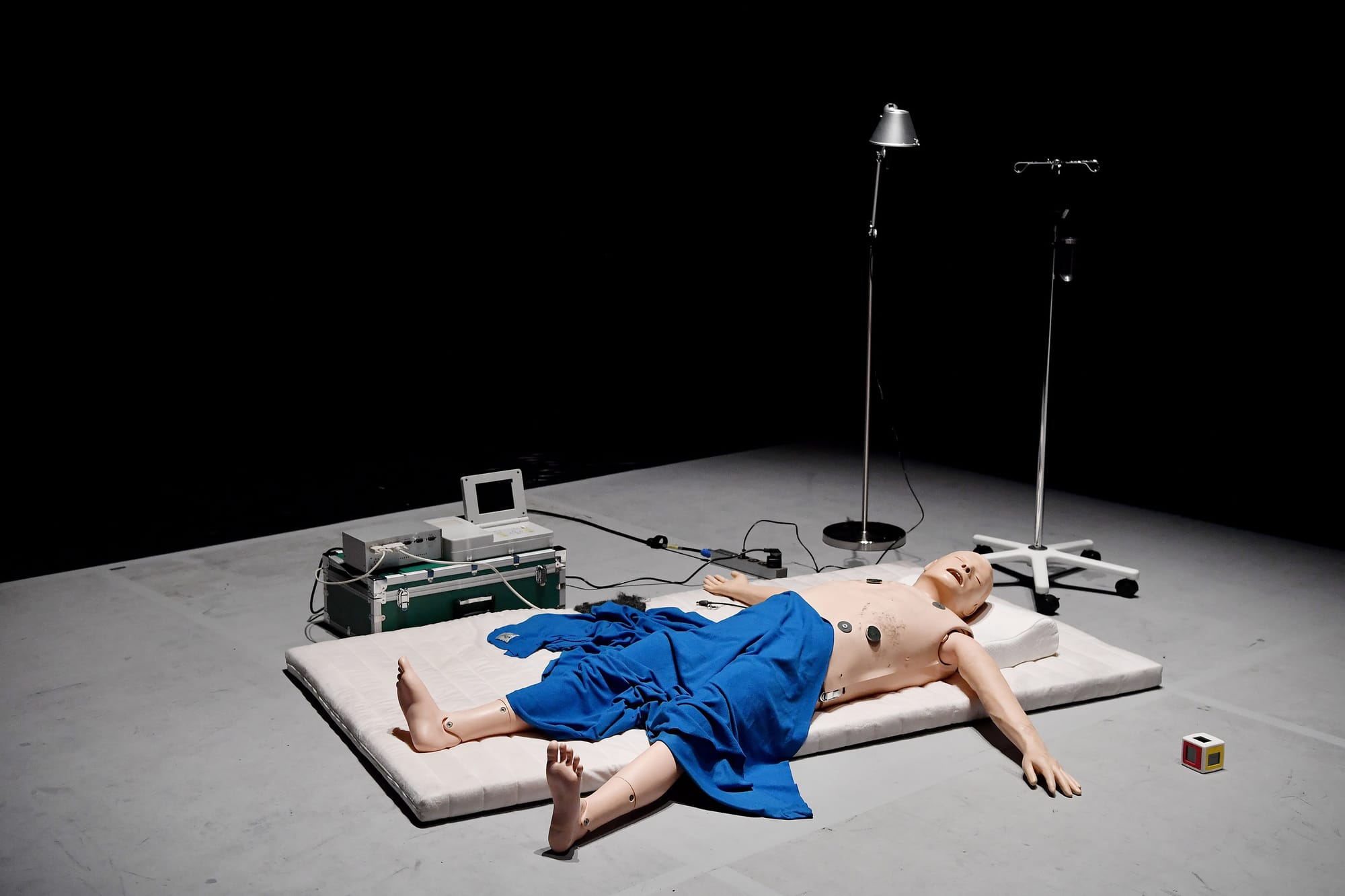
The pieces that first established Jeong as a performing artist harnessed objects such as medical equipment, training dummies, gym machines, and vacuum cleaners. Structured around her efforts to animate immobile objects—often in pursuit of sexual satisfaction—these works explore the mechanics of human desire, oscillating between autoeroticism and mediated interaction, unsettling the binary of human as controller and machine as controlled. The perverse combinations of machine parts, paired with her deadpan delivery, do more than sensationalize—they provoke new readings of intimacy and challenge our conventional relationships with everyday objects.
Crucially, her performances pivot on the function of equipment rather than their symbolic or fetishistic associations. When conceiving a piece, Jeong studies how things work, literally: she obtained an excavator license for Oil Pressure Vibrator (2008), drew on her experience as a fitness trainer for Fitness Guide (2011), and learned cardiopulmonary resuscitation (CPR) protocols for CPR Practice (2013). She explained in a 2016 conversation with curator Seewon Hyun: “CPR training or fire evacuation drills . . . are staged simulations of real situations. Everyone knows they are fake, yet we practice them as if they were real. Such situations make me reflect on what theater really is.” If reality itself is often performative, performance, in turn, benefits from knowledge rooted in the real. In this context, Jeong emerges less as a performer and more as an operator embedded in systems of standards, training, and maintenance. Here, function precedes fetish.
One of her earliest and most emblematic works, the performance-cum-screening Oil Pressure Vibrator, exemplifies this logic. On stage, Jeong narrates a fictional search for the “ideal partner,” while the documentary-style film shows excerpts from earlier works in which medical mannequins, exercise equipment, and household appliances serve as romantic companions. Her restrained affect undercuts sentimentality until she narrates her encounter at a construction site with a hydraulic excavator, whose “long neck and flexible joints” become her object of desire. The film culminates with Jeong piloting the excavator to crush a sand effigy of herself, while simultaneously on stage, she caresses her body with a toy model of the machine. Here, eroticism arises not from projection but from mastery over machinic operations. Even as the work flirts with binaries—subject and object, active and passive, human and machinic—it sets the stage for Jeong’s modus operandi: inhabiting a logic so thoroughly that it can be bent, eroticized, and estranged.