Issue
Frank Young: Ancestral Lines
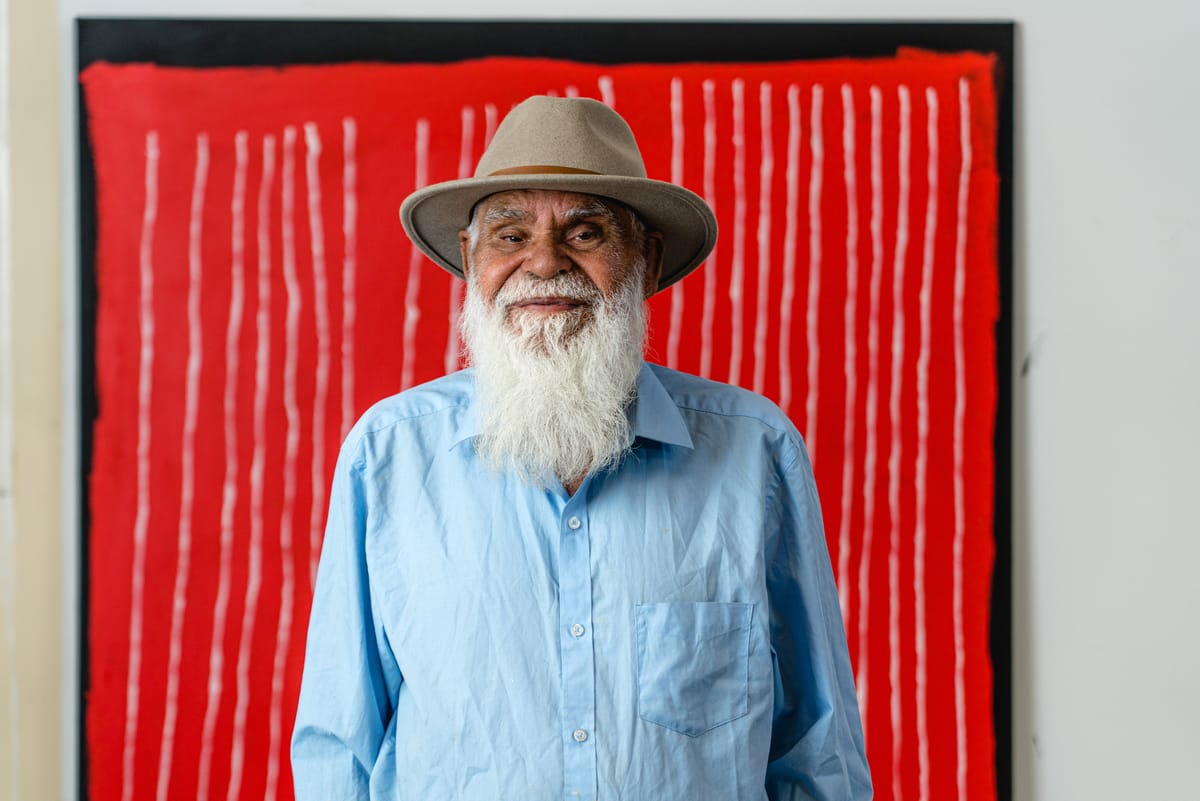
“It’s significant work that we do with our spearmaking,” says senior Pitjantjatjara lawman and artist Frank Young over the phone. “We are telling the story of our land. Making spears, dancing—all those things that we can do for our ancestors—we have to keep doing them to keep our culture alive.”
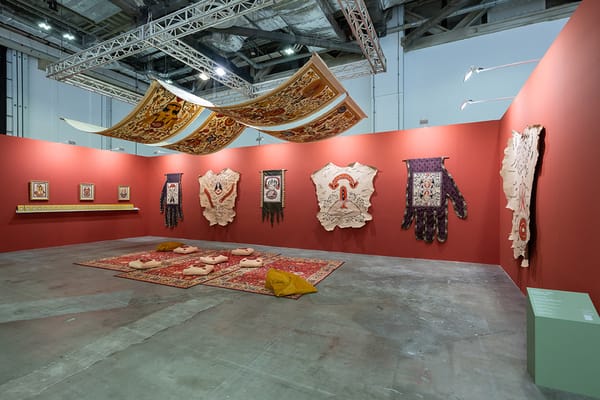
Young’s installations and paintings share stories of kulata (spears), drawing on age-old practices to strengthen community and culture, while bringing new purpose to the lives of First Nations men. Shaped by his experiences with the 1970s Land Rights Movement, Young’s work carries the teachings of elders and ancestors who imparted tjukurpa (creation stories), spearmaking skills, and a deep respect for community and Country. “I want to let my story live on, along with the stories of my people that have been walking with me,” Young says. “I want to bring their spirit alive, so we can be together in my work.”
Born in 1949 near Artuti in the Aṉangu Pitjantjatjara Yankunytjatjara (APY) Lands, Young began making art at 18. He now lives in Amata, another remote South Australian town, where beaming skies stretch over red earth dappled with trees and golden grass. Spiritual and physical knowledge of this place enlivens his works and underpins his sense of communal responsibility.
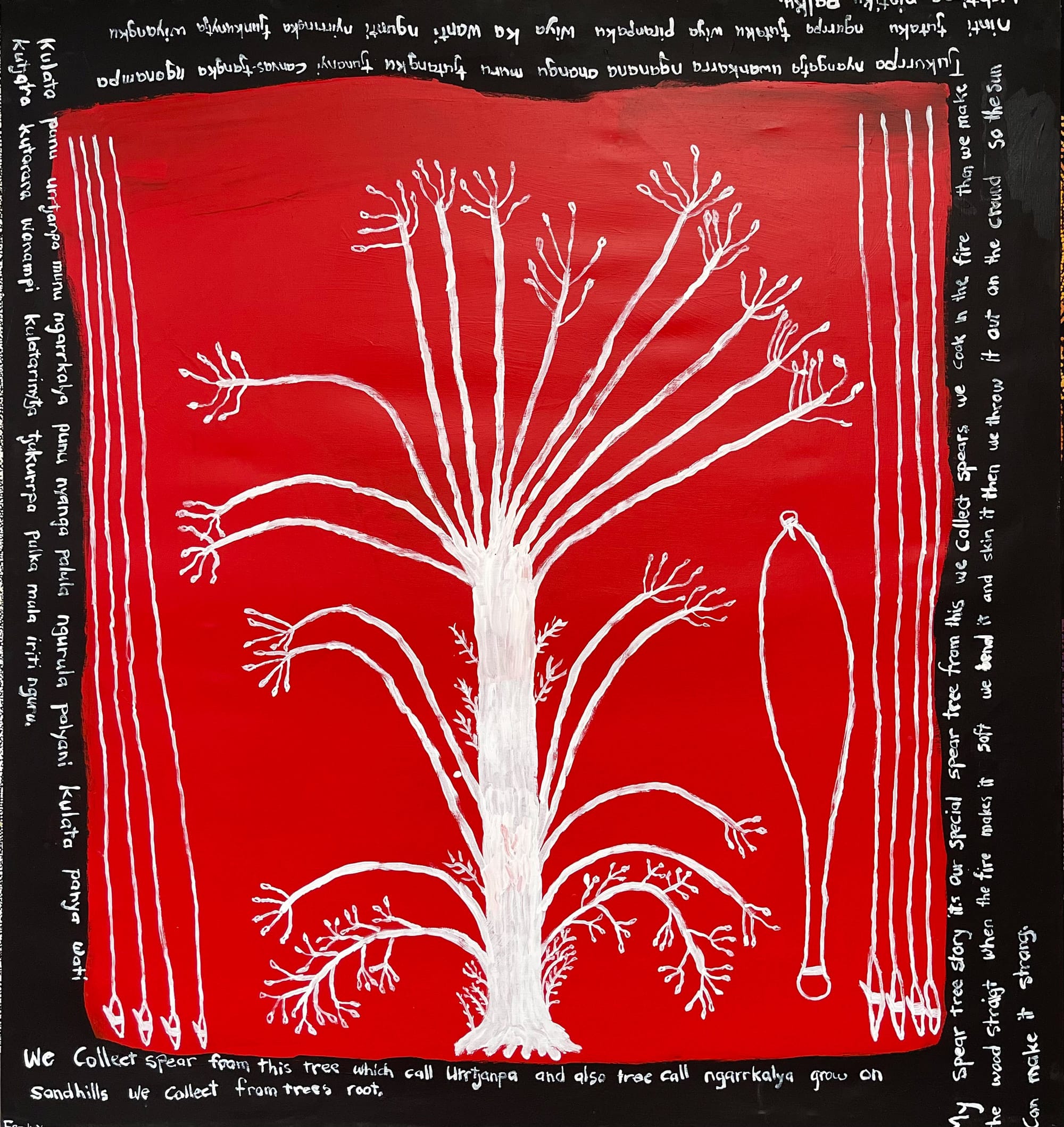
As a painter, Young gives form to kulata knowledge passed down countless generations. Using mostly black, white, red, blue, and green—colors inspired by his experience of the land—he renders spears and the trees from which their wood derives. Often his bold compositions bear Pitjantjatjara inscriptions recounting the arduous spearmaking process, chronicling how punu (wood) is cut from trees, softened and shaped over fire, and bound using kiti (bush glue) and malu pulyku (kangaroo tendon). These skills are part of men’s business, and their continuation is vital to preserving Aṉangu knowledge systems. Young honors this multidimensional significance in Kulata Punu (2024), a painting shortlisted for the national Wynne Prize 2024 that depicts Watarru, where kulata plants grow in abundance. A tree rises at the center, its branching, vein-like form rendered ghost-white against a brilliant scarlet ground. Flanked by columns of weapons and tools, the image is encircled by pale text on a bold black border that details the crafting of kulata, as well as tjukurpa relating to spears and the creation serpent Wanampi. A potent life force radiates from the work, in which kulata are more than weapons of aggression. Instead of taking life, they are part of its genesis.