Issue
Editor’s Letter: Beings in Transition
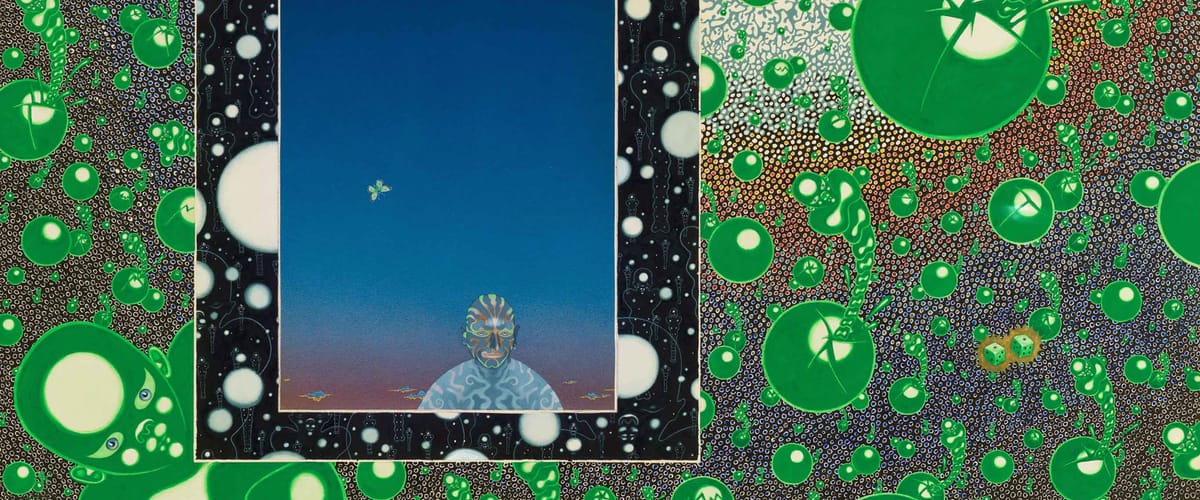
Three months into 2026, and everything feels especially sharp with geopolitical flashpoints flaring, old sovereignties being tested, and futures recalibrating. In this unsettled atmosphere, ArtAsiaPacific turns to artists and institutions engaging directly with transformation—the mutable conditions of bodies, memories, ecologies, and geographies.
We begin with the late Ching Ho Cheng, whose work is featured on our cover. The Havana-born Chinese American artist came of age in 1960s New York, creating gouache paintings and paper works that vibrate with raw tension: early psychedelic swarms of cosmic orbs, flames, and pulsating anatomies; interior spaces rendering plants, matchsticks, and lightbulbs with hyper-real precision. His later abstractions—oxidized, ripped, and reassembled—along with his meditative tableaux of light filtering through windows and entryways, treat destruction and endings as generative. Art historian Christina Shen surveyed Cheng’s brief, yet intensely prolific two-decade career, reflecting: “Whether in prismatic, hypersaturated gouaches inspired by Tibetan art or iron oxide-treaded papers torn into reduced shapes, Cheng’s art reflects a persistent inquiry into how process and materiality can serve as metaphors for cosmic spiritual forces.” Cheng’s rare spellbinding work will be included in the fourth edition of “Spectrosynthesis” at Seoul’s Art Sonje Center in March.
Our second Feature explores fluidity through Geumhyung Jeong’s experiments with identity, desire, and possibility through the mechanical and the performative. Self-taught in robotics, she assembles animatronic bodies from medical skeletons, fetishized mechanisms, and domestic detritus. Looking back at the artist’s earliest projects, independent curator Jiwon Yu writes: “Even as the work flirts with binaries—subject and object, active and passive, human and machinic—it sets the stage for Jeong’s modus operandi: inhabiting a logic so thoroughly that it can be bent, eroticized, and estranged.”
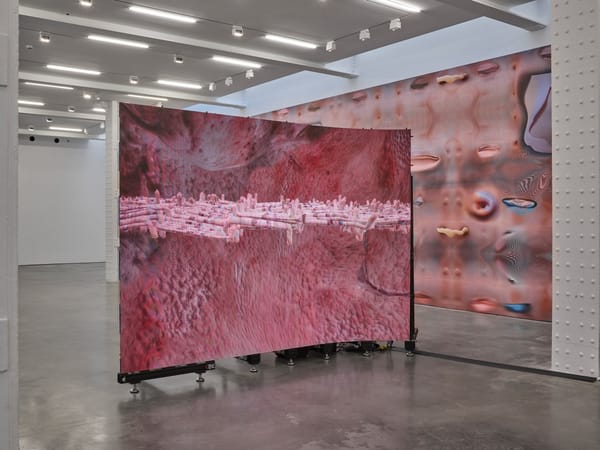
For Up Close, AAP editors expand this dialogue with three artists who examine technology’s imprint on the corporeal in new projects: Hito Steyerl’s Mechanical Kurds, Tishan Hsu’s emergent mesh, and Shao Chun’s Inner Beads (all 2025). For Inside Burger Collection, curator and writer Laura McLean-Ferris sat down with Nick Mauss to talk about his multifaceted oeuvre, which spans ceramics, drawings, paintings on mirrors and textiles, further analyzing histories, bodies, and perception through costumes, exhibition displays, and choreographic interventions.
In Profiles, AAP assistant editor Annette Meier spoke with Indonesian art patron Belinda Tanoto on the eve of her Tanoto Art Foundation’s inaugural exhibition in Singapore, “Rituals of Perception,” to hear about her visions for nurturing South-South dialogues. In Australia, AAP Sydney desk editor Johanna Bear met up with senior Pitjantjatjara artist Frank Young and the APY Art Centre Collective to discuss his efforts to strengthen First Nations artistic communities—including his project for the 25th Biennale of Sydney, curated by Hoor Al-Qasimi under the title “Rememory,” which opens in March.
Meanwhile, for Where I Work, AAP visited Abdullah Al Saadi’s studio in Khor Fakkan, where the Emirati artist—who is also featured in the Biennale of Sydney—revealed his decades-long practice of archiving life on stones, sweet potatoes, and handmade accordion notebooks. With the palpable shift in attention to the Gulf region, Arthur Debsi, a curatorial consultant at the Mathaf: Arab Museum of Modern Art, filed a dispatch from Doha, investigating Qatar’s robust cultural offerings and how its tight-knit art community might benefit during this period of growth and international curiosity. In Essays, Naima Morelli highlights the independent 421 Arts Campus in Abu Dhabi, which recently marked its 10th anniversary, framing it as the UAE’s anti-institution. In The Point, Simon Wang of Shanghai’s Antenna Space explains his rationale for opening a second location in Hong Kong, despite market fluctuations. Finally, for One on One, M+ Sigg Prize winner Wong Ping delves into his admiration of experimental poet, writer, and filmmaker Shūji Terayama, observing: “Born in 1930s Japan and having lived through World War II, ‘home’ became one of the inescapable themes that haunted him throughout his life. He lied compulsively, publicly, insisting he was born on a train, a child without origins, without anywhere to return to.” Echoing Terayama, the seemingly disparate artists and initiatives in this issue converge through their shared commitment to navigating volatility. As they probe hybridizing bodies, reactivated memories, places in transition, they reveal how beings adapt, endure, and reinvent themselves amid today’s uncertainties and upheaval.