Issue
Art Fair Report: Diminishing Returns
The global art fair landscape in 2025 seemed perpetually on the verge of a mutiny. Tim Blum’s closure of his Los Angeles and Tokyo galleries became a flashpoint: despite selling 85 percent of his Art Basel in Basel booth in advance, he reported no meaningful conversations at the fair. “We are in the midst of a paradigmatic shift,” he declared. While some maintained that the market remained fundamentally intact, the year’s closures told a different story. Most notably for Asia, Taipei Dangdai’s cancelation of its 2026 edition following a 40-percent drop in exhibitors revealed a landscape in flux.
Uncertainty and Flux
The recalibration was evident in Seoul, where the fourth edition of Frieze Seoul saw 40 galleries not return, including established international players Michael Werner, Karma, and Sadie Coles HQ. In their place, Asian gallery representation rose sharply to 64 percent—up from 48 percent in 2024. There was a noticeable decline in collectors from Hong Kong, China, the US, and Europe, while Korean collectors showed up in full force, signaling a shift from an international profile to a more regional, even domestic, focus. The Korean art market contracted from around KRW 800 billion (approximately USD 544 million) in 2022 to around KRW 500 billion (approximately USD 340 million), with around 100 small galleries closing and international entrants Peres Projects, König, and Various Small Fires shuttering their Seoul spaces in 2025.
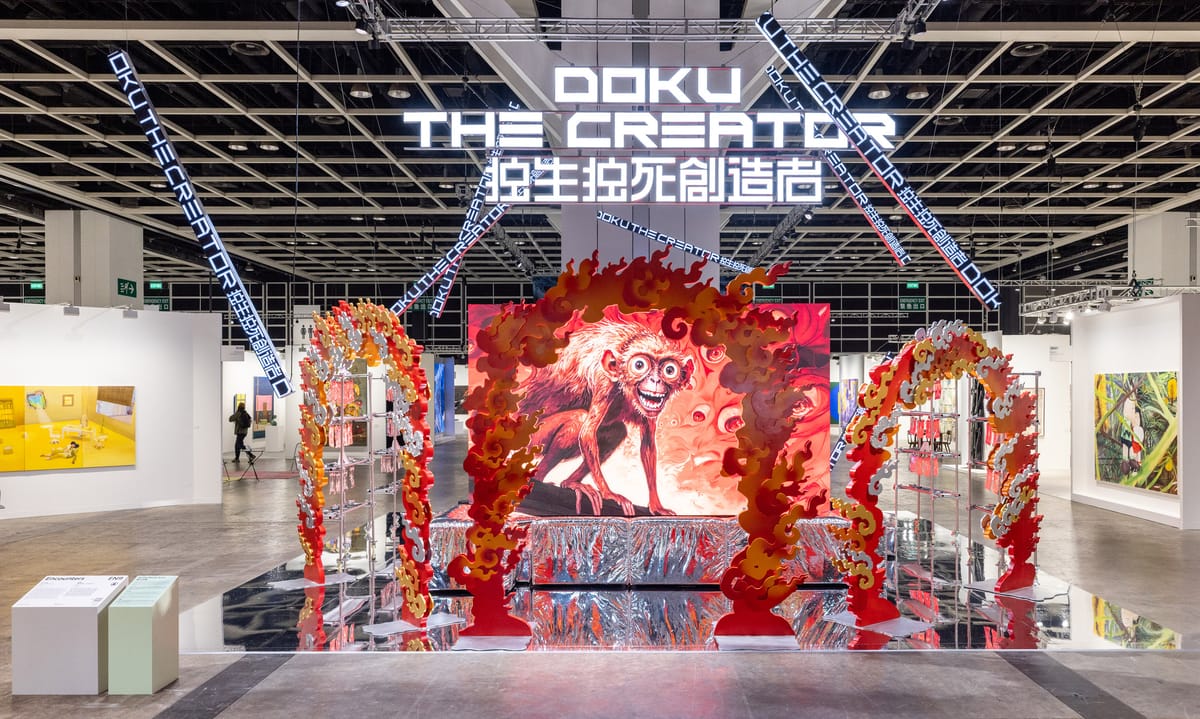
In contrast, Art Basel Hong Kong maintained its position as the region’s anchor, with over half being Asia-Pacific representatives—the highest to date. A notable emphasis emerged on textile-based works, suggesting a growing natural interest in craft as a tactile counterpoint to digital and AI-generated art. This dialogue was particularly present in the Encounters sector, where Movana Chen’s monumental tapestry faced Lu Yang’s AI-driven animation DOKU the Creator (2025). Instead of competing with Seoul and Singapore, Hong Kong deepened its role in fostering commercial and institutional exchanges, emphasizing its richer cultural ecosystem.