Shows
Heigh-Ho, It’s Off to Work We Glow
Bagus Pandega
Daya Benda
Swiss Institute, New York
Sep 30, 2025–Jan 4, 2026
In Disney’s Snow White and the Seven Dwarfs (1937), the dwarfs work with jaunty enthusiasm. With “Heigh-Ho” as their anthem, their refrain—“To dig is what we really like to do”—makes the danger and exhaustion of mining look rosy, and they even return home to find a strange princess asleep in their beds. In reality, a coal miner who starts at 15 may only live into his 40s and 50s. While miners excavate resources that sustain families and fuel the world, their safety and health are inevitably sacrificed, and many extraction methods are hazardous to the environment.
The Swiss Institute (SI) in New York moved into its current home on St. Mark’s Place in the East Village in 2018 and has steadily produced radical programming. SI is not affiliated with the Swiss government, and its exhibitions are not limited to promoting Swiss arts and culture. When I spoke with Stefanie Hessler in early 2023, about a year into her leadership, she emphasized her research interest in environmental and ecological issues. Indonesian artist Bagus Pandega’s first institutional solo exhibition, “Daya Benda” (meaning “power object” in Old Javanese), addressed Indonesia’s colonial past, its resource-dependent economy, and the environmental impact of extraction—nestling squarely within Hessler’s focus.
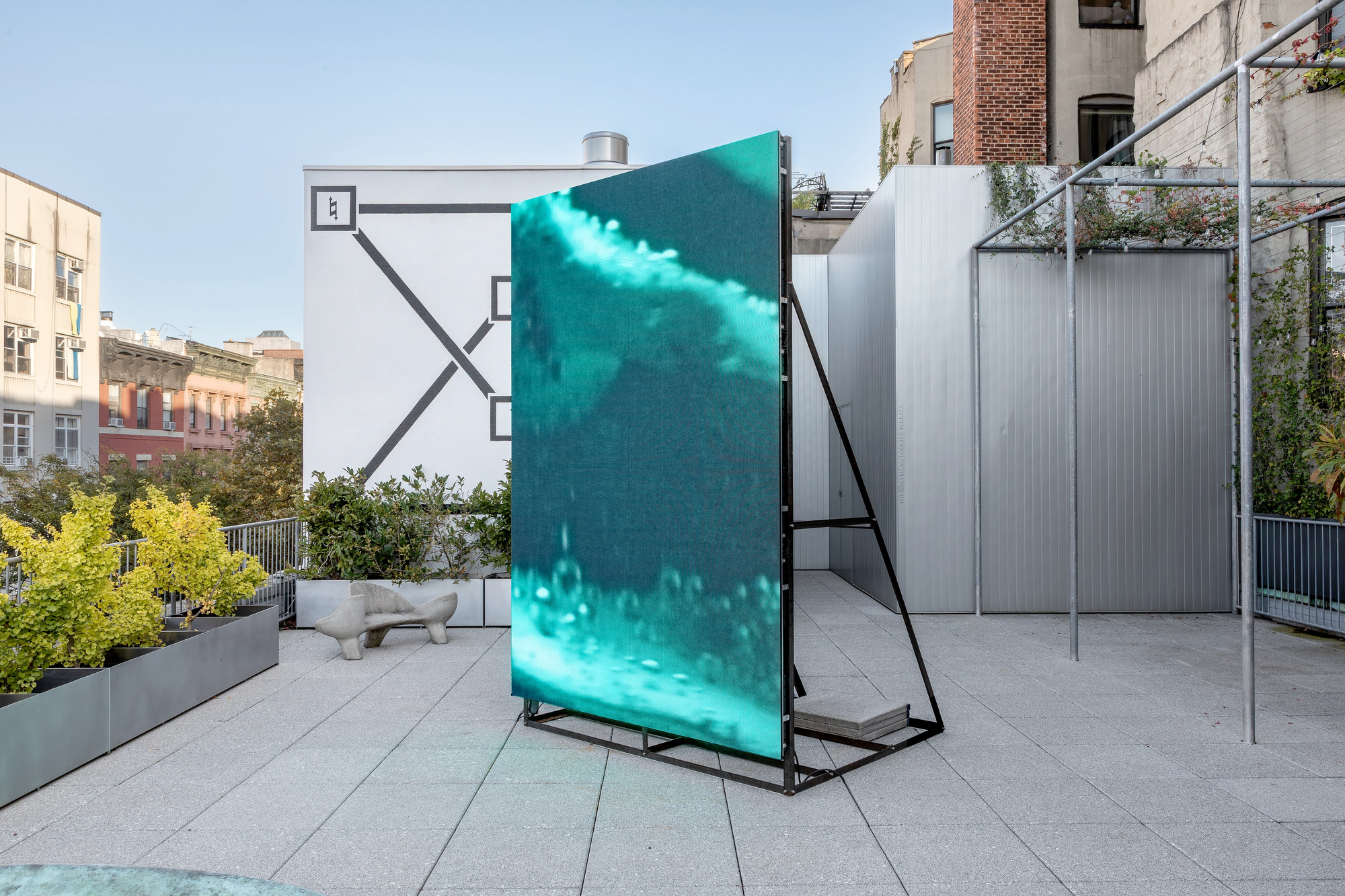
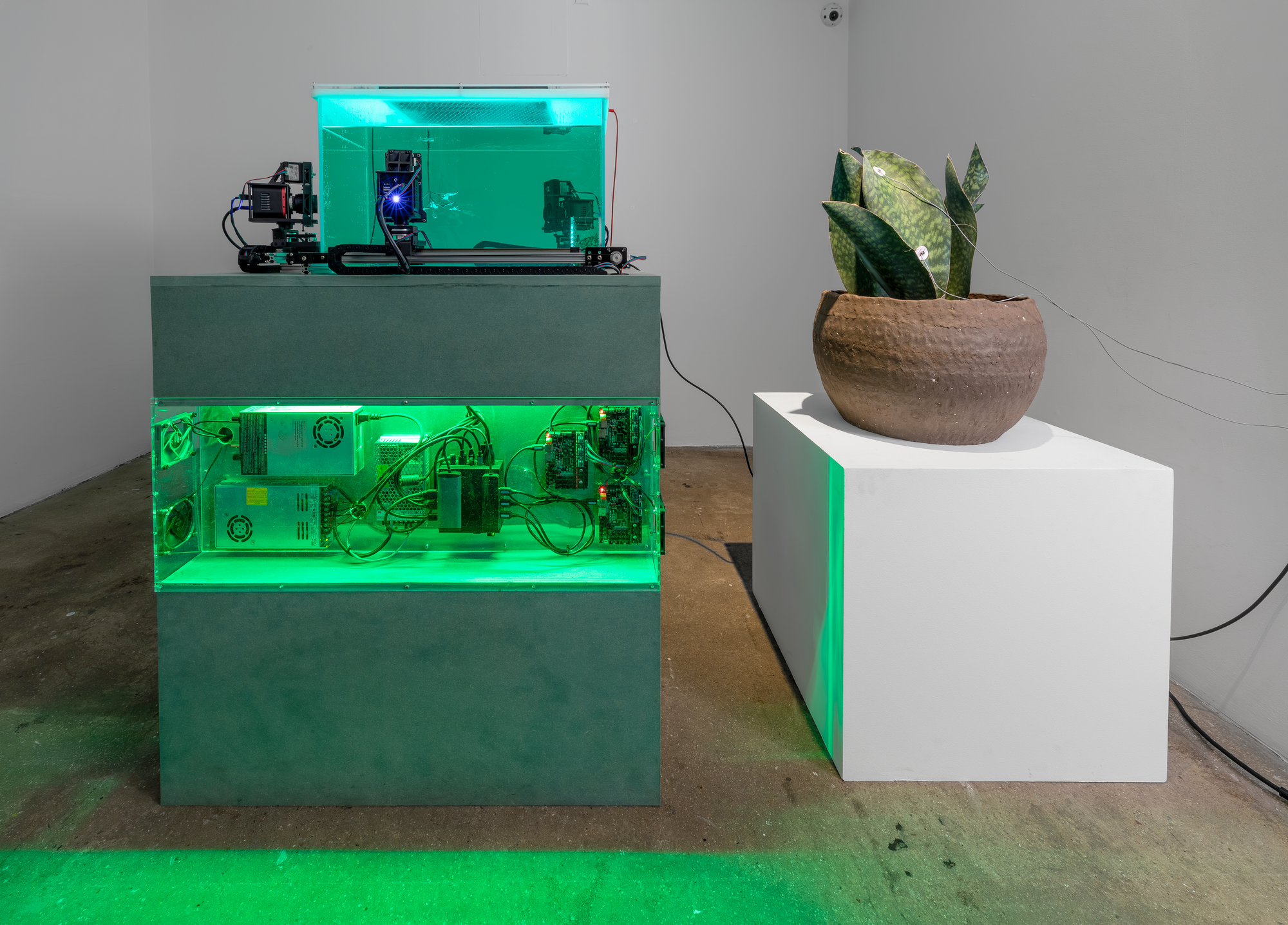
Installation view of BAGUS PANDEGA’s Anim Wraska, 2025, 3D printed sculpture, plants, custom motion rail, custom pedestal (plywood/HMR board with glass), power supply, PC, readymade aquarium, 4K microscope camera, DIY nickel solution, modular synthesizer, LED screen, custom vase, at “Daya Benda,” Swiss Institute, New York, 2025–26. Courtesy the Swiss Institute.
The Dutch East India Company began setting up base in Indonesia in the 17th century. By the early 20th century, the Dutch East Indies was the second largest European colony in Asia. At the peak of its powers, the Company commanded the world’s largest fleet, ferrying cane sugar, spices (cinnamon, cloves, nutmeg, and pepper), metals, minerals, and sandalwood to Europe. 2025 marked the 80th anniversary of the close of World War Two, often framed as the symbolic end of the most overt phases of imperialism. Indonesia declared independence from the Netherlands in 1945 and is now the world’s fourth most populous country and the largest Muslim majority nation. Global economic order and trade patterns may have changed over these eighty years, but the market works much the same. As of 2023, Indonesia’s largest exports were coal and palm oil. With one of the largest nickel reserves in the world, Indonesia has for the last decade been its leading producer, financed by China. Common applications of nickel include the interiors of dish washers, the drums of washing machines and tumble dryers, and electronic devices; batteries for mobile phones and laptop computers also contain nickel to maintain safe levels of voltage and current. The US five-cent coin, called a nickel, does contain nickel but is mostly copper.
Before entering the SI building to see “Daya Benda,” I noticed a big LED screen pitched on the roof deck, its content a little difficult to make out from street level. This was part of a new commission, titled Anim Wraska (2025), meaning “the spirit of the tree.” What I saw on the roof was a blown-up live feed from a smaller ground-floor gallery: an upside-down 3D-printed miniature “clove tree” hanging in an acrylic tank filled with liquid. Dimly lit, the tank’s color shifted between turquoise and green, while several cameras on tracks beside it were wired by probes to a potted snake plant nearby. The plant controlled the cameras’ movements and switching. Tiny bubbles clustered around the leaves of the “clove tree” as finer streams rose steadily to the surface.
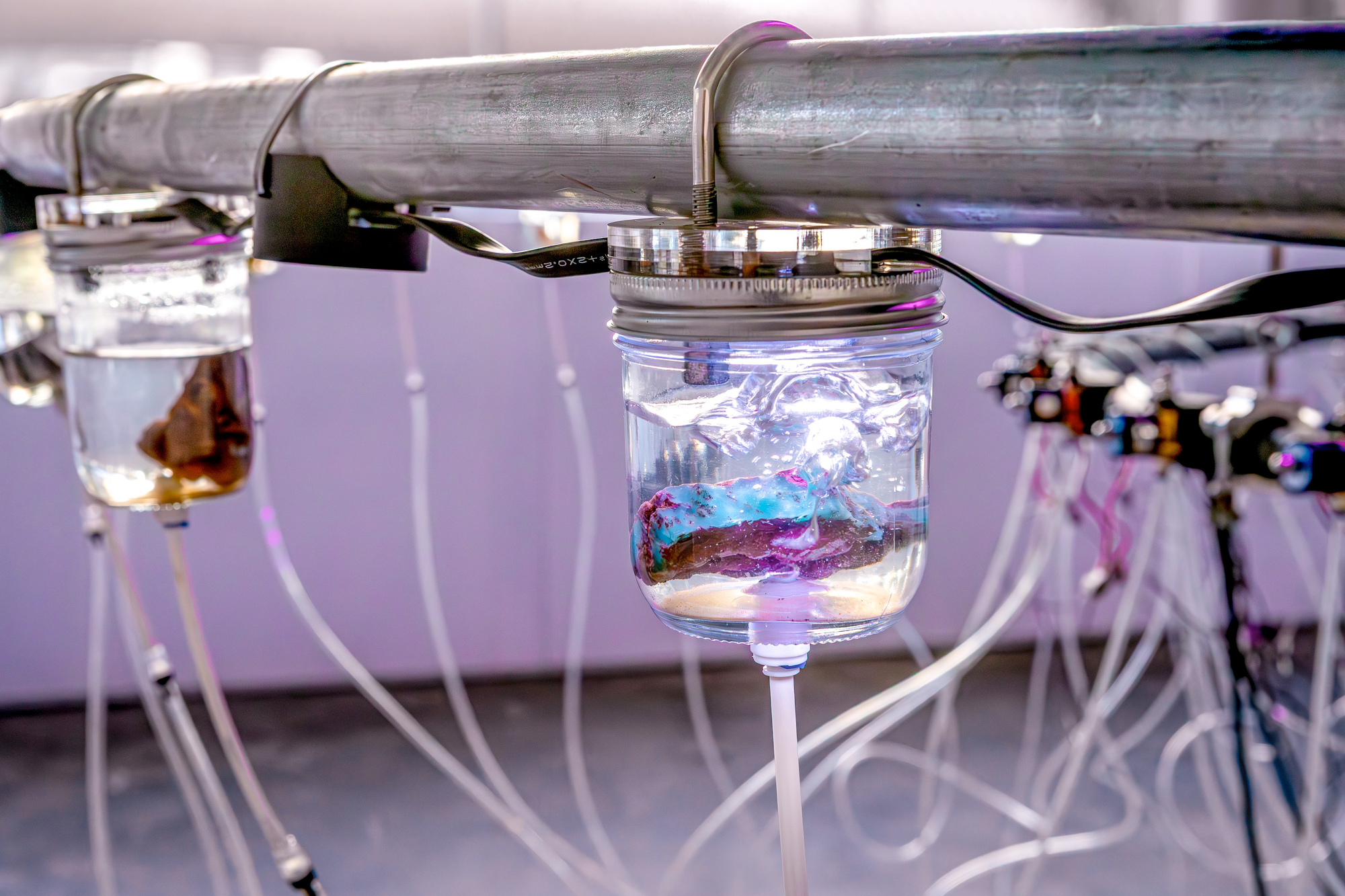
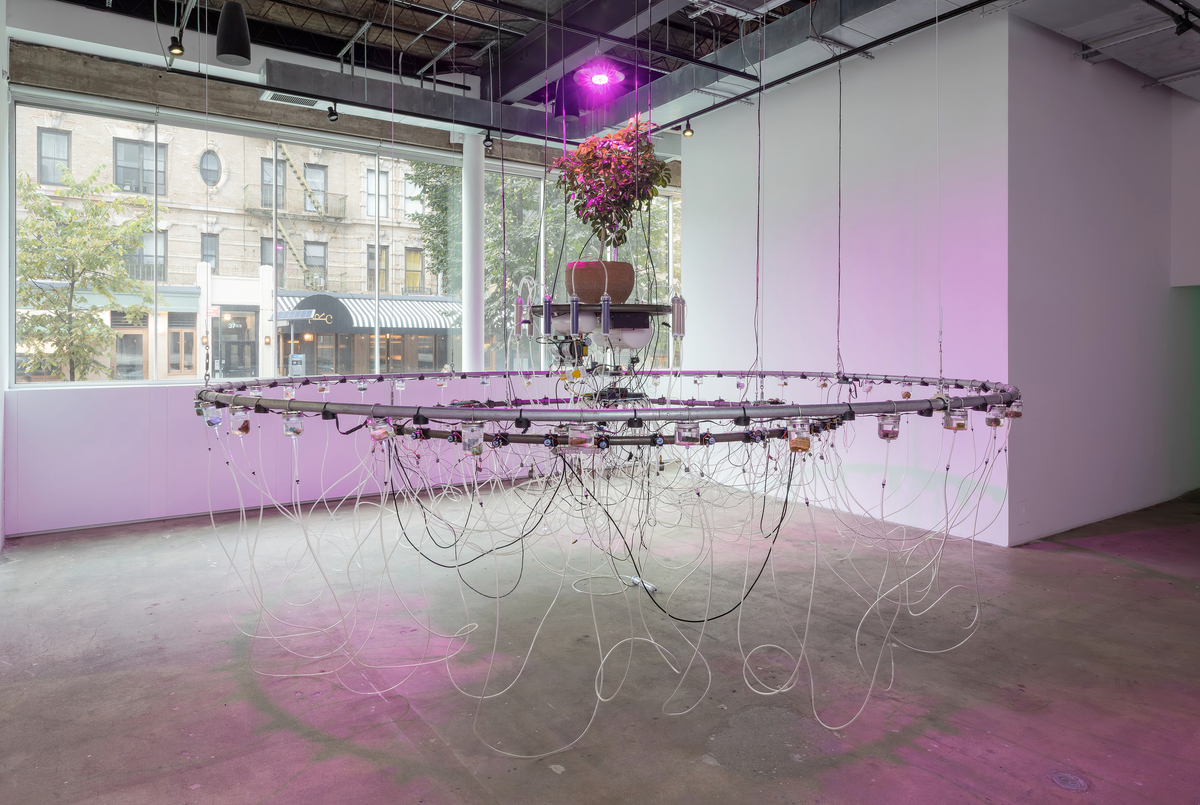
Elements of Anim Wraska echoed those in a larger, earlier work, Hyperpnea Green (2024), also installed on the ground floor. A hanging “chandelier,” resembling something of a flying saucer, centered around what I thought to be a dwarf umbrella plant. Under the magenta glow of a growth lamp, the plant sat high in the hierarchy, amid test tubes, pipes, and two rings of Ball jars arranged in concentric circles. Each jar contained a mineral rock submerged in liquid, with LED lights blinking rhythmically as the sculpture emitted what sounded like an industrial noise band. Like Anim Wraska, the orchestration of light and sound was determined by the plant. Pandega described the work as borne of COVID-era concerns that he might have to queue for oxygen if anyone in his family fell ill. His ingenuity led him to engineer a machine that extracted oxygen from photosynthesis. He wanted to stage a world where technology was operated by nature, without humans. It was bewildering to encounter this sci-fi ritual—a party of plant-worshipping minerals. As I walked in circles around it on a quiet weekend afternoon, I felt like I was mimicking what I had seen earlier in October: the Paris Opera Ballet’s Red Carpet (2025) by Hofesh Shechter, in which dancers orbited a giant chandelier lowered to stage level (a nod, perhaps, to The Phantom of the Opera) like moths or beings summoned by a mothership. Given how many rituals involve circular dances around bonfires, and how, from the stone age to land artists Robert Smithson and Richard Long, people have liked arranging rocks in rings, my déjà vu was hardly surprising.
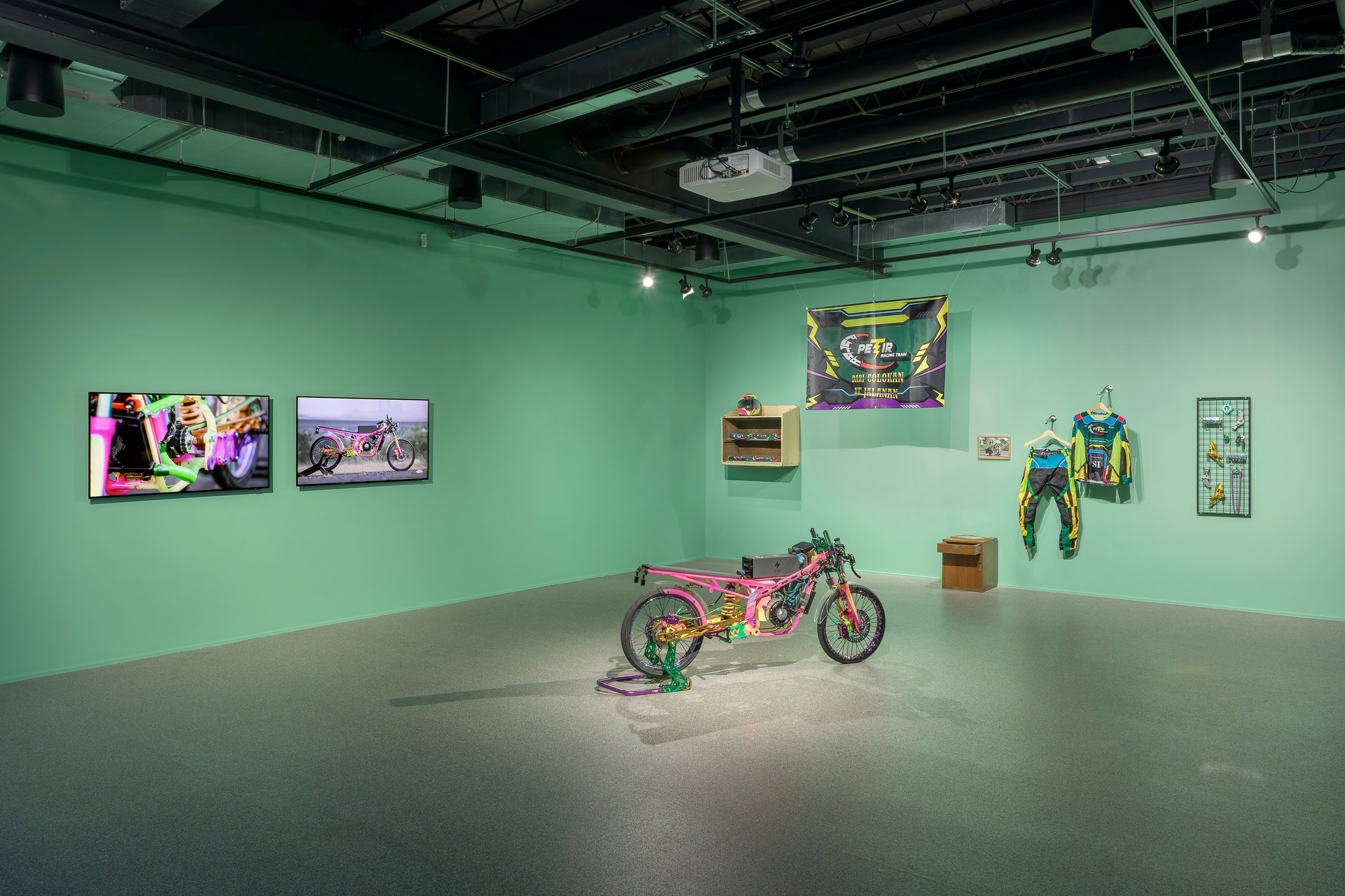
The third work, presented on the second floor, was another new commission, titled Putar Petir Racing Team (2025)—putar means rotation, petir thunder, together “rotating electricity.” The work comprised a fully operational electric battery-powered motorcycle that Pandega designed and built, riffing on Javanese drag-race culture and its flashy neon palette. The entire floor was transformed into a drag-race bike shop, complete with heavy metal music, racks of race suits, a helmet, tools, and a video documenting a Bandung drag race between his e-bike and regular fossil fuel bikes.
While I remained puzzled by many things—what signals the computer was receiving from the plants, why a snake plant (originally from Africa) and a dwarf umbrella plant (native to Hainan province and Taiwan), and why the green light in Anim Wraska—I was fascinated by the little cosmos Pandega created. He merged past and present by coating the “clove tree” with nickel, commodities that defined Indonesia during the spice trade and again today. In electroplating, the substrate is connected to the negative electrode, which releases lighter-than-air hydrogen if the solution contains water—producing the rising bubbles that, in the artwork, read as hope. This chemical process of maintaining material balance—elements that lose an electron replacing it from amenable surrounding materials to remain stable—feels idealistic, even improbable, in our capitalist world. Goods flow toward demand, whereas wealth does not necessarily flow toward miners and farmers, but to the conglomerates that own the mines, farms, factories, and shipping companies. On the roof, the feed was flipped upside down so it looked as though it were snowing, with the bubbles “falling.” With its neon green glow, this snow globe of industrial wasteland visually reincarnated Mike Kelley’s Kandor sculptures (Kandor being the capital of Superman’s destroyed home planet Krypton, shrunk and kept in a bottle), whose forest-like metropolis looks toxic under neon light. In this postapocalyptic capsule—a self-sufficient yet polluted ecosystem—I saw a nuclear winter masterminded by alien species, where but one lone, native tree remained.
SI sits at a rare intersection of academia, intellectual bohemia, and youth culture, in an East Village that has been home to generations of creatives, including Ai Weiwei, Wes Anderson, Diane Arbus, Jean-Michel Basquiat, Shu Lea Cheang, Walter de Maria, Allen Ginsberg, Philip Glass, Yayoi Kusama, Sol LeWitt, Kiki Smith, Rirkrit Tiravanija, and E.B. White. Pandega’s New York debut closed at the beginning of 2026, just as the city swore in its first Muslim mayor, a democratic socialist whose father is a Columbia University scholar of colonialism and whose mother is an award-winning radical filmmaker. With its strong message on the rippling effects of colonialism, “Daya Benda” offered a timely critique of history repeating itself in a city once called New Amsterdam, where the blue, white, and orange of the Dutch flag still emblazon the municipal banner. At a moment when headlines remind us that Country A can still interfere in Country B’s affairs simply because Country B has coveted resources, while everyone else watches, gasps, and calculates their own next move—and a year after the devastating Los Angeles wildfires—Pandega’s alternate universe, where plants call the shots, was a welcome escape.
Kelly Ma is a New York-based curator and writer.