Shows
Ala Younis’s “Past of a Temporal Universe”
Ala Younis
Past of a Temporal Universe
NYU Abu Dhabi Art Gallery
Sep 23, 2025–Jan 18, 2026
When getting to know a country, one of the most revealing relationships to examine is that between our imagination of the place and the place itself. Our imaginaries give buildings, cultural tropes, and people meanings beyond what is immediately apparent. Sometimes these visions originate from outside the nation, forming the bedrock of Orientalist projection; at other times they are born from within, providing political leaders with the raw material of nation-building.
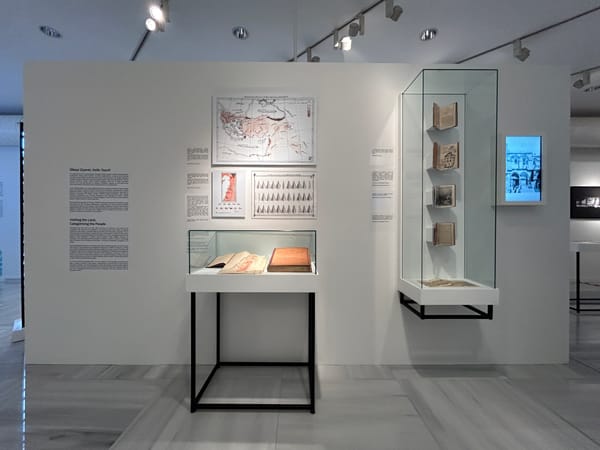
Gigantic rulers and compasses appear throughout Ala Younis’s practice—as literal objects in some works, and as symbolic motifs in others. With these tools, the multimedia artist draws unexpected connections between competing imaginaries. In her midcareer retrospective “Past of a Temporal Universe,” which traced nearly two decades of her career, little was immediately evident as Younis’s artistic language draws from academia, architecture, and archives. Instead, the show was conceived for slow and attentive engagement.
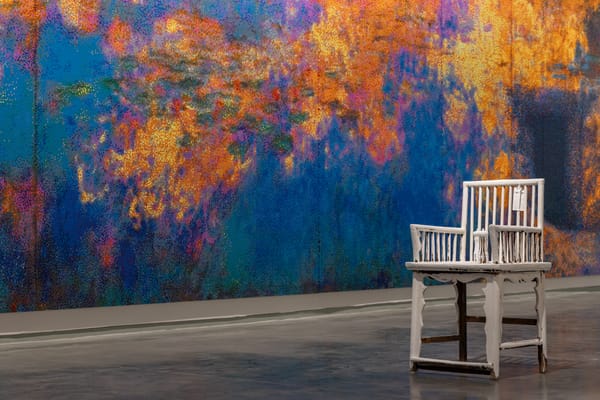
The exhibition unfolded at the NYU Abu Dhabi Art Gallery, situated in a city that has itself been an object of Younis’s inquiry. The show included ‘70s-style mosaics that depicted Metabolist buildings on Dubai’s lesser-known backstreets—a choice that redirected attention away from the oft-cited landmarks (such as the Louvre and Saadiyat Island skyline) that have calcified Abu Dhabi within Western discourse to engage instead with the Gulf’s broader architectural imagination. The tilework reflected her dual training as architect and artist, bridging modernism and ancient techniques. They begged the question: can we really see cities beyond our projections? Can we really look?
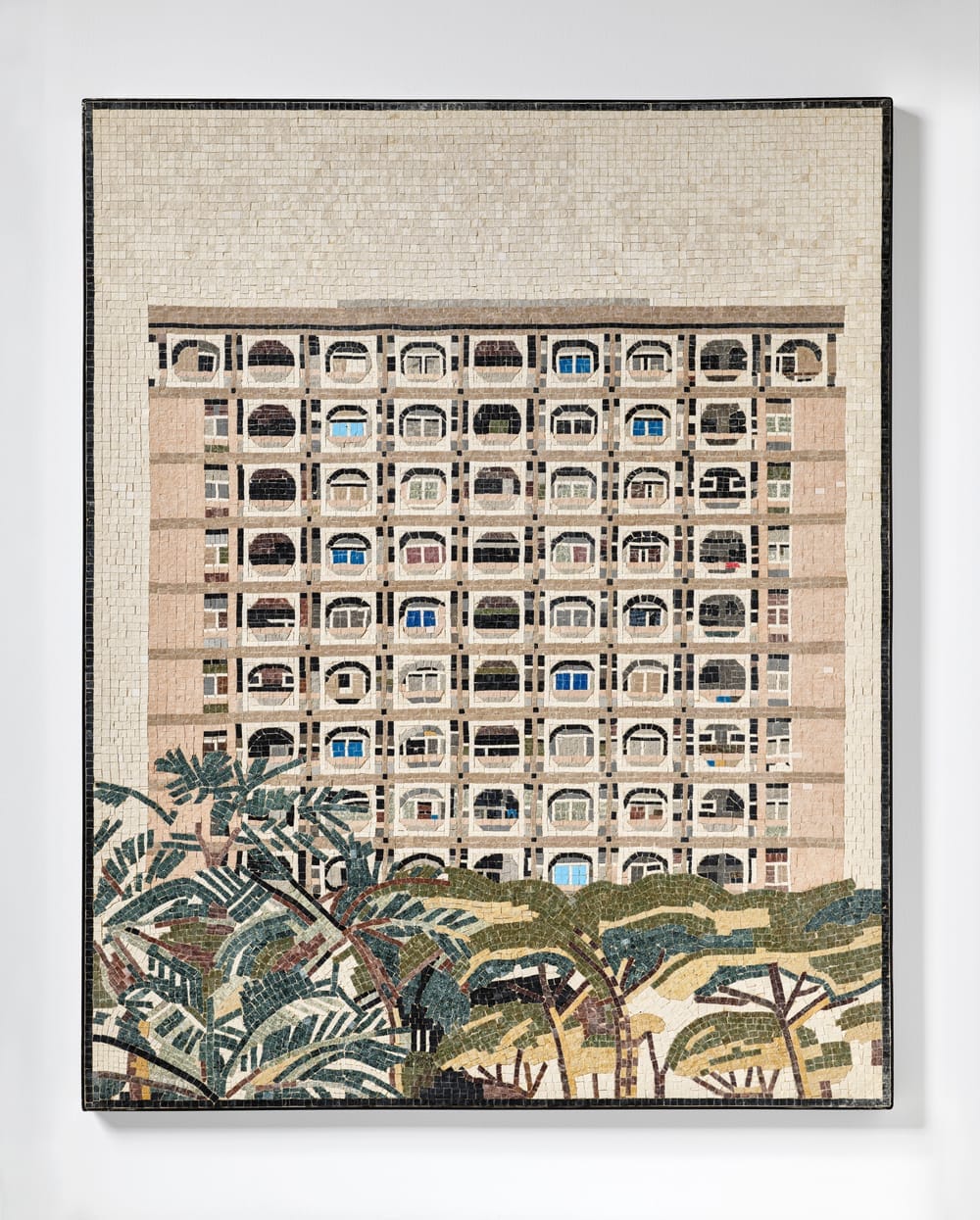
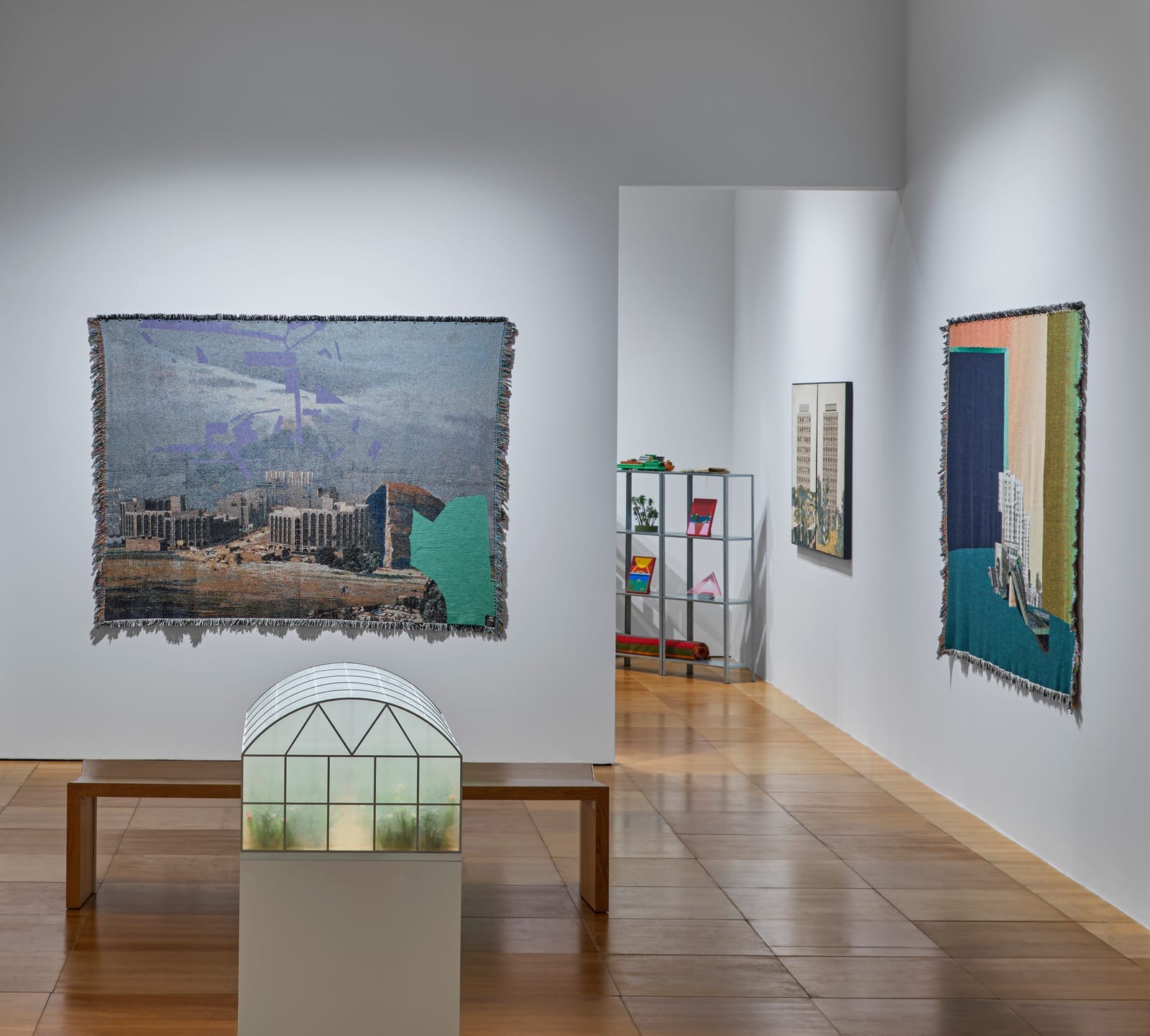
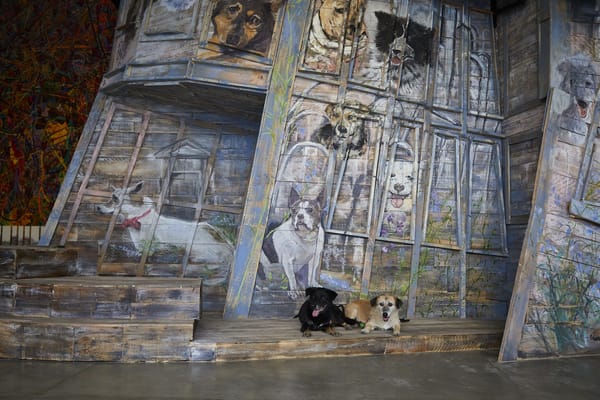
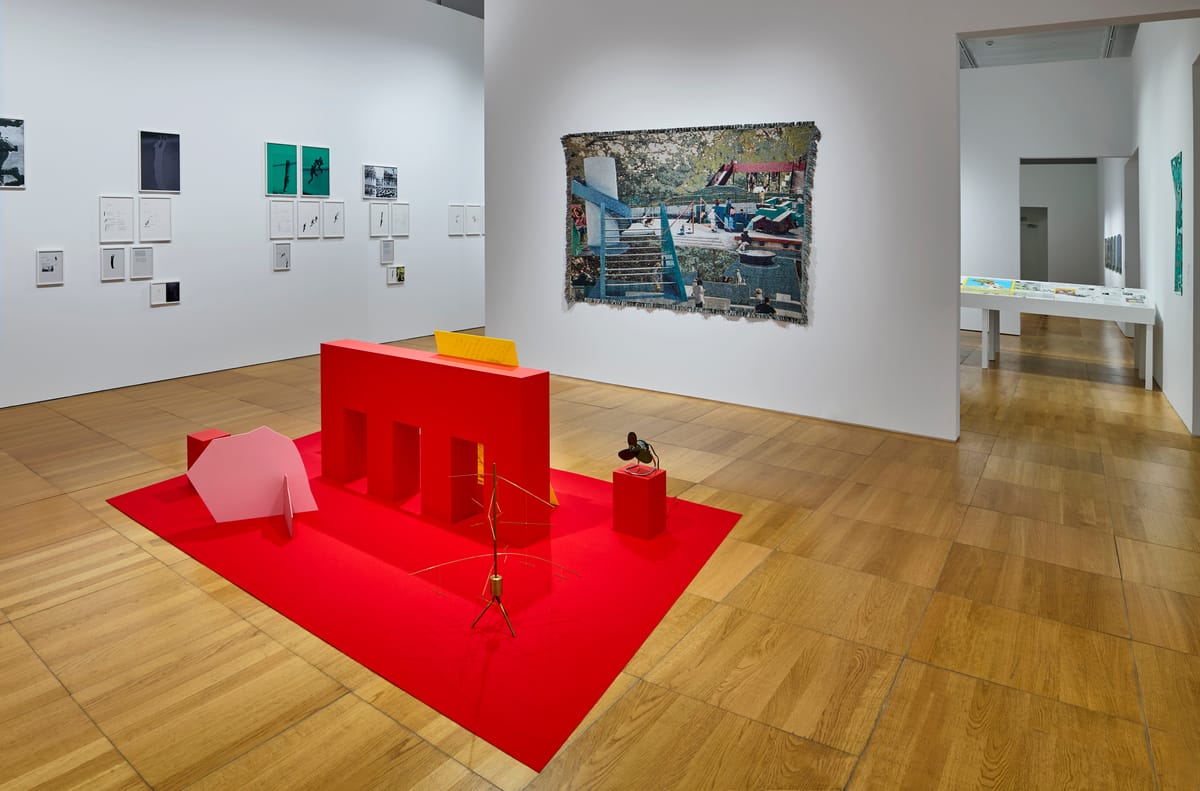
Installation views of ALA YOUNIS’s Climate Conditions 2, 2025, mosaic panel on metal frame, 100 x 80 cm (left); and “Ala Younis: Past of a Temporal Universe” at the NYU Abu Dhabi Art Gallery, 2025 (right). Photos by John Varghese. Courtesy NYU Abu Dhabi Art Gallery.
The NYU research ethos was evident in the exhibition’s structure. Curator of the show, Maya Allison, brought unexpected connections between different bodies of work to the fore, including Younis’s early paintings of Amman—pieces the artist initially preferred to exclude. In these modest canvases, one can already detect the modular impulses central to Younis’s approach: repeated rectangular compositions, tentative exercises in scale and repetition that prefigured later investigations into bureaucratic order and architectural control.
Though Younis’s oeuvre appears highly conceptual and archival, she moves fluidly between political history and pop culture. For example, in Enactment (2017), she demonstrates the porosity between politics and art by delving into the development of performance art in the Middle East. Through photographs and drawings, the work compares political and everyday gestures from the 1960s and ‘70s, proposing that these were the region’s first performance works, created before an “art system” framework existed.
In another piece, Tin Soldiers (2010–12), thousands of handpainted metal figurines represent nine armies implicated in contemporary Middle Eastern conflicts. The installation draws attention to a peculiar historical gap: though the toy-soldier industry peaked between the World Wars, no mass-produced set has ever depicted modern Middle Eastern armies. The tidily arranged regiments evoke both childhood play and the routinized reproduction of violence.
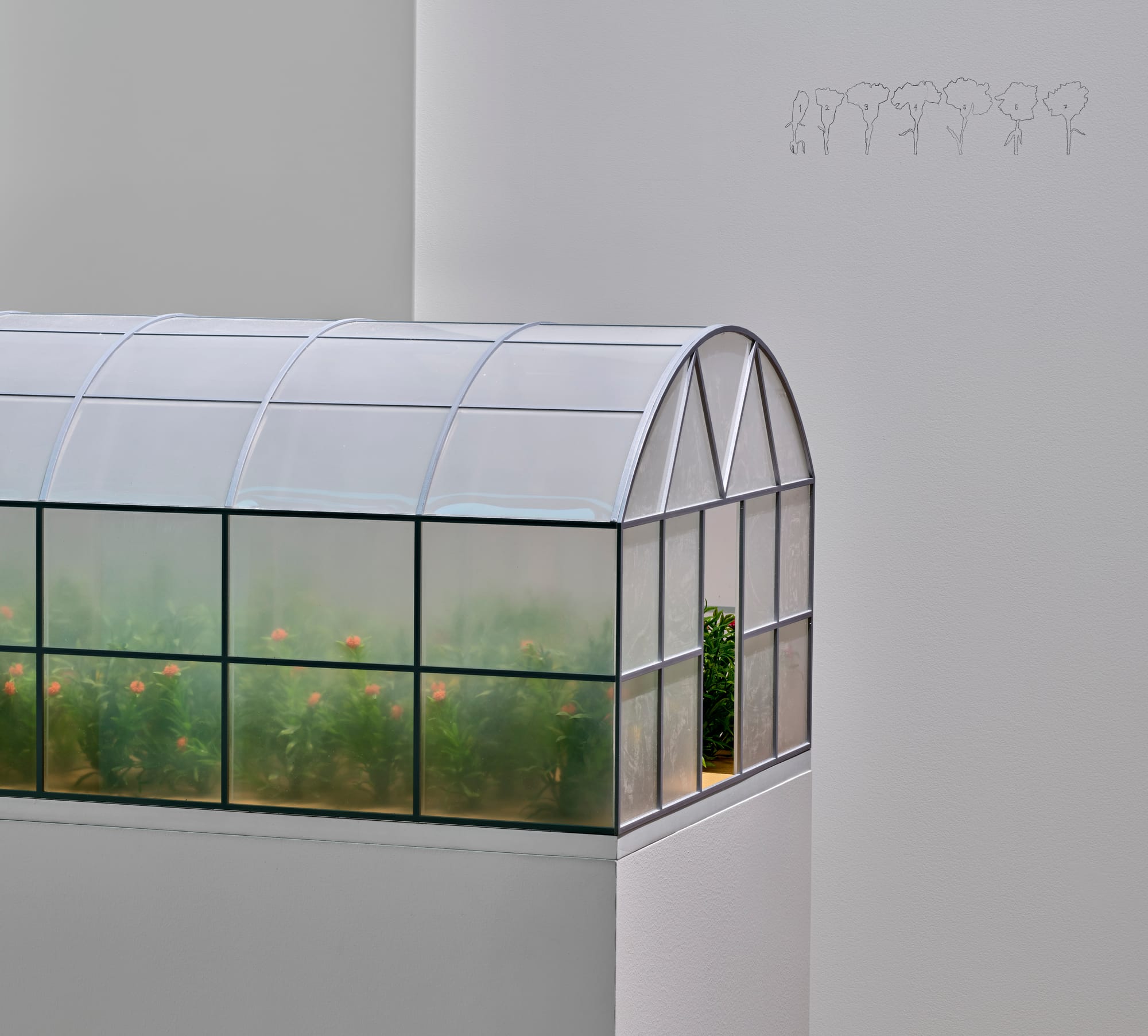
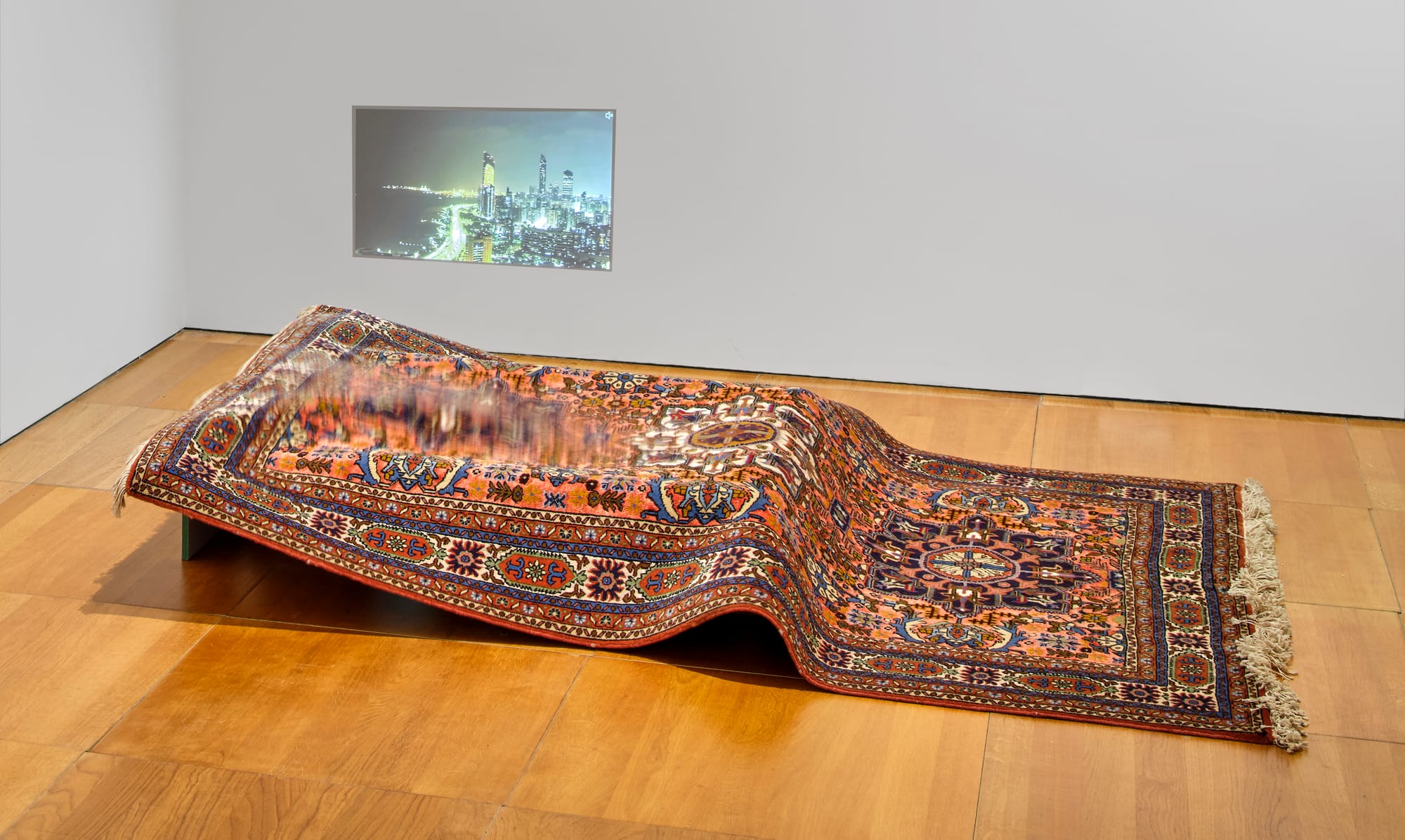
A more optimistic vision emerged in the Friendship Garden series (2023–24), where Younis recreated gardens in different media, from maquettes to tapestry. Other works explore the Pan-Arabian imaginary through the children’s magazine Majid. Readers’ drawings, stamp-collections, and clippings from the magazine become tools for understanding regional identities that were remolded into an aspirational “Arab of the Future”—a phrase borrowed from French Syrian cartoonist Riad Sattouf’s graphic memoir of the same name.
The culmination of Younis’s research-driven practice appeared in the installation Plan for Greater Baghdad (2015–18), shown here, crucially, for the first time as a two-part work. Originally a celebration of the men designing the Iraqi city, the work was later expanded to include the overlooked women of the capital’s modern architecture and cultural spheres. The project stages an intricate choreography of historical actors around the long-delayed Saddam Hussein Gymnasium, designed by Le Corbusier.
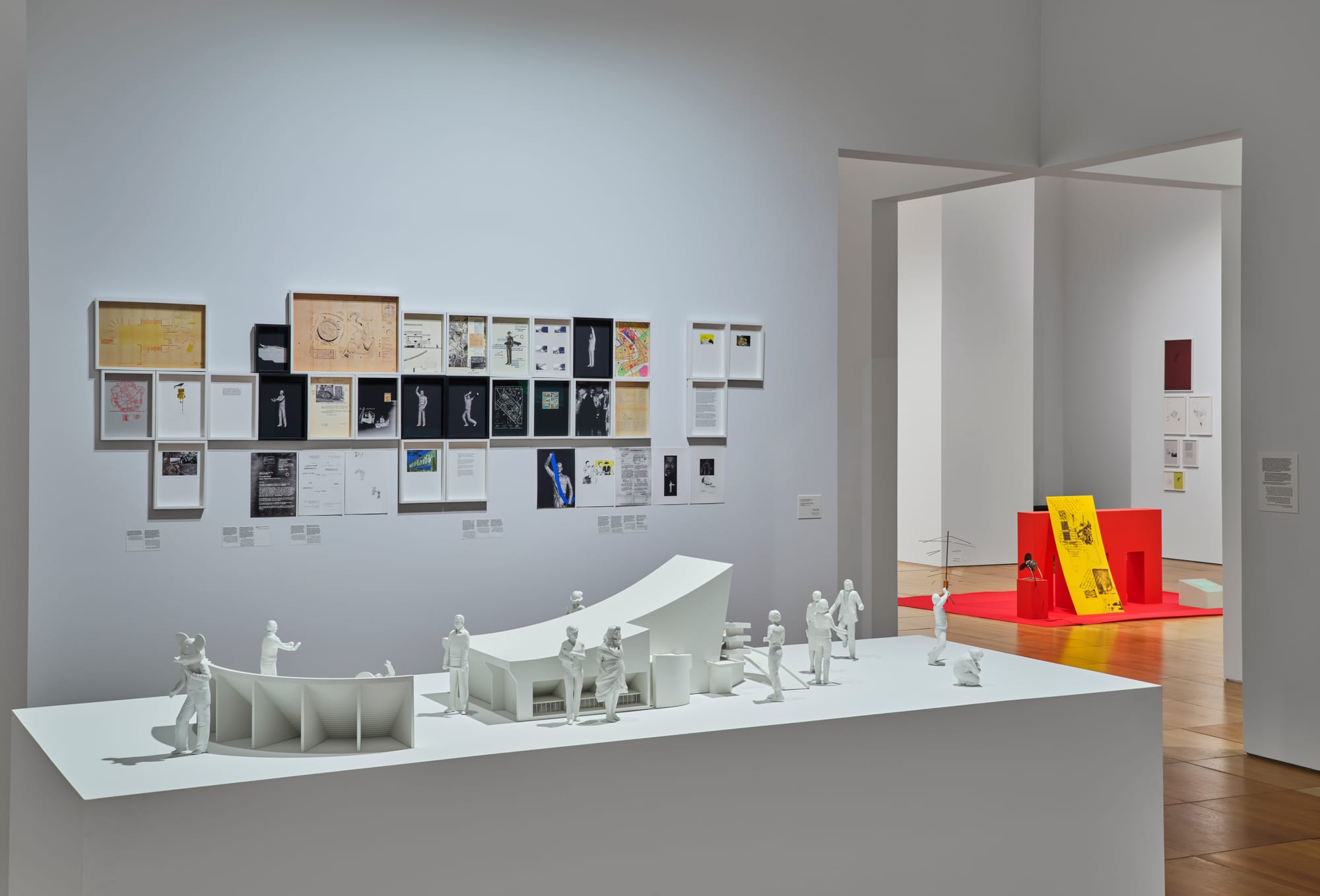
The figurines in the model reenacted gestures of refusals, negotiations, and crises that revealed nation-building as anything but linear. The process, as the work suggested, was shaped by different personalities and individuals: we immediately recognize Zaha Hadid, but also Rifat Chadirji shielding monuments from political appropriation; Jewad Selim sculpting the Monument to Freedom (1962) yet dying before its installation, as well as a number of political and administrative figures whose decisions reshaped the arc of Iraqi modernization.
Walking out of “Past of a Temporal Universe,” into the Abu Dhabi heat, viewers carried with them a sense that the past is a field of moving parts. As one element emerges into the foreground, it demands a reconfiguration of established narratives. And Younis will be ready to welcome each new imaginary: to measure it, and to try to seize it.
Naima Morelli is an art writer and journalist specialized in contemporary art from the Asia Pacific and the MENA region.