News
Chung Sang-hwa, 1932–2026
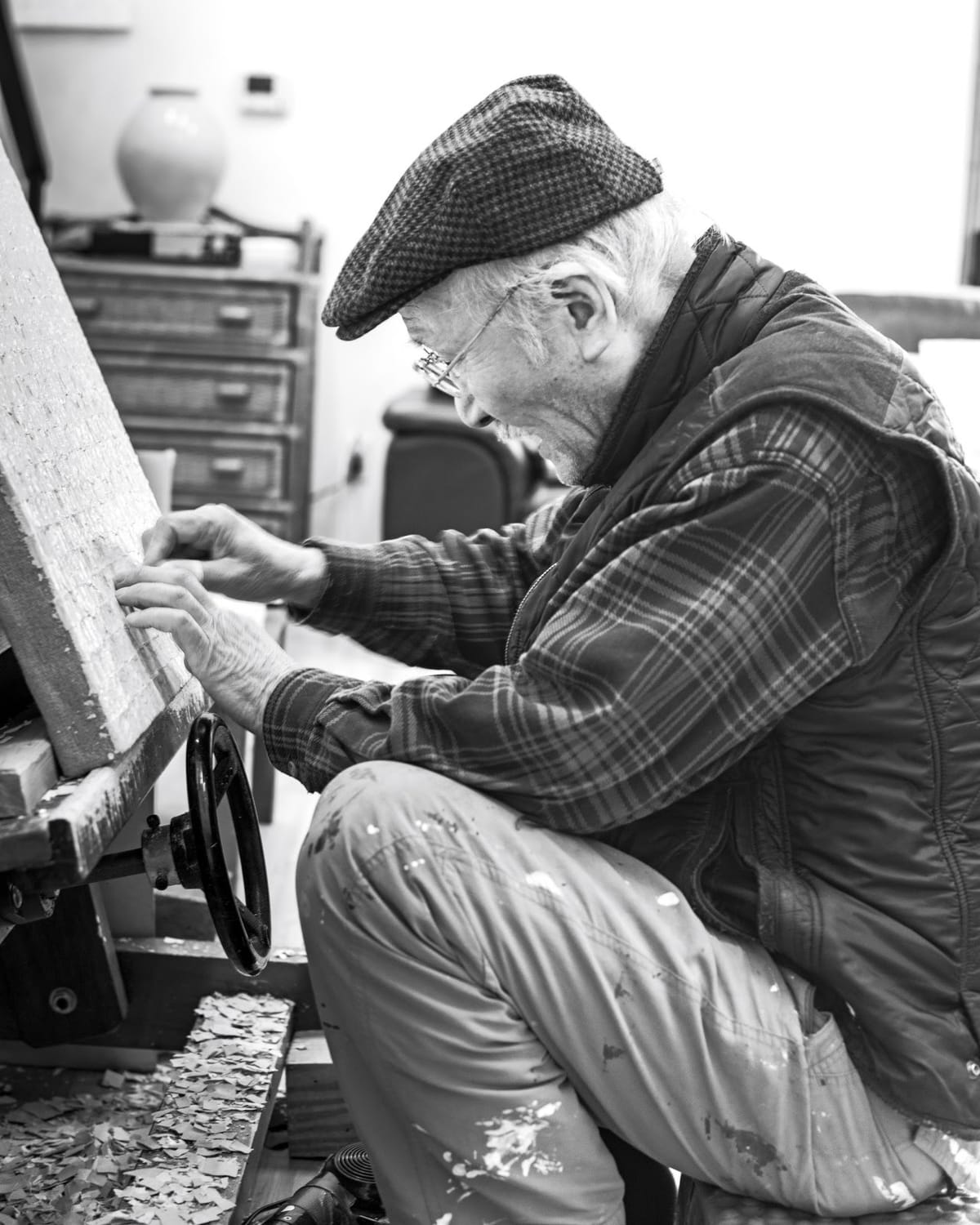
Chung Sang-hwa, a towering figure in postwar Korean abstraction, died on January 28 in Seoul at the age of 93 after a prolonged illness.
Over nearly seven decades, Chung refined an art of endurance. What began in the turbulence of the 1960s—as Korea rebuilt itself from war and sought cultural continuity amid political upheaval and rapid modernization—resolved into a lifelong inquiry into repetition, repair, and resilience. His early canvases, marked by gestural restlessness, already suggested an effort to temper feeling through structure and transpose emotion into rhythm. Meaning, in his hands, resided less in depiction than in duration—in what the surface had lived through.
That rhythm reached formal clarity during his years in Kobe, Japan, from 1969 to 77. Purging color and form, he began coating his canvases with successive layers of kaolin, glue, and water—allowing them to dry, then folding, cracking, and refilling the fissures, again and again. The white grids that emerged, subtle as breath, were never imposed but disclosed, each painting an evidence of process and persistence: a record of intervals, refusals, and small reconciliations between matter and intention.
By the mid-1970s, Chung became associated with Dansaekhwa, the loose constellation of artists—Park Seo-bo, Ha Chong-hyun, Lee Ufan, Yun Hyong-keun—who sought to rebuild abstraction as a site of contemplation rather than expression. Yet his work remained singular in its asceticism—Chung pursued attrition, the gentle breaking and renewal of surface. After his wife’s death in 1977, Chung moved to France, where he would remain for fifteen years. During this period, his meditations on time, touch, and surface deepened as he refined the density and chromatic nuance of his lattices, introducing new colors such as black, blue, and red.
On his return to Korea in 1992, he established a studio in Yeoju, Gyeonggi Province, where he continued his disciplined practice. Working in solitude until the end, never employing assistants, he pursued a practice of accumulated physical and mental labor—it took months, sometimes a year, to complete a single canvas. Each work bore what he called his “blood, pulse, and everything”: a record of time inhabited and concentration sustained until, as he described it, his “inner self became calmly emptied.”
Works by Chung are held in major institutional collections worldwide including the Hirshhorn Museum and Sculpture Garden, Washington, DC; the Guggenheim Abu Dhabi; the National Museum of Modern and Contemporary Art, Korea; Leeum, Samsung Museum of Art; Seoul Museum of Art; and the Museum of Contemporary Art Tokyo, among others.
Major retrospectives—at the Musée d’art moderne et contemporain de Saint-Étienne Métropole, France (2011), and at the National Museum of Modern and Contemporary Art, Korea (2021)—reaffirmed his position not only within Korea’s monochrome movement but in the global canon of process-based abstraction—a lineage of artists for whom making is a form of meditation, and the mark a quiet measure of being.
Michele Chan is managing editor at ArtAsiaPacific.