Market
Is Hong Kong Back? The GRAND PRIX de Basel 2026
Art is the only commodity in the world that promises transcendence of the commodity. In no other industry do you purchase an object that offers, simultaneously, the conviction that you are not the kind of person who buys mere objects. What is for sale is not just the thing, but also a shard of genius, a chapter of history, a claim on the sublime—custodianship of a moment of human consciousness that supposedly cannot be replicated or adequately priced, and so appears to sit, sacred, above profane circuits of capitalist consumption.
Pierre Bourdieu described this as a denial of the economy: the art field sustains a fiction that it operates beyond the logic of profit, and must maintain that fiction sincerely in order to profit. Isabelle Graw puts it more bluntly: art runs on a double game between price and “pricelessness,” and it is the market-negation that keeps the market in motion. The gallerist must perform belief. The collector must be moved. The façade and the knowledge of the façade coexist, because the façade is the product—even now, when no one pretends any longer that art is not also an asset class.
Nowhere are these contradictions more pronounced than in Hong Kong, where, unlike New York, Paris, or London, the market arrived first and the infrastructure—institutions, patrons, and critics that balance, or indeed sustain, the double game—much later. Sotheby’s set up shop here in 1973, Christie’s in 1986, Art Basel in 2013, ushering in the international galleries, and M+ only in 2021. The museum is vital, but the bombast around it—“global,” “world-class”—underscores how Hong Kong’s contemporary cultural imaginary is thoroughly calibrated to imported benchmarks, its operating system foreign-made: Western infrastructures grafted onto a financial freeport, capital driven, real estate constrained, with institutions and nonprofits largely routed through market machine circuitry rather than standing outside it.
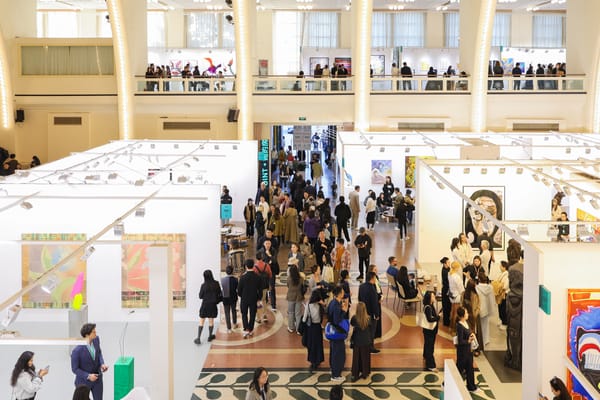
For two weeks in March, that engine ran at full capacity: 240 galleries at Art Basel Hong Kong at the Convention and Exhibition Centre, drawing 91,500 visitors; over 100 galleries at Art Central on the harborfront, its 11th and largest edition; three new boutique fairs; four new art spaces; at least five auction previews; over a dozen institutional shows and nonprofit art space exhibitions; and upward of 60 gallery openings across town. The phrase most overheard among collectors and gallerists was: “Are you surviving?”
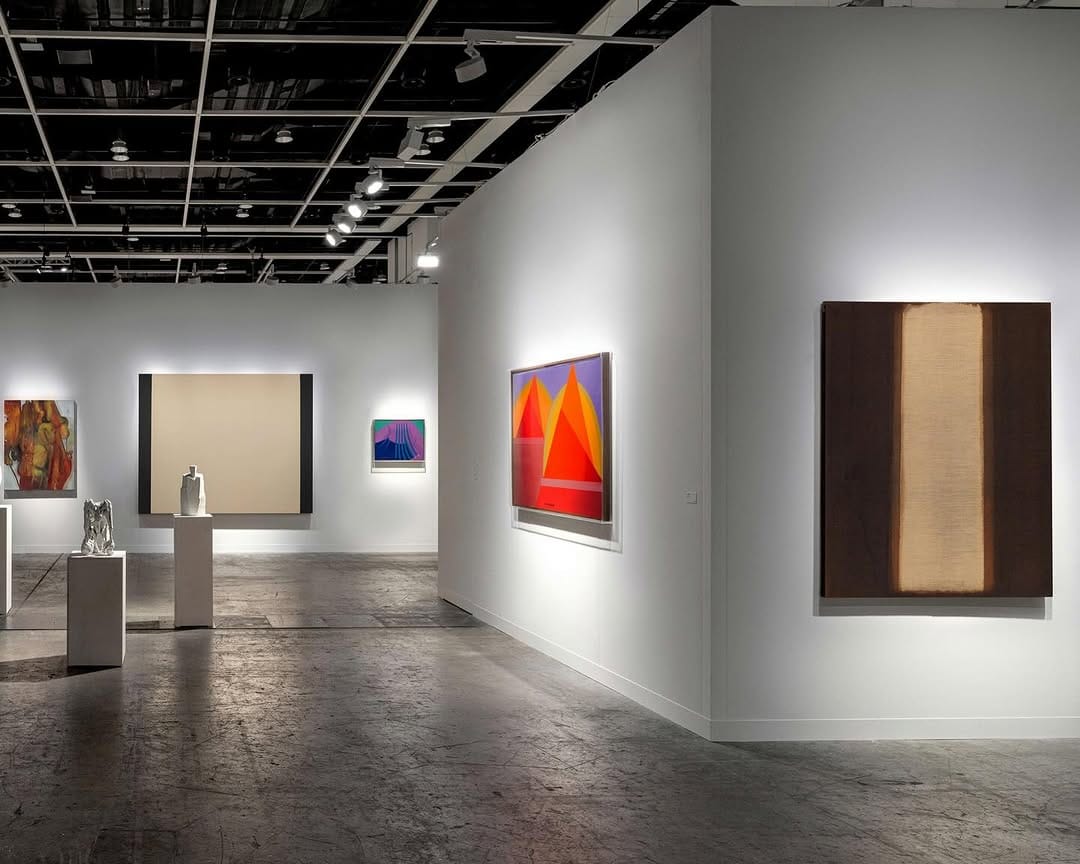
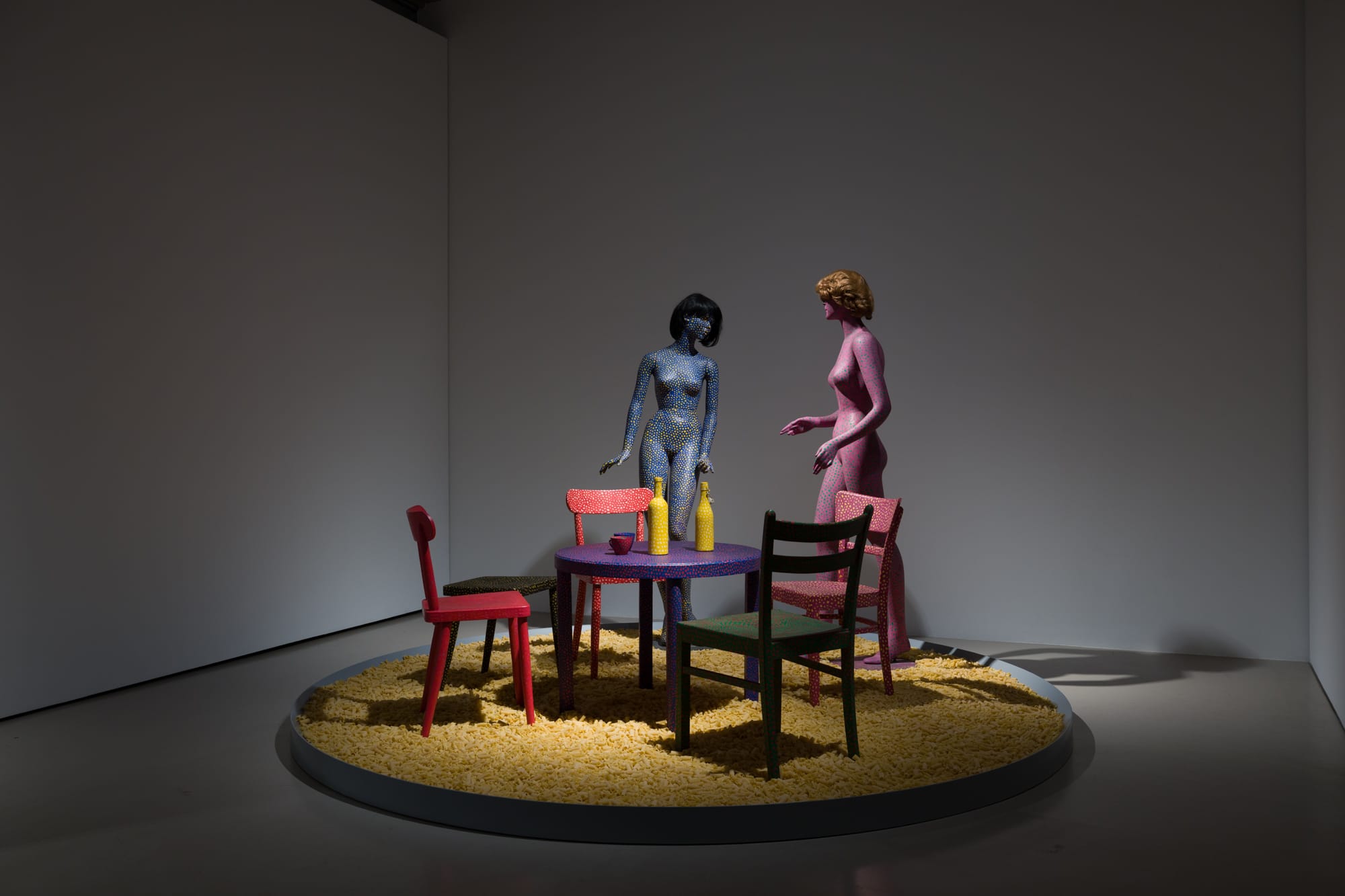
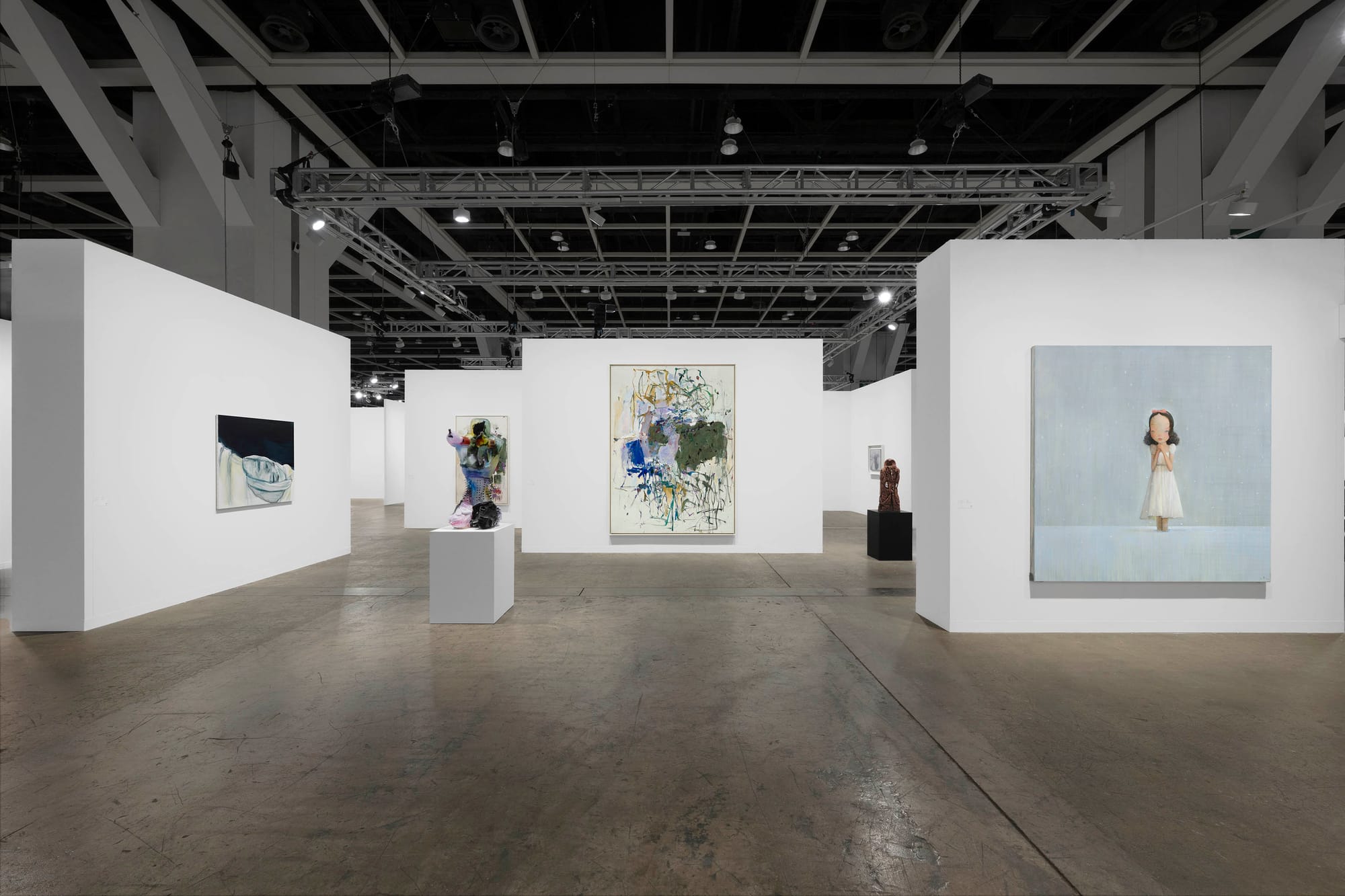
Installation views of PKM Gallery’s booth at Art Basel Hong Kong, March 25–29, 2026 (left); and YAYOI KUSAMA’s Driving Image, 1964–66, at “The Uncanny” at Art Intelligence Global, Hong Kong, 2026 (right). Courtesy Yun Hyongkeun studio and Art Intelligence Global.
It was manic. Personal highlights included 10 stolen minutes of Zhang Xiaogang’s lecture at a packed (literally overflowing) Asia Art Archive; an electrifying performance by Justin Talplacido Shoulder at Tai Kwun; a pilgrimage to my old stomping ground Art Intelligence Global to gawk at Yayoi Kusama’s original, long dispersed and now reassembled 1964–66 installation Driving Image; repeated visits to PKM’s fair booth to simply breathe in and breathe out in front of an exquisite 1970s Yun Hyongkeun; and Chow and Lin’s first Hong Kong solo, held at SC Gallery, which reworked the artist duo’s world-renowned, widely traveled project The Poverty Line (2010– ) into color-coded constellations of still-life photographs showing the food a subsistence-level household can afford in a day. Sold in neat sets of four, these images of bare‑minimum survival, formatted as highly legible wall works, felt like the most surreal yet simultaneously the clearest illustration of how perversely intertwined culture, capital, and commerce are in this city.
On paper, the numbers were respectable enough. Blue-chip galleries reported a handful of seven-figure transactions: David Zwirner moved a large 2006 Liu Ye snow scene, not seen in the market for over a decade and taken straight back down right after VIP day, for USD 3.8 million and a 2002 painting by Marlene Dumas for USD 3.5 million; Hauser & Wirth placed Louise Bourgeois’s four‑panel work on paper À Baudelaire (#1) (2008) and fabric sculpture Couple (2002) for USD 2.95 million and USD 2.2 million respectively, the latter with an Asian foundation; and White Cube sold Tracey Emin’s striking painting Take Me To Heaven (2024) to an Asian collector for GBP 1.2 million (USD 1.6 million). Asia-Pacific historical and midcareer names fared well: Massimodecarlo sold a Yan Pei-Ming painting in the EUR 250,000–350,000 (USD 290,000–410,000) range, coinciding with the artist’s solo at Guangzhou’s He Art Museum, and a bronze Danh Võ between EUR 200,000–300,000 (USD234,000–350,800); Tina Kim placed a Pacita Abad trapunto and a Lee ShinJa textile into Asian institutional collections at prices ranging from USD 150,000–300,000; SCAI The Bathhouse sold Natsuyuki Nakanishi’s G/Z 9 VI 93 HOHO‑II (1993) for USD 200,000; ROH sold a large Maria Taniguchi painting for USD 280,000; and P·P·O·W sold Dinh Q. Lê’s Damaged Gene (1998) to a Vietnam‑based foundation for USD 150,000–200,000. Works by some younger, trending painters moved swiftly: Shanghai-based Jiang Cheng at BANK sold out, as did British artist Plum Cloutman at Althuis Hofland, while Hong Kong’s own Stephen Wong Chun Hei sold out works across the booths of mother’s tankstation, Maho Kubota, and Gallery Exit.
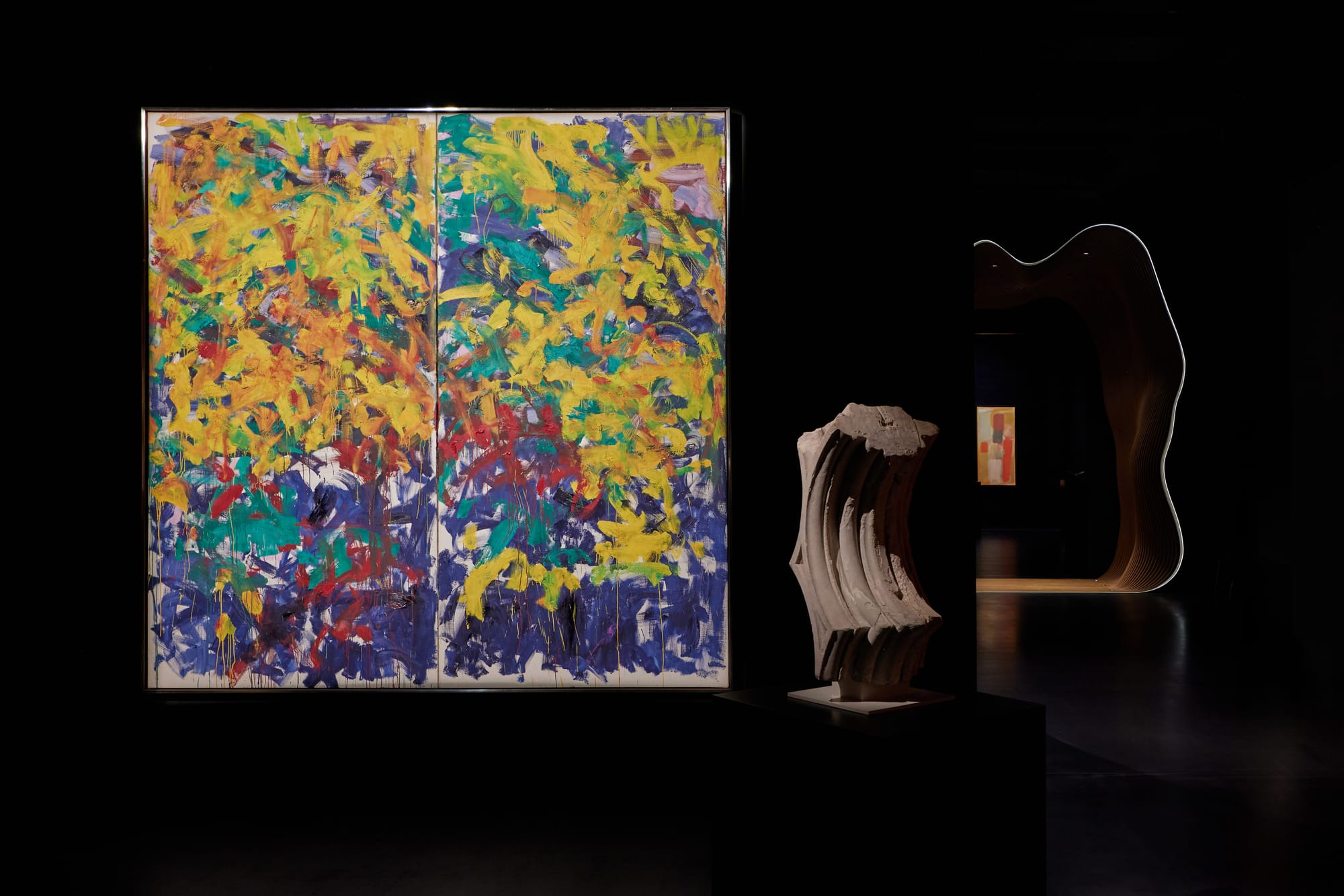
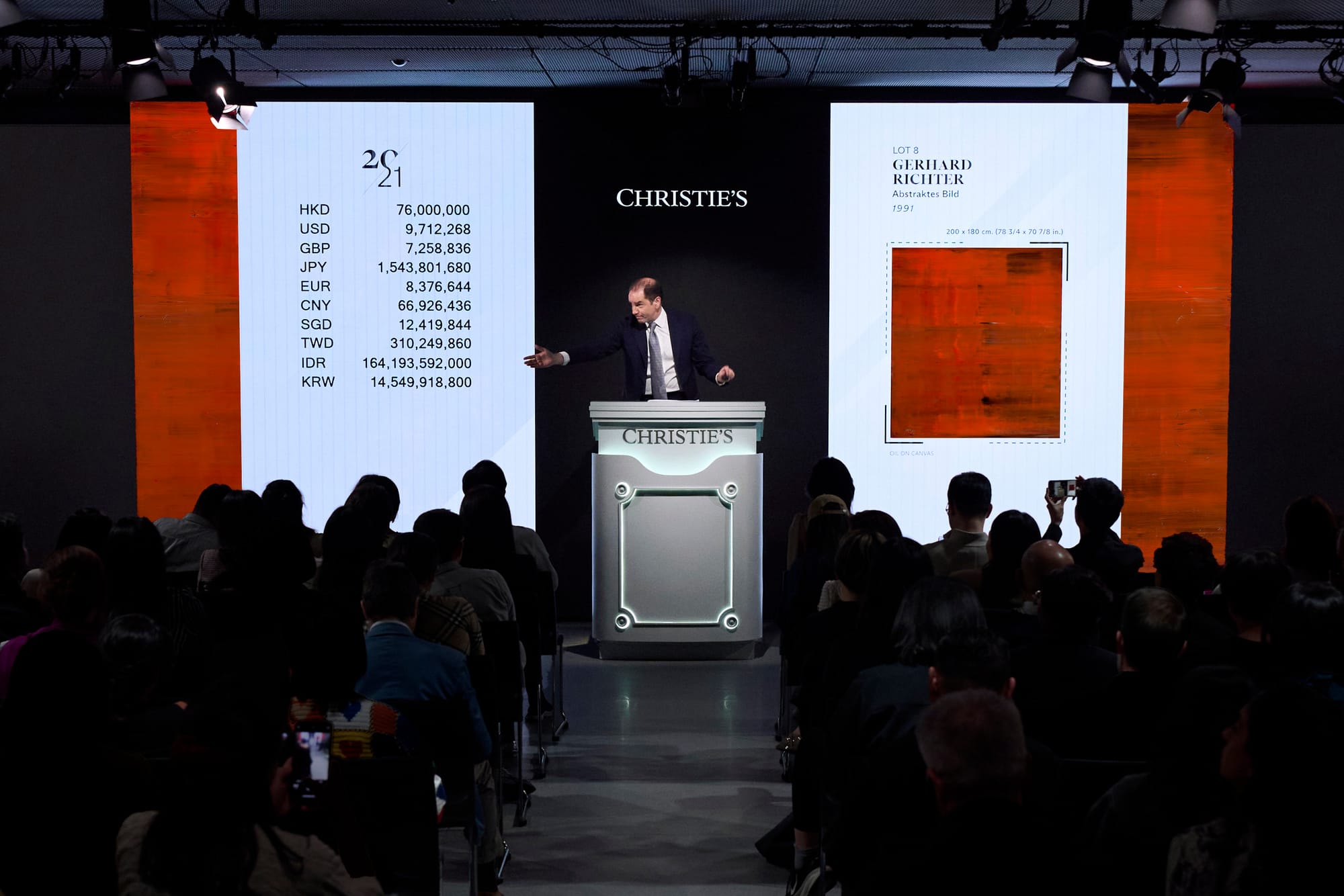
Installation view of JOAN MITCHELL’s La Grande Vallée VII, 1983, oil on canvas, in two parts, 260.3 x 260.7 cm overall, at Sotheby’s Maison, Hong Kong, 2026 (left); and auction scene of GERHARD RICHTER’s Abstraktes Bild, 1991, oil on canvas, 200 x 180 cm, at Christie’s Hong Kong, March 27, 2026 (right). Courtesy Sotheby’s and Christie’s.
Amid murmurs that “Hong Kong is back,” with added emphasis “even with the war in the Middle East”—after a dire 2025 that saw mega-galleries Pace and Perrotin shutter their spaces in the city and auction results slump to an eight-year low—Christie’s and Sotheby’s rallied in lockstep. The two houses, each putting up handsome previews, collectively hauled in roughly USD 200 million across their modern and contemporary auctions, trumpeting “white glove” evening sales with robust year-on-year increases (17% for Christie’s, 84% for Sotheby’s). Star lots included a muscular 1983 Joan Mitchell diptych at Sotheby’s that set a new Asia record for the artist at USD 17.6 million, becoming the most expensive work by a woman artist sold at auction in the region, and Gerhard Richter’s Abstraktes Bild (1991) at Christie’s—this season’s obligatory “big red” anchor—which fetched USD 11.7 million. Each house fielded an auspicious equine painting by Chinese French painter Sanyu, riding on the Year of the Horse.
By the metrics that matter to the trade, Hong Kong seems to have passed its stress test—though the terms of that success remain those of mega-galleries, auction houses, and a government invested in a “world‑class” narrative, rather than the people and practices that live in, and sustain, the ecosystem. New initiatives such as Knotting Space at H Queen’s, a permanent platform pairing galleries and institutions for each exhibition, and new boutique fairs Pavilion (a few floors up at H Queen’s) and ArtHouse in Tai Hang, read as attempts to rewrite the script, leaning on collaboration, neighborhood engagement, and discovery. These efforts, locally spearheaded—Knotting Space is directed by Hong Kong curator Jims Lam; ArtHouse Tai Hang the brainchild of auction veteran Jacky Ho; Pavilion co-founded by husband-and-wife gallerist duo Willem Molesworth and Ysabelle Cheung of PHD Group Holdings—widened the field of visibility for artists and galleries otherwise absent in the week’s main fairs. These homegrown structures also point to something crucial: a growing insistence that Hong Kong’s art scene define itself on its own terms—asking who and what the week is for, beyond servicing an imported market playbook.
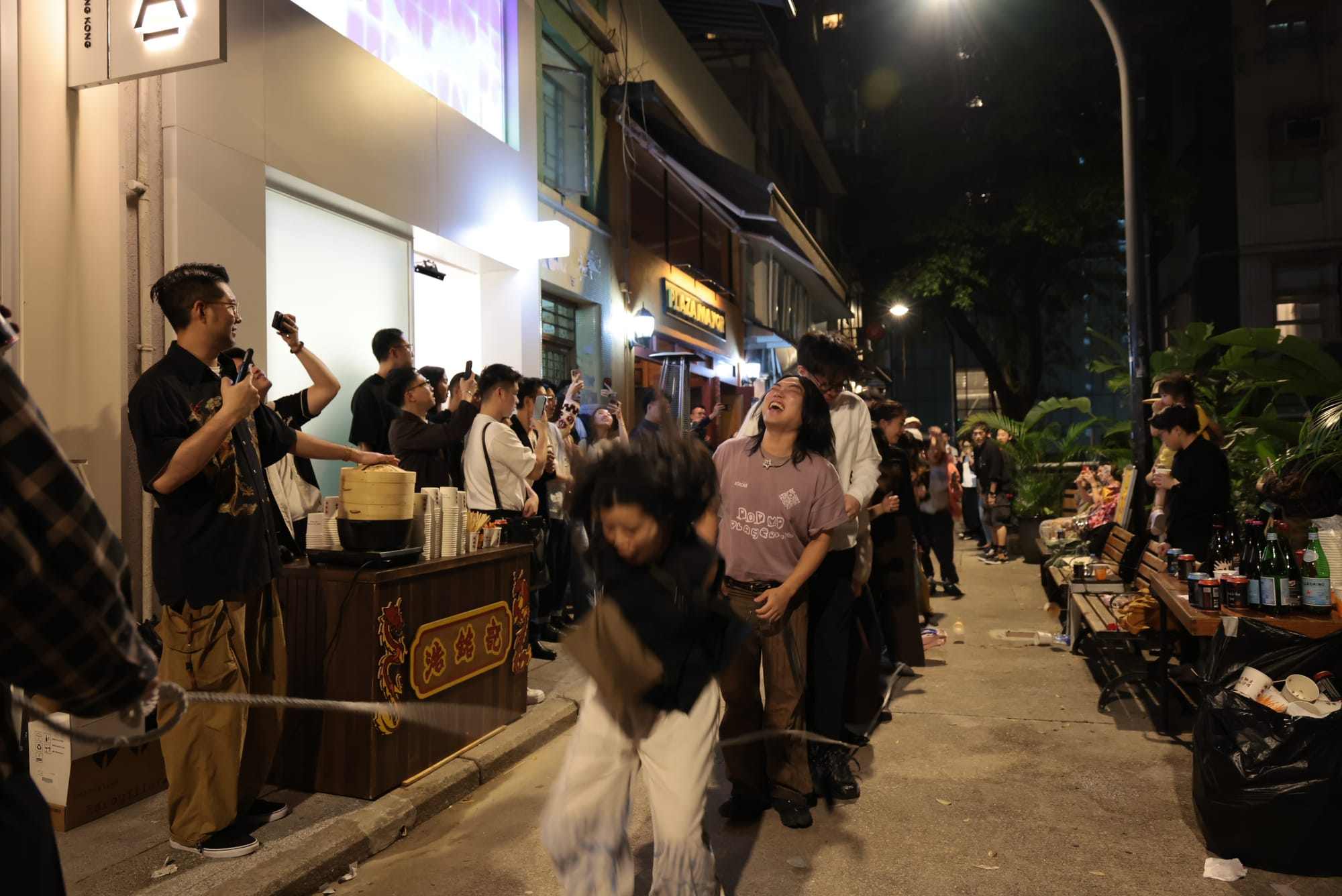
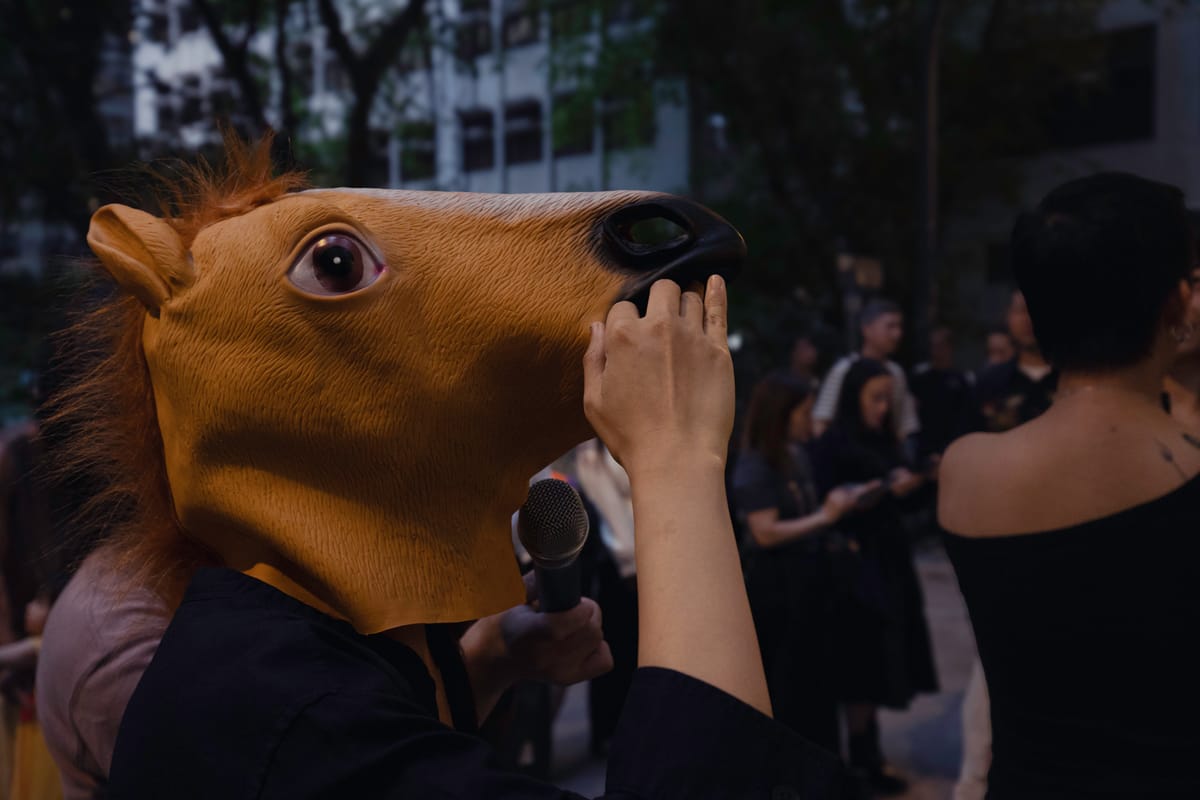
It was check‑in SIDE SPACE, a nimble, compact affair held in a Chinese tenement building in Wan Chai’s Star Street Precinct, that most precisely distilled the myriad idiosyncrasies of not only Hong Kong’s art ecology but the global fair circuit. On a narrow street‑level floor, nine participating dealers were instructed to bring only what would fit into a single suitcase—a format keyed to the “carry‑on” logic of the fly‑in, fly‑out fair week, and also to the reality of galleries traveling light amid exorbitant shipping costs. Co-founders Alex Chan of Tai Hang’s THE SHOPHOUSE and curator, writer, podcaster Matt Chung kept participation fees deliberately low—a pointed counter to notoriously rising booth rates. On an opening night that drew a hip, semi‑insider crowd, transactions and socializing took place downstairs while, in an upstairs enclave, performance artist Florence Lam, via her “live art platform” Per.Platform, invited five local collectives and independent spaces to stage GRAND PRIX de Basel, a tongue‑in‑cheek “horse race” to raise funds for the local scene. Visitors could climb a narrow staircase to peer into the discussions and wagering, but the lack of space quickly turned curiosity into congestion, with many drifting back down.
For a few hours, the city’s infamous real‑estate scarcity became dramaturgy: the difficulty of reaching “upstairs” mirroring how structurally hard it is for non‑transactional practices to occupy space and visibility. Yet the sound system glitched this division; speakers relayed upstairs voices—talk of labor, locality, and mutual support—into the downstairs crush, bleeding into spaces of circulation and deal‑making. A single vertical slice of Hong Kong, 96 square meters to be exact, made legible what Josh Kline recently diagnosed in New York: that art is “ultimately dependent on real estate.” But rather than denying the economy, the event used the market’s own formats—the fair, the suitcase, the stacked yet separated proximities of disparate art worlds—to expose the wiring. In the slippage between downstairs and upstairs, between “market” and “making,” what became clear was that these worlds never stand that far apart, and that reckoning with their coexistence might be a place to begin again.
Michele Chan is managing editor at ArtAsiaPacific.